- 380 pages
- English
- ePUB (mobile friendly)
- Available on iOS & Android
eBook - ePub
About this book
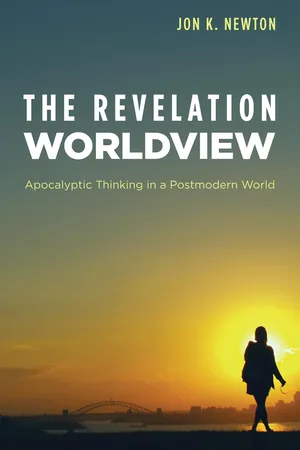
Does Christianity have anything useful or credible to say to the twenty-first century, or is it just a relic of a past era, doomed eventually to die a long and painful death, perhaps to be replaced by the new atheism or another religion? In an original contribution to such debates, The Revelation Worldview is a bold attempt to construct a biblically based Christian worldview that makes sense to postmodern people. It also seeks to make the book of Revelation, one of the most strange and difficult books in the Bible, relevant to issues facing people in the twenty-first century. Jon K. Newton wrestles with the complex notion of worldview, tells the story of the changing Western worldview from its ancient and medieval beginnings through the modern era and into the unpredictable world of postmodernism, and compares the worldview found in Revelation with other worldviews of its day. He then uses Revelation as a source for identifying some basic Christian answers to questions such as: What is real? How do we know anything? How can religious knowledge claims be justified? How can we understand the concept of the human person? How can we make sense of history? And how should we respond to pluralism?
Information
Chapter 1
Times Are Changing
Christianity in a Postmodern World
We are living in tumultuous times. I’m a “baby boomer” born not long after the end of World War II. That means I missed out on World War I, the Great Depression, the Russian revolution, Hitler, the Holocaust, and Hiroshima. But I’ve lived through the Cold War, the H-bomb, Vietnam, the Berlin Wall, the assassinations of John F. Kennedy and Martin Luther King Jr., Mao and the “cultural revolution,” the Six-Day War in 1967, the Yom Kippur War of 1973, the first Gulf War, 9/11, and the rise and fall of apartheid. I’ve seen the coming of TV (1956 in Australia), CDs, PCs, DVDs, KFC, McDonalds, Subway, ATMs, satellite communication, cell phones, the Internet, Google, email, Facebook, YouTube, and Twitter. Recently we’ve been facing the GFC (or its effects on Europe and the USA in particular), debates over climate change and radical terrorism, and the problems with the Eurozone, the rise of China and India, the Arab Spring, civil war in Syria, and other continued tensions in the Middle East. Our lives have been changed by globalization and the Internet, and politically, economically, and culturally everything is different to when I was growing up. Homosexuality used to be illegal, but now it’s legal and “proud”; abortion used to be illegal, but now it’s regarded as a woman’s right; divorce was frowned on, but now it’s a daily occurrence; the environment has taken center stage in modern politics; and the level of choices in people’s lives is at unheard of levels, but the level of common thinking on morals is much lower. And, at least in Australia, you can no longer assume that nearly everyone is at least a nominal Christian.
What is more significant is the changing way we think.
Modernism: The First Revolution in Western Thought
There have been two massive shifts in European thinking over the last five hundred years. The first shift took us from the Middle Ages to the modern era. The basic worldview of European people had been unchanged in many respects for over a thousand years, but the rise of modern humanism, the split in Western Christianity brought about by the Reformation, the discovery by Europeans of “new worlds” in America and elsewhere, the European Enlightenment, and the rise of modern science and technology caused a revolution in thinking that literally makes it impossible for us to think like a person of 1500.54
Consider that the average Western European in 1500 not only believed in Christianity but held firmly to such beliefs as:
• The supremacy of the pope in the church and among the Christian kingdoms
• The power of witches and the need to put them to death
• The need to pray to dead saints in order for them to approach Jesus for you
• The centrality and fixity of the earth in God’s universe
• The authority of Aristotle and other ancients in science
• Tradition as the most important feature determining our beliefs
• The need to follow the same occupation as your father, unless perhaps you were called to be a monk
• The right of kings and nobles to rule
• The authority of the Bible, and the church as its interpreter, to tell us what to think and how to live
Ideas such as democracy, tolerance, individualism, human rights, rationalism, empirical science, technological growth, capitalism, socialism, and progress would have been meaningless to them.
It took a series of revolutionary changes to change the Western worldview.
• The Renaissance put the focus on humanity, human learning, and human possibilities with its revival of Greco-Roman culture.
• The Reformation championed the right of individual believers to read the Bible (in their own language) and make up their own minds about what it meant. It also, inadvertently, undermined the authority of Christianity in people’s thinking by splitting the (institutional) church from the Bible.55
• The Enlightenment looked for a new basis for knowledge in human reasoning and “criticism.” As Kant famously wrote, “To criticism everything must submit.”56
• Modern science looked for answers about the natural realm through empirical research (that is, going out and looking and doing experiments) instead of traditional speculative reasoning.
• The Industrial Revolution unleashed the power of technology and the free market to give everyone a hope of progress and prosperity (albeit at incredible cost in upheaval of people’s lives, as documented by writers like Charles Dickens).57
• The American and French Revolutions championed the ideas of individual rights, the secular state, and democracy.
The result was the new world order known broadly as modernity. Reason and science, rather than church and ...
Table of contents
- Title Page
- Preface
- Introduction
- Chapter 1: Times Are Changing
- Chapter 2: Revelation in Context
- Chapter 3: The Reality of the Spirit World
- Chapter 4: The Validity of Revelation
- Chapter 5: The Significance of Personhood
- Chapter 6: The Centrality of the Biblical Story
- Chapter 7: Rival Narratives
- Chapter 8: Towards a Christian Worldview for the Twenty-First Century
- Bibliography
- Index of Subjects
- Index of Modern Authors
Trusted by 375,005 students
Access to over 1.5 million titles for a fair monthly price.
Study more efficiently using our study tools.
Frequently asked questions
Yes, you can cancel anytime from the Subscription tab in your account settings on the Perlego website. Your subscription will stay active until the end of your current billing period. Learn how to cancel your subscription
No, books cannot be downloaded as external files, such as PDFs, for use outside of Perlego. However, you can download books within the Perlego app for offline reading on mobile or tablet. Learn how to download books offline
Perlego offers two plans: Essential and Complete
- Essential is ideal for learners and professionals who enjoy exploring a wide range of subjects. Access the Essential Library with 800,000+ trusted titles and best-sellers across business, personal growth, and the humanities. Includes unlimited reading time and Standard Read Aloud voice.
- Complete: Perfect for advanced learners and researchers needing full, unrestricted access. Unlock 1.5M+ books across hundreds of subjects, including academic and specialized titles. The Complete Plan also includes advanced features like Premium Read Aloud and Research Assistant.
We are an online textbook subscription service, where you can get access to an entire online library for less than the price of a single book per month. With over 1.5 million books across 990+ topics, we’ve got you covered! Learn about our mission
Look out for the read-aloud symbol on your next book to see if you can listen to it. The read-aloud tool reads text aloud for you, highlighting the text as it is being read. You can pause it, speed it up and slow it down. Learn more about Read Aloud
Yes! You can use the Perlego app on both iOS and Android devices to read anytime, anywhere — even offline. Perfect for commutes or when you’re on the go.
Please note we cannot support devices running on iOS 13 and Android 7 or earlier. Learn more about using the app
Please note we cannot support devices running on iOS 13 and Android 7 or earlier. Learn more about using the app
Yes, you can access The Revelation Worldview by Jon K. Newton in PDF and/or ePUB format, as well as other popular books in Theology & Religion & Biblical Criticism & Interpretation. We have over 1.5 million books available in our catalogue for you to explore.