- 124 pages
- English
- ePUB (mobile friendly)
- Available on iOS & Android
eBook - ePub
About this book
Where is Western culture going?
What should Christians think about it?
Those who already ask these questions often come up with confused answers. Those who do not are, arguably, living in a fool's paradise (or a fool's hell.)
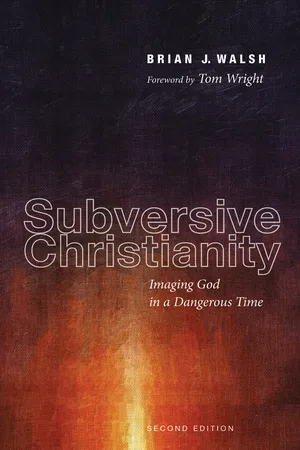
In this second edition of Subversive Christianity, Brian Walsh returns to the themes of cultural discernment that he unpacked more than twenty years ago. In a new Postscript, Walsh revisits Francis Fukuyama, Bruce Cockburn, and the prophet Jeremiah and asks, Where are we now? In light of 9/11 and the world economic crisis of 2008, how do we discern the times, and what does that discernment tell us about the calling of the church?
Information
Topic
Theology & ReligionSubtopic
Christian Church1
On imaging God in Babylon
Christianity as a subversive cultural movement
If someone were to ask you to characterise the place of Christianity in Western culture, I wonder whether “subversive” would be the first word to come to your mind. For example, are corporate executives, who happen to be Christian, viewed as being somehow subversive in the functioning of their corporations? Are politicians who are Christians perceived as a national security threat? Does Scotland Yard, the Royal Canadian Mounted Police, or the FBI regularly monitor the worship activities of Christian churches? I suspect not.
Listen to Nobel Prize winning economist Milton Friedman:
Few trends could so thoroughly undermine the very foundations of our free society as the acceptance by corporate officials of a social responsibility other than to make as much money for their stockholders as possible. This is a fundamentally subversive doctrine.1
What Friedman is saying here is that anyone who believes that corporations have social responsibilities that are more foundational than the making of profits, and could even militate against the making of “as much money as possible” for their stockholders, is propagating a subversive doctrine that could undermine “the very foundations of our free society.” It seems to me that a Christian economic perspective would propagate precisely such a doctrine.2 Therefore, Christianity is subversive—at least in Friedman’s terms. And I think that Friedman is right.
I could demonstrate this subversive quality of Christianity in reference to any number of issues or dimensions of our secular culture, but because I want to talk about what it means to image God, I will illustrate my point primarily as it speaks to our work lives.3 When a community in a capitalist society insists that labour—the work of our hands, the toil of our brow—is good, it is being subversive. Why? Because when such a community breaks with the dominant utilitarianism, which sees work as a disutility and consumer goods as utilities, it thereby breaks with the whole movement of twentieth-century industrial capitalism. This movement has propelled us into energy and capital intensive production processes which pro duce more and more goods at an ever increasing rate, while also decreasing the quality of the products, decreasing the role of human labour, and decreasing the resources of creation. When that is the fundamental movement of a culture, then a community which says that work is good and more and more consumer goods and services is not necessarily good, that community is being subversive. Insisting that work is an integral dimension of human life (not to be contrasted as productive activity over and against consumptive leisurely activity), that it is a form of worship, that it is meant to ennoble humankind, that it should be dedicated to serving one’s neighbour and the stewardly care of the creation—all of these are subversive ideas.
But Christianity is not only subversive in a culture such as ours; it is also deeply offensive to the dominant forces in our culture. This offence is related to what the Bible calls “the offence of the cross.” A Christian worldview, a Christian lifestyle lived in the light of the events of Easter, proclaims that the true lord of history is the crucified and risen one—the one who proclaimed that the kingdom of God is at hand. And that kingdom, that rule, undermines all other pretentious kingdoms and all other cultural experiments that are not rooted in the kingdom of God. This kingdom calls for their total redirection. This is a gospel that is subversive and therefore, for those who benefit from present socio-cultural arrangements, offensive.
The Christian community and worldview conflict
What is at stake in our struggle for an integral Christian witness in a secular culture? What is at stake when we propose alternative views of what labour is all about, complete with alternative understandings of the role and function of the business enterprise, alternative views of corporate social responsibilities, different structures for labour/management/stockholders/consumer relationships, and fundamentally new criteria or norms to govern all of this? What is at stake in this context is not simply the ability to adjust and tinker in different ways with the economic machinery of our society. From a Christian perspective, what is at stake is much more profound. To use the language of Paul at the end of his letter to the Ephesians, making such proposals, and attempting to be a Christian witness in the workplace, is to enter into nothing less than a spiritual conflict.
For we are not contending against flesh and blood, but against principalities, against the powers, against the rulers of this present darkness (Eph 6:12).
What is at stake here are fundamental allegiances—loyalty to different gods.
Another way to say this is that Christians live out of a worldview or a vision of life, that is different from the worldview that dominates Western culture as a whole. Simply stated, Western culture, like any cultural experiment in history, is rooted in an underlying and unifying worldview. That worldview, like all worldviews, tells a story. The Western story is the myth of progress. This myth, which is the implicit religion of Western culture, sees history, beginning way back with Egypt and Greece (not India and China!), as a story of cumulative development leading up to modem Western society.4 We are the culmination of the story. This story, this Western cultural myth, proclaims that progress is inevitable, if we only allow human reason freely and scientifically to investigate our world so that we can acquire the technological power to control that world in order to realise the ultimate human good, that is, an abundance of consumer goods and the leisure time in which to consume them.
This myth of progress is engraved in our high-school textbooks, proclaimed in corporate advertising, phallically erected in our downtown bank and corporation towers, propagated in our universities, assumed by our political parties, and portrayed in the situation comedies, dramas, and news broadcasts on the popular media.5 This myth idolatrously reduces human labour to the efficient exercise of power to produce maximum economic good. Serving the three gods of scientism, technicism, and economism, our work lives (in both the shop and the office) are subjected to scientific analysis by industrial engineers and a whole army of consultants, to determine the most efficient way to accomplish the task at hand using the best and quickest techniques to attain the highest possible economic good.
It is in the context of this idolatry that we are called to be a Christian witness, because this economistic worldview does not just guide industry, the media, and government in our society. More foundationally this is the worldview that captivates the imagination of our society. We experience our lives in its terms. Looking at life with this worldview is as natural as breathing for us. Because, after all, it is in the air everywhere, and the church provides no gas mask.
Because this worldview defines reality for our life we simply assume that progress in science, technology and economics is our historical destiny. We simply assume that labour is a sellable commodity. We simply assume that labour relations are adversarial and that the stockholders own the enterprise. We simply assume—it is self-evident, it needs no justification—that the goal of our labour is to raise our standard of living and that this standard can be measured by a growth in the GNP, by an increase in consumptive goods and the leisure time to consume them. And all of these assumptions are rooted in fundamental beliefs about the world we live in as “a planet for the taking”—as resources waiting for exploitation—and beliefs about who we are as human beings and what our goals in life should be—homo economicus!
In my judgment, these assumptions have to do with the principalities and powers with which we must contend. Indeed, it seems to me that our experience is in many ways not unlike the experience of exile for the Jews in sixth-century BC. We live in Babylon. Babylonian definitions of reality; Babylonian patterns of life, Babylonian views of labour, and Babylonian economic structures dominate our waking and our sleeping. And, like the exiled Jews, we find it very tempting to think that all of this is normal. This is the way life basically should be. Western materialistic affluence coupled with two-thirds world poverty is normal. A proliferation of cheap and useless consumer goods is normal. Environmental collapse is normal. Dedicating one’s life to economic growth is normal. People living for the weekend is normal. A throwaway society is normal. Deficit financing is normal. Rapid and greedy resource depletion is normal. But Canadian poet and songwriter Bruce Cockburn tells us at this point that “the trouble with normal is it always gets worse.”6
If our presence in this culture is to be Christian we must recognise with Christian insight the profound abnormality of it all. This means that we cannot allow our experience of exile to define reality for us. We must not allow the Babylonian economistic worldview so to captivate our imaginations that its patterns, its views, and its priorities become normal for us.
This was also the central problem for the exiled Jews in Babylon. One of the ways in which they dealt with this problem was by constantly reminding each other of who they really were. In the face of Babylonian stories and myths, Jews told and retold their own stories. In fact, it was most likely at this time that they first wrote down one of their most foundational stories—the creation story.7 Since we live in a culture that tells a different story—a progress story with homo economicus as the Promethean hero—and since that story so often captivates our imagination, it seems to me that we...
Table of contents
- Title Page
- Foreword
- Preface
- Chapter 1: On imaging God in Babylon
- Chapter 2: Beyond Worldview to Way of Life: Diagnosis
- Chapter 3: Waiting for a Miracle
- Chapter 4: Waiting for a Miracle
- Postscript: Subversive Christianity 22 Years Later
Trusted by 375,005 students
Access to over 1.5 million titles for a fair monthly price.
Study more efficiently using our study tools.
Frequently asked questions
Yes, you can cancel anytime from the Subscription tab in your account settings on the Perlego website. Your subscription will stay active until the end of your current billing period. Learn how to cancel your subscription
No, books cannot be downloaded as external files, such as PDFs, for use outside of Perlego. However, you can download books within the Perlego app for offline reading on mobile or tablet. Learn how to download books offline
Perlego offers two plans: Essential and Complete
- Essential is ideal for learners and professionals who enjoy exploring a wide range of subjects. Access the Essential Library with 800,000+ trusted titles and best-sellers across business, personal growth, and the humanities. Includes unlimited reading time and Standard Read Aloud voice.
- Complete: Perfect for advanced learners and researchers needing full, unrestricted access. Unlock 1.5M+ books across hundreds of subjects, including academic and specialized titles. The Complete Plan also includes advanced features like Premium Read Aloud and Research Assistant.
We are an online textbook subscription service, where you can get access to an entire online library for less than the price of a single book per month. With over 1.5 million books across 990+ topics, we’ve got you covered! Learn about our mission
Look out for the read-aloud symbol on your next book to see if you can listen to it. The read-aloud tool reads text aloud for you, highlighting the text as it is being read. You can pause it, speed it up and slow it down. Learn more about Read Aloud
Yes! You can use the Perlego app on both iOS and Android devices to read anytime, anywhere — even offline. Perfect for commutes or when you’re on the go.
Please note we cannot support devices running on iOS 13 and Android 7 or earlier. Learn more about using the app
Please note we cannot support devices running on iOS 13 and Android 7 or earlier. Learn more about using the app
Yes, you can access Subversive Christianity, Second Edition by Brian J. Walsh in PDF and/or ePUB format, as well as other popular books in Theology & Religion & Christian Church. We have over 1.5 million books available in our catalogue for you to explore.