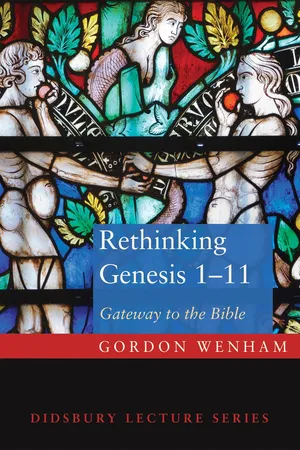
- 86 pages
- English
- ePUB (mobile friendly)
- Available on iOS & Android
eBook - ePub
About this book
Genesis 1-11 contains some of the best-known stories in the world. To modern Westerners they may look like no more than entertaining tales that children can enjoy, but modern adults cannot take seriously. However, when read in the context of the ancient Orient, Genesis 1-11 looks very different. It turns out to be a truly revolutionary document. In retelling the history of the ancient world, it puts a new spin on it by introducing an all-powerful, all-knowing, unique God whose greatest concern is human welfare.
The God who appears in Genesis 1-11 is the God presupposed by all the Old Testament writers, indeed by the New Testament as well. The gripping tales of Genesis thus provide the theological spectacles for a sympathetic reading of the Bible. They are the gateway to a valid understanding of its message and can even help modern believers construct a worldview that integrates both the discoveries of modern science and the insights of Christian theology.
Information
Topic
Theology & ReligionSubtopic
Biblical Commentary1
Rethinking Genesis 1
A Creation Designed for Man
Introduction
Few biblical texts are the focus of such controversy as Genesis 1–11.1 Anyone setting out to read the Bible is immediately plunged into difficulty with the very first chapters. And assumptions about the nature of the text brought by the reader will profoundly determine how it is understood. The scientist who reads it like an article in Nature or the New Scientist will read it quite differently from the anthropologist who classifies it as primitive myth. Within the Christian community, creationists will see the opening chapters of Genesis as literal history, while theistic evolutionists will understand them as theological narrative.
On reflection, we can see that each interpreter comes with his own agenda and then tries to give an interpretation compatible with his preconceptions. And anyone who points this out is liable to find himself making the same mistakes. Can we escape the vicious circle and instead of imposing our own interpretation on the text allow the text to speak for itself? This is the great problem of hermeneutics, discussed at length in numerous books and articles.
This book will not enter into this debate at a theoretical level. It must suffice to say that I do not agree with those who think that it is so difficult to avoid subjective interpretation that we cannot understand the author’s meaning, at least approximately. With careful attention to the ancient Near Eastern context in which the text originated, it is possible to define the genres used in Genesis 1–11 and thereby attune ourselves to the message that was intended to be conveyed. But it is not just ancient Near Eastern texts that can be drawn on to illuminate Genesis. Literary criticism, which pays close attention to the shape and structure of texts, also provides invaluable insights into its meaning. Using these methods and the insights of commentators ancient and modern, I shall endeavor to draw out the meaning of the text as it was understood 3,000 years ago, a meaning that still resonates with us today.
Genesis 1
Some Earlier Commentators
The opening chapter of Genesis is majestic as it declares God’s sovereign power in ordering the cosmos. Repeatedly God says, “Let there be X,” and the narrator reports, “And there was X.” In just six days of working, God brings the whole world into being. This pattern is obvious to every reader of Genesis, but how have commentators understood these days of divine activity?
According to Saint Augustine (354–430 AD), probably the most influential Christian theologian of all time, God created the universe out of nothing, but he doubts whether this was done in six ordinary days. “What kind of days these were it is extremely difficult, or perhaps impossible, for us to conceive.”2 He goes on to point out that the first three days of creation must be different from days four to six, because the sun was not created until the fourth day. “We see that our ordinary days have no evening but by the setting, and no morning but by the rising of the sun; but the first three days of all were passed without sun, since it was reported to have been made on the fourth day.”3
Similarly John Calvin, the great Protestant reformer and Bible commentator, rejects the theory that held God created everything in a moment: rather he did not hurry, but took six days. But that is not to say that Calvin regards Genesis 1 as a scientific account. He says: “He who would learn astronomy and other recondite arts, let him go elsewhere”4 Rather, he sees Genesis as written for the unlearned, and it therefore does not offer an exact account, but describes how things appear to the simple observer. Calvin knows that there is not an ocean above the firmament of the heaven, but that is how it seems when it rains. The windows of heaven open and water gushes out. Calvin thus sees the division of God’s creative activity into six working days as an accommodation to human nature: it would overwhelm the human reader to have all God’s creative acts occurring on the same day.5
The distinguished nineteenth-century commentator Franz Delitzsch argued that the days were days in the life of God and therefore could be of any length as measured by human standards. “Days of God are intended, and with Him a thousand years are but as a day that is past, Ps.xc.4.” Those who argue “that the days of creation are, according to the meaning of Holy Scripture itself, not days of four-and-twenty hours, but aeons, are perfectly right.”6
With Hermann Gunkel’s (1862–1930) Schöpfung und Chaos in Urzeit und Endzeit7 (1895) and his commentary on Genesis (1901) the modern era in the study of Genesis 1–11 began. Gunkel was the first to seriously engage with the material from Mesopotamia that archaeologists were unearthing and assyriologists were deciphering. He focused on the story of the cosmic battle between the gods Marduk and Tiamat, which is described in Enuma elish. He argued that there were echoes of this conflict in the Bible, especially in the Psalms and Isaiah, and that it formed the background to Genesis 1. However, he thought that in the Old Testament the major mythical features have been expunged and now we can talk only of “faded myth.”8 The same general position is taken by Gerhard von Rad and Claus Westermann in their great Genesis commentaries. While they both acknowledge parallels between Genesis 1 and other Near Eastern texts, they pointedly refrain from describing Genesis 1–11 as myth. Von Rad says “In essence [Genesis 1] is not myth and not saga, but Priestly doctrine.”9 And Westermann regularly refers to the opening chapters of Genesis as “story” or “narrative.”10
Literary Patterns
This rapid survey shows the diversity of approach to the first chapter in the Bible and it invites us to take a fresh look at some of the issues, particularly using the tools of literary analysis to see if there are any clues to its genre. These investigations will show that it is a highly structured and artistic piece of literature. It has long been observed that the six days of creation are paired: that though the first three days must have differed from the last three because there was no sun to define the first group, the first day corresponds to the fourth, the second to the fifth, and the third to the sixth.
| Day 1. Creation of Light | Day 4. Creation of Lights = Sun, Moon, Stars |
| Day 2. Creation of Sky and Sea | Day 5. Creation of Birds of Air and Fish of Sea |
| Day 3. Creation of Land and Plants | Day 6. Creation of Animals and Man |
| Day 7. Sabbath | |
Not only does day 3 correspond to day 6 in what is created, the creation of the land and plants makes possible the life of man and the animals.
The failure to pair the Sabbath with another day makes it unique. It stands apart, not only in content (God rests instead of working), but also in structure.
If 2:1–3 is the tailpiece to the six days of divine activity, 1:1–2 is the prelude. The great Jewish commentator Cassuto drew attention to the way prelude and tailpiece have common features that bespeak careful composition. For example, the wording of 1:1 is echoed in 2:1–2, but the key terms appear in reverse order. Literally translated 1:1 reads “In the beginning created God the heavens and the earth.” “Created,” “God,” and “heavens and earth” reappear in 2:1–3.
2:3 God rested from all his work . . . in creation
2:2 On t...
Table of contents
- Title Page
- Preface
- Chapter 1: Rethinking Genesis 1
- Chapter 2: Rethinking Genesis 2–4
- Chapter 3: Rethinking Genesis 6–9
- Chapter 4: Rethinking Genesis 5–11
- Chapter 5: Epilogue
- Bibliography
Trusted by 375,005 students
Access to over 1.5 million titles for a fair monthly price.
Study more efficiently using our study tools.
Frequently asked questions
Yes, you can cancel anytime from the Subscription tab in your account settings on the Perlego website. Your subscription will stay active until the end of your current billing period. Learn how to cancel your subscription
No, books cannot be downloaded as external files, such as PDFs, for use outside of Perlego. However, you can download books within the Perlego app for offline reading on mobile or tablet. Learn how to download books offline
Perlego offers two plans: Essential and Complete
- Essential is ideal for learners and professionals who enjoy exploring a wide range of subjects. Access the Essential Library with 800,000+ trusted titles and best-sellers across business, personal growth, and the humanities. Includes unlimited reading time and Standard Read Aloud voice.
- Complete: Perfect for advanced learners and researchers needing full, unrestricted access. Unlock 1.5M+ books across hundreds of subjects, including academic and specialized titles. The Complete Plan also includes advanced features like Premium Read Aloud and Research Assistant.
We are an online textbook subscription service, where you can get access to an entire online library for less than the price of a single book per month. With over 1.5 million books across 990+ topics, we’ve got you covered! Learn about our mission
Look out for the read-aloud symbol on your next book to see if you can listen to it. The read-aloud tool reads text aloud for you, highlighting the text as it is being read. You can pause it, speed it up and slow it down. Learn more about Read Aloud
Yes! You can use the Perlego app on both iOS and Android devices to read anytime, anywhere — even offline. Perfect for commutes or when you’re on the go.
Please note we cannot support devices running on iOS 13 and Android 7 or earlier. Learn more about using the app
Please note we cannot support devices running on iOS 13 and Android 7 or earlier. Learn more about using the app
Yes, you can access Rethinking Genesis 1–11 by Gordon Wenham in PDF and/or ePUB format, as well as other popular books in Theology & Religion & Biblical Commentary. We have over 1.5 million books available in our catalogue for you to explore.