eBook - ePub
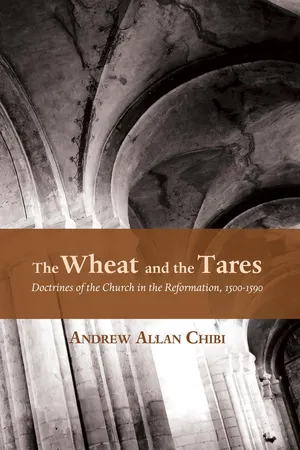
The Wheat and the Tares
Doctrines of the Church in the Reformation, 1500–1590
- 502 pages
- English
- ePUB (mobile friendly)
- Available on iOS & Android
eBook - ePub
About this book
In 1500 Christians knew that God gave them the church to shepherd believers toward salvation and that it was centered at Rome and ruled by a pope. Today, that church is but one of forty thousand Christian denominations, each with distinctive structures and doctrines. How did this happen? Then, as now, all aspects of the church--from its divine mission to its offices and operations, hierarchy, and bureaucracy--were of interest to theologians, thinkers, and troublemakers alike, but for ages there had been satisfaction with the status quo.
In the late Renaissance this gave way to frustration and heated debate, as some people wanted fewer clerical controls over their lives, and others sought a church more representative of its purest, earliest form. Ecclesiology (the doctrine and theory of the church) became a major controversy separating not only Roman Catholics from emerging Protestants, but also Protestants from one another. In the writings of the various reformers, the same issues surfaced repeatedly. Jesus's parable of the Wheat and the Tares was discussed often as an image of the church, as reformers sought to rediscover the purity of the church as God's gift. This book uses the words of a range of reformers to explain how the one church began to divide into the many.
Information
Topic
Theology & ReligionSubtopic
Christian Theology1
Erasmus, Abuses in the Church, and the Needs of Christendom
Neither humanism nor Erasmus needs a detailed introduction; their aims and interests are well documented. It was noted earlier, however, that humanism gave rise to a lay piety movement searching for greater spiritual succor. One aspect of this challenge was an increased criticism of the church’s perceived material orientation. The necessity of forever shifting resources away from the servicing of lay spiritual needs had left the church open to a charge of excessive worldliness (even if the original intentions had always been good). It was something of a vicious circle; the increased personal involvement in pursuit of spiritual meaning (i.e., personal piety) among the laity increased disappointment with the church as an institution and with its theology. This in turn left the pious searching more and more outside the church’s walls for enlightenment or satisfaction. Humanism also inspired a different kind of intellectual approach to the perceived problems of late medieval Christendom. Humanists looked out on the continuous internecine warfare between Christian leaders, including clergymen, and wondered where the church and society had gone so badly wrong. They considered the pax Europa and searched for Christian renewal.9 They were not calling for widespread changes in the church per se, but rather for a means to broad-based moral improvement. With Humanism’s ad fontes approach in mind, scriptural correctness became important.
It is well known that humanist scholars were also interested in language, particularly the biblical languages of Latin, Greek and Hebrew, and particularly Latin as a lingua franca of pan-European communication. In order to perfect their own understanding of Latin, critical, literary and historical textual analysis was applied to ancient sources with a rapidly increasing expertise. Bible stories were recognized as being of particular times and places, the records of human activity and development, placed in the context of literary and linguistic developments. Given these aims of contextual, historical and literary analysis that the humanists would turn also to the Bible and its own context is unsurprising. It was obviously a key resource in the study of Christendom’s historical development (both secular and sacred). Erasmus, as in so much else a bridge between the medieval and reformation periods, was well aware of the weaknesses of the institutionalized church and of the obstacles that lay in the path of Christian renewal and general peace. Like his fellow humanists he was not interested in challenging the church’s power or its theology, but he was interested in extracting from its most important historical documents moral and doctrinal insights which could then be applied to his own time and circumstances. What this means is that Erasmus and some of the other humanists (they had widespread interests after all) were less interested in the usual selection of Sentences, glosses and commentaries and much more interested in the actual source material. They were searching for a living, breathing Christ and a vital church. The lessons and wisdom gleaned from His words and works they could then apply to a recapture of the vitality and energy of the early, “primitive” church. Humanists, particularly northern European or Christian humanists, looked increasingly at the New Testament and the writings of the ancient church fathers (Christianity in its purest forms) in the attempt to exact practical solutions.
As McGrath pointed out, the humanist program was not sola scriptura as the Bible was but one source of doctrine and morality among many.10 It should be clear that the reformers also became interested in the same sources (e.g., the Bible and the writings of the church fathers) but more strictly as sources of correct doctrine. The church fathers were, for them, early theologians and commentators on Scripture for a church unsullied by the plethora of subsequently assumed duties and responsibilities. The fathers were less worldly and more spiritual. Erasmus, and some other humanists, pursued their ideals by exposing and condemning the abuses and weaknesses in the church (as an institution and among its custodians), comparing the contemporary model with the ancient ideal. In doing so they thought to encourage a more practical, spiritual Christianity, one suitable for both clergy and laity as equally members of the Christian community and one which would inspire renewal and peace. One of the first products of this new search was Erasmus’ Handbook of the Christian Soldier (or Enchiridion militis christiani) of 1503.11
Handbook was written as an improving text for an anonymous friend and is the type of manual with which we are all now quite familiar. Were Erasmus to have written it in the twenty-first century it would have been called something self-deprecating and amusing like Christianity for Dummies. He was writing for an interested audience rather than for professional theologians so there was an emphasis on the individual and on the development of a personal, inward spirituality dependent on nothing but a genuine pursuit of faith. The anonymous friend he was addressing was a soldier, however, so he couched the argument in military terms making it personal. He considered such questions as how good could finally triumph over evil, or what does it mean to be a Christian or can one live a Christian life without having to become isolated from the world?12 Those seeking increased personal piety in the church were faced by ceremonies with a heavy material emphasis like the Mass, pilgrimages, veneration of saints, images and indulgences finding that these had replaced and overwhelmed the actual central message of Christianity, just as rigid dogma and doctrine had replaced the ideas they were originally meant to explain. To address this disorder Erasmus switched the emphasis for Christians back to the words, teachings, actions and example of the Christ. Reardon expressed this best when he said that the heart of Erasmus’ message was “charity.” Not the mere mechanical donation of money but actual involvement: the edification of one’s neighbor, counting all as equal under Christ, rejoicing in a friend’s triumphs and commiserating in his failures (as if these were personal), in other words, taking part in genuinely altruistic, charitable activities.13 Erasmus wrote that a tally of church attendances, or “prostrations” before statues, or mere “repetition” of certain prayers, was of little real value:
Of all these things God has no need. Paul declares charity to be the edification of one’s neighbour, the attempt to integrate all men into one body so that all men may become one in Christ, the loving of one’s neighbour as oneself . . . just as Christ gave Himself completely for us, so also should we give ourselves for our neighbour.14
One can appreciate how attractive such a message would be to seekers of personal piety. If everyone took Erasmus’ advice, there would be peace. The Handbook was, therefore, a step-by-step plan for self-improvement (divided into two parts) as a microcosm of Christendom’s improvement.
The first part is a series of essays on the nature of man and on the importance of reading Scripture, thematically connected through the imagery of a warrior arming himself with all the spiritual, non-material weapons and shields he will ever need for the constant spiritual battles ahead. This is an important point—the battles never end—being a Christian soldier is not easy; diligence and vigilance are the constant watchwords. This is followed up by twenty-two life guidelines. In the first part we discover that all the weapons necessary for Christian warfare against evil are to be found in Scripture, so attentive study and some “sensible reading of pagan poets and philosophers” go a long way.15 Christianity is in the mind, heart and soul. Here was a basic sola scriptura message of fulfilling spiritual needs supplemented by a pursuit of edifying moral literature. How well does this fit into Erasmus’ wider program of Christian renewal?
Well, almost at a stroke he repudiates much of the external structures of organized religion. There was no real place for ceremonials, rules, regulations, usages, church buildings and even the special place usually accorded clerics and monks in society was played down in favor of an internal mystical dialog and personal relationship to Christ (through imitation). Erasmus’ fifth guideline made an important distinction between visible things as imperfect or indifferent, “mere shadows of reality,” and the invisible and spiritual as sweet and bright (echoing Plato). This became a familiar mantra as every reformer echoed this anti-materialist message. Some would go a little too far, however. The distinction can also be applied to Scripture, as words have both external, corporeal meanings as well as mysterious or spiritual significance. Erasmus recommended reading the church fathers in conjunction with the Bible for guidance and better understandings, dismissing ceremonies, verbose doctrine and other materialistic externals as “the worst plague of Christianity”: “This false set of values brings more ruin than any other because in appearance it is very close to godliness. There are no vices that are more dangerous than those that have the veneer of virtue . . . to place the whole of religion in external ceremonies is sublime stupidity.” He was not attacking the ceremonies or externals as such but warning they are indifferent to salvation. Lighting a candle, wearing a vestment, looking at a statue does not grant grace, indeed there is a risk of abuse. “In short, you must avoid the horns of the dilemma. To observe these unimportant things is, of course, wholesome, but to make them the whole object of your devotions is extremely dangerous.”16
He was also trying to move society beyond “golden age” mythology. It was not enough that Christians try and recapture an ideal asceticism (by founding more monasteries, for example) or revive Aquinas (as scholasticism had had its day). Nor are there degrees within Christendom (as all souls are of equal value), thus there is in reality no difference between clergymen and laity. The baptized are all equal. Erasmus was in the vanguard of a new approach, a spiritual, non-materialistic approac...
Table of contents
- Title Page
- Preface
- Acknowledgments
- Abbreviations
- Introduction
- Chapter 1: Erasmus, Abuses in the Church, and the Needs of Christendom
- Chapter 2: Luther’s Doctrine of the Church
- Chapter 3: Zwingli’s Doctrine of the Church
- Chapter 4: The Ecclesiology of the Second-Generation Reformers
- Chapter 5: Tudor Ecclesiology
- Conclusion
- Bibliography
Trusted by 375,005 students
Access to over 1.5 million titles for a fair monthly price.
Study more efficiently using our study tools.
Frequently asked questions
Yes, you can cancel anytime from the Subscription tab in your account settings on the Perlego website. Your subscription will stay active until the end of your current billing period. Learn how to cancel your subscription
No, books cannot be downloaded as external files, such as PDFs, for use outside of Perlego. However, you can download books within the Perlego app for offline reading on mobile or tablet. Learn how to download books offline
Perlego offers two plans: Essential and Complete
- Essential is ideal for learners and professionals who enjoy exploring a wide range of subjects. Access the Essential Library with 800,000+ trusted titles and best-sellers across business, personal growth, and the humanities. Includes unlimited reading time and Standard Read Aloud voice.
- Complete: Perfect for advanced learners and researchers needing full, unrestricted access. Unlock 1.5M+ books across hundreds of subjects, including academic and specialized titles. The Complete Plan also includes advanced features like Premium Read Aloud and Research Assistant.
We are an online textbook subscription service, where you can get access to an entire online library for less than the price of a single book per month. With over 1.5 million books across 990+ topics, we’ve got you covered! Learn about our mission
Look out for the read-aloud symbol on your next book to see if you can listen to it. The read-aloud tool reads text aloud for you, highlighting the text as it is being read. You can pause it, speed it up and slow it down. Learn more about Read Aloud
Yes! You can use the Perlego app on both iOS and Android devices to read anytime, anywhere — even offline. Perfect for commutes or when you’re on the go.
Please note we cannot support devices running on iOS 13 and Android 7 or earlier. Learn more about using the app
Please note we cannot support devices running on iOS 13 and Android 7 or earlier. Learn more about using the app
Yes, you can access The Wheat and the Tares by Andrew Allan Chibi in PDF and/or ePUB format, as well as other popular books in Theology & Religion & Christian Theology. We have over 1.5 million books available in our catalogue for you to explore.