eBook - ePub
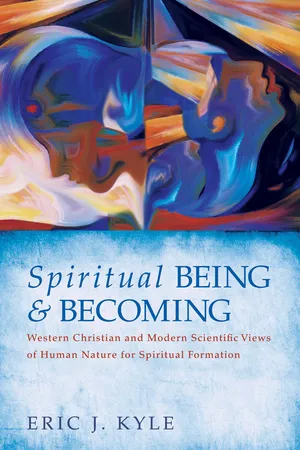
Spiritual Being & Becoming
Western Christian and Modern Scientific Views of Human Nature for Spiritual Formation
- 314 pages
- English
- ePUB (mobile friendly)
- Available on iOS & Android
eBook - ePub
Spiritual Being & Becoming
Western Christian and Modern Scientific Views of Human Nature for Spiritual Formation
About this book
It is reported that there are as many as 100 billion neurons that make up the human nervous system. This system is incredibly complex, and yet it is a fundamental part of what makes us who we are. Yet, there is far more to human beings than biology. Many academic disciplines study the human condition and there are many schools of thought within that study. We must also appreciate that the study of human nature did not begin in contemporary times. History, particularly Western Christian history, is full of texts that offer detailed explorations of the human condition. However, no consensus has yet emerged.
Consensus or not, those working towards religious and spiritual formation are tasked with pursuing the transformation of their communities. This book is an attempt to provide some of the background to support this ministerial work. It seeks not only to offer a fuller understanding of some of the common views of human nature, but also insights into how we might utilize this knowledge in our ministries--ministries that strive towards the spiritual being and becoming of our world.
Information
Topic
Theology & ReligionSubtopic
ChristianityChapter 1
Western Christian Theological Anthropologies
We begin our massive synthesizing effort with western Christian thinkers. In particular, we will be briefly exploring the theological anthropologies of the following nine sources: the Bible (according to one author); Augustine of Hippo; Maximus the Confessor; Thomas Aquinas; Martin Luther; Immanuel Kant; Karl Barth; Karl Rahner; and contemporary anthropologies in light of modern Western science. In order to help us to better understand how their views of human nature might be relevant for spiritual formation, we will review the following three major areas: 1) their general views of human nature, including any components they identify and how they account for goodness and evil; 2) their views of the Divine in relation to humanity; and 3) their assertions related to the nature of change for humans, and God’s relationship to such transformation. The first two topics address the basic elements of their theological anthropologies while the third one is of a more specific interest to the field of theistic spiritual formation. Collectively, these thinkers provide insights into some of the diverse views that may be found in this religious tradition and they conceive of how human transformation might transpire.
Biblical Views (BCE—Second Century CE)
We begin these historical explorations with where Christianity often does: the Bible. Rather than turning directly to the Bible and attempting my own summary of the theological anthropologies found therein, I instead chose to look to one resource that appeared to have already accomplished this: Joel Green’s (Professor of New Testament Interpretation at Fuller Theological Seminary) book, Body, Soul, and Human Life.1 Green is primarily concerned “with how the Bible portrays the human person, the basis and telos of human life, what it means for humanity, in the words of Irenaeus, to be “fully alive.””2 Given this focus, Green claims that he is additionally interested in how such views inform our contemporary understandings of such topics as “freedom, salvation, Christian formation, and the character of the church and its mission” in light of modern scientific claims.3 In addition to these, as we shall see, Green is additionally interested in the topic of life-after-death and what, if anything, survives.
Regarding the nature of human beings, Green highlights a number of important points that uniquely characterize us. He asserts the fundamental unity of the human person as found in both the Hebrew and Christian Testaments.4 Turning to scriptural concepts such as “nephes,” “gewiyya,” and others, he claims that these concepts emphasize the wholeness of the individual.5 Throughout these explorations, Green finds that “segregating the human person into discrete, constitutive ‘parts,’” is not emphasized, but rather are persons considered in their completeness.6
Given this wholeness, Green further finds that the embodiedness of humanity is also stressed.7 Jewish perspectives emphasize a “psychosomatic unity,” while Christian texts, such as Luke and Peter, highlight the bodilyness of Jesus and humans in general8. Based upon these insights, Green asserts his own similar views when he writes, “What I want especially to underscore here, though, is that who we are, our personhood, is inextricably bound up in our physicality.”9 Humans are therefore seen to be in continuity with other animals, we share our embodiedness with the earth.10 Based on the Bible, Green claims, “humanity is formed from the stuff of the earth.”11
Equally emphasized with our physicality, is relationality; our relatedness to others, God, and creation at large. Central to human nature, following from the Genesis creation story, is our “capacity to relate to Yahweh as covenant partner,”12 and Jesus’ own life and resurrection may only be understood “with reference to relationality and mission.”13 Our personal identities, claims Green, are therefore intricately bound up with the Divine, but also the human relationships that we have.14 So important are these relationships, that we cannot be “genuinely human and alive” without them.15
With these two central aspects of human nature, our embodiedness and our ...
Table of contents
- Title Page
- Acknowledgments
- Introduction
- Chapter 1: Western Christian Theological Anthropologies
- Chapter 2: Modern Science Views of Human Nature
- Chapter 3: Seeking Synthesis
- Chapter 4: Spiritual Being and Becoming
- Chapter 5: Spiritual Groundedness
- Anthropological Afterthoughts
- Appendix A: Summary Table of Western Christian Views
- Appendix B: Summary Table of Modern Science Views
- Bibliography
Trusted by 375,005 students
Access to over 1.5 million titles for a fair monthly price.
Study more efficiently using our study tools.
Frequently asked questions
Yes, you can cancel anytime from the Subscription tab in your account settings on the Perlego website. Your subscription will stay active until the end of your current billing period. Learn how to cancel your subscription
No, books cannot be downloaded as external files, such as PDFs, for use outside of Perlego. However, you can download books within the Perlego app for offline reading on mobile or tablet. Learn how to download books offline
Perlego offers two plans: Essential and Complete
- Essential is ideal for learners and professionals who enjoy exploring a wide range of subjects. Access the Essential Library with 800,000+ trusted titles and best-sellers across business, personal growth, and the humanities. Includes unlimited reading time and Standard Read Aloud voice.
- Complete: Perfect for advanced learners and researchers needing full, unrestricted access. Unlock 1.5M+ books across hundreds of subjects, including academic and specialized titles. The Complete Plan also includes advanced features like Premium Read Aloud and Research Assistant.
We are an online textbook subscription service, where you can get access to an entire online library for less than the price of a single book per month. With over 1.5 million books across 990+ topics, we’ve got you covered! Learn about our mission
Look out for the read-aloud symbol on your next book to see if you can listen to it. The read-aloud tool reads text aloud for you, highlighting the text as it is being read. You can pause it, speed it up and slow it down. Learn more about Read Aloud
Yes! You can use the Perlego app on both iOS and Android devices to read anytime, anywhere — even offline. Perfect for commutes or when you’re on the go.
Please note we cannot support devices running on iOS 13 and Android 7 or earlier. Learn more about using the app
Please note we cannot support devices running on iOS 13 and Android 7 or earlier. Learn more about using the app
Yes, you can access Spiritual Being & Becoming by Eric J. Kyle in PDF and/or ePUB format, as well as other popular books in Theology & Religion & Christianity. We have over 1.5 million books available in our catalogue for you to explore.