eBook - ePub
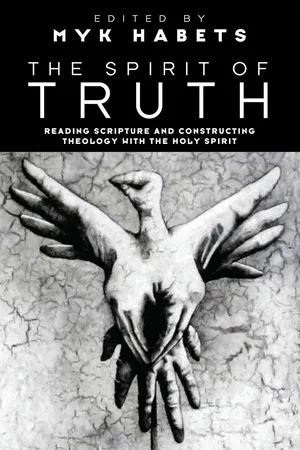
The Spirit of Truth
Reading Scripture and Constructing Theology with the Holy Spirit
- 238 pages
- English
- ePUB (mobile friendly)
- Available on iOS & Android
eBook - ePub
The Spirit of Truth
Reading Scripture and Constructing Theology with the Holy Spirit
About this book
Among the theological loci pneumatology is one of the most stimulating, exciting, and difficult topics to study; it is also one of the most rewarding. The identity and mission of the Holy Spirit is pervasive throughout Scripture and the Great Tradition, and within contemporary Christianity it is one of the most popular topics currently being explored. Here ten scholars present twelve essays spanning biblical, hermeneutical, theological, and practical disciplines. The result is not an evangelical pneumatology in systematic fashion, nor is it a comprehensive theology of the Holy Spirit. Rather, this volume presents explorations in pneumatology from a variety of evangelical scholars working in varying contexts (mostly the South Pacific basin) but each wrestling equally with what the Spirit of Truth is saying to the churches today. This is a work of outstanding scholarship with essays by Canadian theologian Gary Badcock and a cast of established and emerging Kiwi-or New Zealand-theologians, which gives the work a unique contextual flavor alongside its ecumenical and evangelical commitment.
Information
Topic
Theology & ReligionSubtopic
Christian TheologyPart One
Reading Scripture with the Spirit
1
The Holy Spirit and the Presence of God
by Gary Badcock
Both at the level of ordinary Christian awareness, and in that second-order level of formal theological reflection that we call Christian theology, talk of the Holy Spirit is commonly reckoned to be concerned with God as present and active today.1 The Holy Spirit is, after all, the one sent after the departure of the Lord Jesus, so that while for a time we cannot see him, the Spirit whom he sent is present forever (John 14:16; 16:5–16). But what, exactly, do we mean by this idea of the “presence” of the Spirit? This seemingly simple question is, in fact, far from simple to answer, for a cluster of issues of the greatest moment begins to emerge at this point on closer inspection. For instance, does the presence of the Spirit constitute something unique over against the presence of Christ, or alternatively, is talk of the presence of the Spirit shorthand for the presence of what we might call “God-in-general”? Again, if the Spirit is said to be present, are we, by this affirmation, committed to the idea that the Spirit is present not only in the present (this being the fundamental sense of the word “presence”) but also in a particular place; in short, is the Holy Spirit present in space as well as in time? And if so, then in what space, or where, exactly, is it possible to encounter the “present” Spirit of God? Ought this space itself thereby to have theological significance, along with the time as well with which it is to be taken together? Large questions, then, are summoned forth from ordinary Christian awareness at this point, and it is the task of the present essay to begin to unpick strands of the knot implicit in some of them, at least, as we seek to understand what it is that we believe.
Presence and Omnipresence
Several distinct loci from the classical theological tradition will serve as our point of departure. To begin with, let me quote some well-worn words from the eighth-century theologian John of Damascus. God, John teaches in a famous argument, “is his own place” (topos).2 Though this claim has recently been read (rather unsurprisingly, by an exponent of panentheism) as meaning that, for John of Damascus, “the world’s spatial-temporal existence is opened by and embraced by God’s unimaginable ‘roominess,’” the point is in fact rather different.3 For John, it is both possible and necessary to speak of the “place” of God because while God fills and energizes all things without mixing himself with any one thing, the same God is said to dwell especially in those places that have a greater share in his energy and grace than others. Heaven is such a place, the place of God’s throne, while earth, for its part, is relativized as God’s footstool; equally, John observes, the “sacred flesh” of Christ and the church can be spoken of as special places in which God is present. In general, in fact, he argues that we are able to speak of anywhere that the divine energy becomes manifest to us as the place of God, not because of the special dignity of the space itself, but solely because of the God who dwells there by way of his transcendent power. That God is his own place means, in effect, that God dwells where he wills—but also that God does dwell there in the sense that to the place of dwelling is given to share in his energies.
Medieval theology in the Latin tradition took a slightly different approach, but was, in general terms, preoccupied with the same questions. On the one hand, we might say that the classical divine attribute of divine omnipresence, according to which God is present everywhere, made the answer to the question of the possibility of divine presence somewhere rather obvious: God’s presence in one place or person in particular is grounded in his generic presence in all things. On the other hand, this raises a clear problem, for if God really is present everywhere, then in what possible sense could it be said that God also can indwell one person, people, or place any more than the next? Is there, in a word, no difference between God’s presence in the sinner and in the saint?
The importance of these issues was widely recognized in medieval discussions of the presence of God. Thomas Aquinas, for example, argues that God, the cause of all things, dwells in everything in a generic sense per essentiam, potentiam et præsentiam.4 Metaphysically, the presence of God can be seen as an implication of the doctrine of creation, and falls under the heading of what in Catholic theology is called the “presence of immensity.” God’s creative power is such as not only to generate all that came to exist in the beginning, but also to hold all things in existence at every instant of created time.5 Yet Thomas is also well aware that God is said to be present to and in the human person in another way that surpasses the divine creative presence, by virtue of the Son or the Holy Spirit’s being “sent” to dwell with, in, or among the saints in a more intimate way. Thus there comes about, as he puts it, “a special presence consonant with the nature of an intelligent being.” In Thomas’s theology, this presence is tied, as one might expect, to the life of conscious faith and of moral obedience. In spiritual creatures who apprehend by faith the truth of God, he maintains, God comes to be present “as the object known by the knower and as the one beloved of the lover” (cognitum in cognoscente et amatum in amante), so that, by acts of knowing and loving, a person is said to touch God himself, who dwells in the person “as in his temple.”6 In a strikingly beautiful exposition, Thomas speaks of a process of divinization, or of being made like God by virtue of this specific form of divine presence:
By grace the soul takes on a God-like form. That a divine person be sent to someone through grace, therefore, requires a likening [assimilatio] to the person sent through some particular gift of grace. Since the Holy Spirit is Love, the likening of the soul to the Holy Spirit occurs through the gift of charity and so the Holy Spirit’s mission is accounted for by reason of charity. The Son in turn is the Word; not, however, just any word, but the Word breathing Love; The Word as I want the meaning understood is a knowledge accompanied by love [citing Augustine De Trinitate 9.10]. Consequently not just any enhancing of the mind indicates the Son’s being sent, but only that sort of enlightening that bursts forth into love; the kind, namely, that John describes, Everyone that hath heard from the Father and hath learned, cometh to me; and the Psalm, In my meditation a fire shall come forth. [This] points to a kind of experiential awareness and this precisely is what wisdom is, a knowing that, as it were, is tasted . . .7
It would seem that Thomas forgot at least this little nugget of gold when, towards the end of his life, and for whatever reason, he famously confessed that all that he had written seemed like straw to him.8
There is, however, a residual problem, for Thomas, in speaking of the sending of the Son and of the Holy Spirit as the basis of the distinctive presence of God to the saints, is unable to admit that such a sending involves in any sense that God should come to be located somewhere new. What it means to say that the Son or the Spirit is sent is not that God literally moves to be with or in someone or some place (for as the axiomatically omnipresent one, he must already have been there), but rather, that the creature has come to God. What the missions of the Son and of the Holy Spirit amount to, in short, is a change in the relation of the creature to the divine source of the “sending,” whereby, according to that peculiar use of language that is theology, God is said to be made present. Thus Thomas speaks of the likening of the creature to the Trinitarian person “sent” as constitutive of the divine presence. Two things emerge from this treatment that are worth noting: first, as has been indicated, the creature rather than God is changed, for there can be nothing new for God; while secondly, and crucially, the presence of God is conceived in Trinitarian terms, for the change in view is a likening of the creature to the Trinitarian person said to be “sent,” and it is this likening that effectively defines the presence of God.
Expanding upon these Thomistic ideas in his pneumatology, the twentieth-century Dominican theologian Yves Congar argues that since God must be spoken of as already both everywhere and nowhere (everywhere because he cannot be confined to one space, and nowhere for precisely the same reason), it is necessary to have recourse to this traditional argument in order to avoid taking the concept of presence too crudely.9 What takes place when God becomes present to a person, Congar maintains, is that the person is placed in a certain relationship with God, who becomes present now not only implicitly, but explicitly and spiritually as the object of love and knowledge. It is not that a change in God’s location is effected; rather, there has come about a change in the person concerned, or more precisely, in his or her conscious relation to God. God’s presence, precisely because it is by way of and in a certain logical sense identical with his transcendence, is unalterable. “Where can I go from your spirit? Or where can I flee from your presence?” asks the 139th Psalm (v. 7), and the answer given, of course, is that there is nowhere that God is not, and therefore no such place to which we can flee and hide, or no pit in which we cannot be found by him. That there are those for whom the thought of the presence of God ...
Table of contents
- Title Page
- Preface
- Acknowledgments
- Contributors
- Abbreviations
- Part One: Reading Scripture with the Spirit
- Chapter 1: The Holy Spirit and the Presence of God
- Chapter 2: Spirit, Geist, and the Knowledge of God
- Chapter 3: A Pneumatology for an Everyday Theology: Whither the Anonymous Spirit in Luke 10:1–12?
- Chapter 4: Spirit, Interpretation and Scripture: Exegetical Thoughts on 2 Peter 1:19–21
- Chapter 5: James and the Spirit: Wisdom and Hermeneutics
- Chapter 6: Reading Scripture and Doing Theology with the Holy Spirit
- Part Two: Constructing Theology with the Spirit
- Chapter 7: Eastern Promises: Remedying the Pneuma-tological Deficits of Western Theology
- Chapter 8: Theosis, Yes; Deification, No
- Chapter 9: Teleology as the Key to Pneumatological Anthropology
- Chapter 10: “When Groans and Mumblings Are Not Enough”: Investigating Being “Slain in the Spirit” in Acts
- Chapter 11: Taking the Spirit to Work
- Chapter 12: The Spirit and Particularity
Trusted by 375,005 students
Access to over 1.5 million titles for a fair monthly price.
Study more efficiently using our study tools.
Frequently asked questions
Yes, you can cancel anytime from the Subscription tab in your account settings on the Perlego website. Your subscription will stay active until the end of your current billing period. Learn how to cancel your subscription
No, books cannot be downloaded as external files, such as PDFs, for use outside of Perlego. However, you can download books within the Perlego app for offline reading on mobile or tablet. Learn how to download books offline
Perlego offers two plans: Essential and Complete
- Essential is ideal for learners and professionals who enjoy exploring a wide range of subjects. Access the Essential Library with 800,000+ trusted titles and best-sellers across business, personal growth, and the humanities. Includes unlimited reading time and Standard Read Aloud voice.
- Complete: Perfect for advanced learners and researchers needing full, unrestricted access. Unlock 1.5M+ books across hundreds of subjects, including academic and specialized titles. The Complete Plan also includes advanced features like Premium Read Aloud and Research Assistant.
We are an online textbook subscription service, where you can get access to an entire online library for less than the price of a single book per month. With over 1.5 million books across 990+ topics, we’ve got you covered! Learn about our mission
Look out for the read-aloud symbol on your next book to see if you can listen to it. The read-aloud tool reads text aloud for you, highlighting the text as it is being read. You can pause it, speed it up and slow it down. Learn more about Read Aloud
Yes! You can use the Perlego app on both iOS and Android devices to read anytime, anywhere — even offline. Perfect for commutes or when you’re on the go.
Please note we cannot support devices running on iOS 13 and Android 7 or earlier. Learn more about using the app
Please note we cannot support devices running on iOS 13 and Android 7 or earlier. Learn more about using the app
Yes, you can access The Spirit of Truth by Myk Habets, Habets in PDF and/or ePUB format, as well as other popular books in Theology & Religion & Christian Theology. We have over 1.5 million books available in our catalogue for you to explore.