eBook - ePub
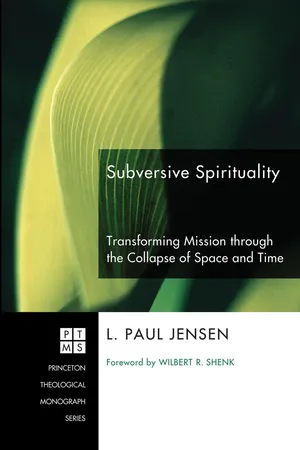
Subversive Spirituality
Transforming Mission through the Collapse of Space and Time
- 392 pages
- English
- ePUB (mobile friendly)
- Available on iOS & Android
eBook - ePub
About this book
Subversive Spirituality links the practice and study of Christian spirituality with Christian mission. It develops a twofold thesis: grace, spiritual disciplines, and mission practices are inseparably linked in the mission of Jesus, of the early church, and of several historical renewal movements, as well as in a contemporary field research sample; and amidst the collapse of space and time evidenced by our culture's increasingly hurried pace of life, more time and space are needed for regular solitary and communal spiritual practices in church, mission, and leadership structures if Christian mission is to transform people and culture in our time. This requires a subversion of the collapsed spatial and temporal codes that have infected our Christian institutions.
Jensen employs methods and approaches from a variety of academic disciplines to explore both spirituality in terms of space and time and mission in terms of deed and word. Specifically, Jensen examines the spirituality and mission of Jesus, the early church, the apostolic fathers, Origen, the Devotio Moderna, the early Jesuits, David Brainerd, and several women in 19th century Protestant missions. He considers the spirituality and mission that have arisen within the postmodern generations born after 1960. Based on the theological, historical, cultural, and field analyses of this study, a model for spirituality and mission is proposed. The model addresses the contemporary collapse of space and time and appears to have widespread applicability to diverse cultures and eras. Jensen's model is applied to the pluralistic and postmodern milieu of North America with recommendations for spirituality and mission in church, mission, and educational structures. A derivative model for teaching and practicing spirituality and mission in the academy, which also has application for non-formal leadership development structures, is also proposed.
Information
Topic
Theology & ReligionSubtopic
Biblical StudiesTable of contents
- Title Page
- Acknowledgements
- Foreword
- Preface
- Chapter 1: Introduction
- Chapter 2: The Collapse of Time and Space
- Chapter 3: Jesus’s Rhythms of Spirituality and Mission
- Chapter 4: The Early Church’s Rhythms of Spirituality and Mission
- Chapter 5: Rhythms of Spirituality and Mission in the Modern Age
- Chapter 6: Rhythms of Spirituality and Mission in the Postmodern Age
- Chapter 7: Conclusion
- Appendix A: Some Contemporary Definitions of Spirituality
- Appendix B: What Is a Spiritual Discipline?
- Appendix C: Physical Symptoms, Psychological Signs, and Underlying Beliefs of Time Pathologies
- Appendix D: Luke’s Gospel, Part A
- Appendix E: Luke’s Gospel, Part B
- Appendix F: Three Branches of Spiritual Theology
- Appendix G: Summary of Rhythms of Spirituality and Mission in the Devotio Moderna
- Appendix H: Summary of Rhythms of Spirituality and Mission in Ignatius and the Early Jesuits
- Appendix I: Journey to Reach the Next Generations
- Appendix J: Suggestions for Extended Personal Communion with God
- References Cited
Trusted by 375,005 students
Access to over 1.5 million titles for a fair monthly price.
Study more efficiently using our study tools.
Frequently asked questions
Yes, you can cancel anytime from the Subscription tab in your account settings on the Perlego website. Your subscription will stay active until the end of your current billing period. Learn how to cancel your subscription
No, books cannot be downloaded as external files, such as PDFs, for use outside of Perlego. However, you can download books within the Perlego app for offline reading on mobile or tablet. Learn how to download books offline
Perlego offers two plans: Essential and Complete
- Essential is ideal for learners and professionals who enjoy exploring a wide range of subjects. Access the Essential Library with 800,000+ trusted titles and best-sellers across business, personal growth, and the humanities. Includes unlimited reading time and Standard Read Aloud voice.
- Complete: Perfect for advanced learners and researchers needing full, unrestricted access. Unlock 1.5M+ books across hundreds of subjects, including academic and specialized titles. The Complete Plan also includes advanced features like Premium Read Aloud and Research Assistant.
We are an online textbook subscription service, where you can get access to an entire online library for less than the price of a single book per month. With over 1.5 million books across 990+ topics, we’ve got you covered! Learn about our mission
Look out for the read-aloud symbol on your next book to see if you can listen to it. The read-aloud tool reads text aloud for you, highlighting the text as it is being read. You can pause it, speed it up and slow it down. Learn more about Read Aloud
Yes! You can use the Perlego app on both iOS and Android devices to read anytime, anywhere — even offline. Perfect for commutes or when you’re on the go.
Please note we cannot support devices running on iOS 13 and Android 7 or earlier. Learn more about using the app
Please note we cannot support devices running on iOS 13 and Android 7 or earlier. Learn more about using the app
Yes, you can access Subversive Spirituality by L. Paul Jensen in PDF and/or ePUB format, as well as other popular books in Theology & Religion & Biblical Studies. We have over 1.5 million books available in our catalogue for you to explore.