- 162 pages
- English
- ePUB (mobile friendly)
- Available on iOS & Android
eBook - ePub
About this book
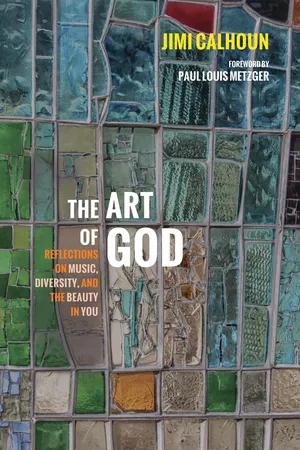
In The Art of God, pastor and musician Jimi Calhoun suggests that the master artist, God, programmed diversity into every aspect of the natural order. Today more of us than ever live in closer proximity to people once viewed as different. The multicultural conversation of the recent past has proven to be inadequate to address the present intercultural reality in which we live.
The question then becomes, how will we live together?
Quite often the presence of difference results in the avoidance of the other.
Many accept this as simply a natural occurrence, but in the world of art, difference does not always trigger division. Art encompasses multiple disciplines and forms. Art welcomes diversity within its borders.
This book traces the evolution of art and music, then extracts principles from a musical motif to encourage the development of an artistic worldview that recognizes the beauty residing in everything and everybody.
Information
1
Art and Culture
Picture that you and I have just exited a brand-new shiny black chauffeur-driven Rolls Royce limousine in the luxurious tourist destination of Monaco, Monte Carlo. We are dressed to the nines, but we remove our shoes and embark on a scenic stroll alongside a glistening white sandy beach. Our eyes take in the ornate buildings that adorn the mountainside to our left. The curve in the shoreline briefly draws our attention away from the exquisite hillside architecture and back to the bluish-green tint of the pristine sea. As we walk, the wind provides relief from the midday sun that is just beginning to raise the temperature. In fact, the weather is so pleasant that we decide to quicken our pace until our joyful skip had reached the level of a jog.
Were you able to follow that vignette? Were you able to get a feel for the action? If you just answered yes to those two questions, I would ask why. Allow me to answer my own question by putting forward a very unscientific theory. I believe that human beings think in images and pictures more so than in ideas and concepts. In the illustration above, written words evoke the images of pristine beaches and majestic buildings. When we listen to the lyrics of a song, they evoke pictures in our hearts and souls too. We do not simply “think” music; we think and feel it! When we read a gripping novel, or view a film that is done well, we do not just mentally absorb the story or plot. What we most likely do is enter into that story emotionally, allowing it to have a visceral effect in us, and tempering our own reasoned reaction to it. The phenomena I have just described could be called visual thought and visual sound. Art is one of the most powerful forces in our society. It is ubiquitous, and it wields an infinite amount of power and influence on most every person living today. Unlike the information we are able to access through modern technologies, art not only informs us, art forms-in us—it is able to influence a wide range of human emotions, beliefs, and attitudes as it re-forms us.
Let us pause here to establish a working definition for the word art. I acknowledge up front that a simple definition for a word that describes something so very subjective is tricky, but here it goes. Art is a vehicle used to express human thought and emotion via a plurality of forms. Merriam-Webster’s dictionary defines the noun pluralism the following ways: “The quality or state of being plural—A theory that reality is composed of a plurality of entities.”1 Webster’s defines the term in other ways as well, and we will come back to them later, but for now let us focus on just this one. It is the phrase “that reality is composed of” that is germane to our discussion because the phrase suggests that diversity is written into the DNA of all that exists. We need not look any further than art to discover evidence that my premise is on good footing. The arena of art includes music, poetry, sculpture, computer graphics, photography, baking, cooking, self-defense, creative writing, lowbrow street art such as pop surrealism, the more conventional type of art displayed in traditional galleries, as well as many other disciplines too numerous to list here. Art is diverse, and you can see that having a plurality of art options is actually a good thing. Most of us use and enjoy one or more of the art forms just listed.
Recently the word diversity has become more synonymous with engagement based on division (a negative) and less connected with pluralism, which is the acceptance of peaceful coexistence (a positive). Pluralism within the art world is what diversity should be to culture—an amalgam of different entities that produce coherence and compatibility. Allow me to suggest that the best way to view art is through the lens of this simple aphorism, “All is art, and art is all.” Every art form may not be equally enjoyed by all, but all art is equal. Where there is art, there is beauty. Art is variegated in structure and yet similar aesthetically—art proves that compatibility can be achieved where differences exists. For this reason the beauty resident in each one of you makes this even more incredible about the art of God.
The ideas and values expressed through art can teach us much if we are willing to view art as something more than simply entertainment. A cursory look at the history of art reveals that art has had a powerful effect on every culture throughout time. Common parlance might restrict the meaning of the word power to brute strength. The word power conjures up a picture of domination, force, or aggression. The power resident in art can occasionally be explosive, but it can also be gentle, even benevolent. An example of this can be found in a socially conscious song by U2 or in a poem lamenting the struggle of women worldwide. Art really does have a type of power all its own. It occupies a unique place in various cultures because its beauty has both intrinsic value and practical value. Art heals, it unites, it frees, it enlightens. Simply put, art has not only brought an incalculable amount of pleasure to billions of people; it has served a practical purpose by helping to shape who we are as human beings.
Socialization and Information
Let us take a look at some of the ways that art has been used in the Western world. According to a book titled Art: A World History, “art first manifested itself in Europe with the appearance of humans during the Upper Paleolithic Age (40,000—10,000 BCE) Motifs found in cave paintings and small sculptures from this time used the animal world for inspiration and are often interpreted as charms used to assist the hunt.”2 Immediately we see that art had a practical side in addition to adding beauty to its environment. Visual art told a story, and it also gave instruction on how to advance the number-one societal goal of the time: survival. This suggests that art added value to the lives of people, and it also recorded the story of those people that would survive thousands of years. It is worth noting that we would not know that our forebears organized themselves into communities and were hunter-gatherers if not for art. Allow me to push the envelope a little: If some communication systems did not yet exist (such as standardized spelling or vernacular speech), how did the people communicate with each other? Art! Art has been instrumental in the way that human beings have organized their societies throughout history, and that continues to be true to this day.
We will now take a brief pause from our historical journey in order to highlight one similarity between the prehistoric use of art and the way it is used in major cities all across America today. In many American cities new types of tribal communities have formed. Relative to art, the people within the tribe often interact with each other in a manner similar to the ways our ancestors did. These modern tribes are called street gangs. I realize that many view the American street gang as an undesirable subculture, but their use of art and symbol illustrates the continuing power of art. I do not want to debate what effect gangs have on our youth and the overall culture. I simply want us to see how visual art, in this case body art called the tattoo—is still functioning in much the same fashion as the visual art of times gone by. Visuals affect both what and how we think. I remember reading several years ago that a Greek philosopher named Aristotle said that a person never thinks without an image. That was not a direct quote, but today’s use of body art seems to bear out Aristotle’s basic theory.
A gang member in the U.S. will use ink to tattoo the body in order to express solidarity with that one group. The tattoo also enables the gang member to display his or her major achievements in order to improve social standing within the group. Gangs creatively use spray paint to place symbols called graffiti on buildings, freeway overpasses, and other surfaces, in much the same manner. Stone Age paintings were used all over Europe and North Africa by our ancestors. Graffiti, like the communication art form of wall painting from antiquity, is a crude and effective system designed to signal tribal unity and to warn adversaries to beware. My point is that art has always been used to communicate and record the cultural habits and history of every society. Art has also been utilized to broadcast the hardships and challenges of the people within societies, often having a unifying effect among the insiders. The graffiti on display in public spaces serve as a daily reminder of the harsh realities of life as viewed through the lens of a particular group. People in every society find it important to let others know that they lived and how they lived. Gang members want people outside the group to know their story too. Story is an extremely important method of transferring knowledge, both orally and visually, and there is no better way to tell a story than through art.
From Bridges to Basilicas
I was raised in the Protestant Christian tradition. There are many subsets within that tradition. In fact there are so many strands of Protestantism, each with their own unique expression of worship, that it can be difficult for people unfamiliar with the tradition to be able to view it as a loosely knit whole. As a younger person I knew very little about the Roman Catholic tradition. I knew that they did several things that were very different from the things we did in our church. The clergy dressed differently than ours, and there was a lot of ceremony with people executing certain body movements on cue. Their buildings were ornate in comparison to ours with lots of murals, statues, and figurines. And when I was a very young boy, some of the homilies at their services were in a strange language, Latin. However it is the statues, the stained-glass windows, and the other types of art on display in those churches that is of interest to our study of the history of art.
Many believe that cultures are formed when groups of people develop a common set of traditions, social norms, values, and customs. These things then become the ingredients that cultivate the worldview of the population. I would submit that it is also through the telling of stories that the attitudes, values, and the preferences of a group are cultivated, codified, and then passed down. The end result of this process is what we call culture. If you are a person that identifies with the Christian tradition, then the following observation may have extra meaning for you because we share a spiritual history with the Jewish people. It is nothing short of miraculous that the Jewish people have been able to maintain their cultural and spiritual integrity over thousands of years. They have accomplished this in spite of being geographically scattered, and despite suffering persecution at every stop along the way. How have the Jewish people maintained their cultural and spiritual integrity? Perhaps they have done so through the telling of their story, and then the retelling of their story, over and over again. It was through these stories that they were able to maintain their cultural identity regardless of the circumstance. Just as the Jewish people have passed their story along through oral and literary narratives, so the Roman Catholic Church has passed on its stories, theology, and devotion through art. Catholic Christians have used art to tell and retell “His Story,” meaning the story of Jesus Christ. The result is that the Roman Catholic Church has been able to thrive in different places, and to adapt to a wide variety of cultural settings, all while maintaining its identity.
Europe attained the status of being the global cultural leader riding on the trails forged by the military conquests of the Roman legion, which ironically also facilitated the rapid spread of Christianity. The Roman Catholic Church became the face of this bourgeoning new faith in the West, and it was almost single-handedly responsible for Christianity becoming a major player religiously and politically. If the Roman military was indeed responsible for the rapid spread of Christianity worldwide, art was equally responsible for educating the new converts, and making this new religious form attractive. From the time that Roman Emperor Constantine converted to Christianity during the early portion of the fourth century, through the period referred to as the Renaissance, which many say ended in the seventeenth century, Christian art ruled!
The book referenced earlier, Art: A World History, is an excellent resource because it offers several pictures from this time period depicting the story of Christ and the teaching of the church. Perhaps you have seen some of the art from that period without actually being aware of its history. Have you ever seen any paintings of golden-haloed angels flying around a person, presumably God, seated on a lavishly decorated throne in the sky? What about paintings that depict Jesus on a cross, speaking to his disciples or to his mother, Mary, while he endures the brutal process of crucifixion? Through paintings, murals, and sculptures of biblical figures and Christian saints, nonliterate people in Europe came to grow in faith and knowledge. Think with me: Hundreds of years elapse; thousands of people—maybe more—were educated, trained, and nurtured in the Christian faith simply as a result of this one medium, visual art. That is a powerful testimony to the effect that art actually has on the society in which it is placed.
Art Comes Off the Wall
In 1439 CE Johannes Gutenberg became the first European to use movable type, and he is widely credited with inventing the printing press. I am aware that there were other people that laid claim to the invention, but this is a book about art; it is only important to point out that people acquired the capability to print books at this time. With the rise of the printing press and increasing literacy that accompanied it, visual art on church walls lost its role as the primary tool for transmitting theology and telling the story of Christ. The printing press allowed priests and scholars in various parts of Eu...
Table of contents
- Title Page
- Foreword
- Acknowledgments
- Introduction
- Chapter 1: Art and Culture
- Chapter 2: What Is That Sound?
- Chapter 3: A Rocker’s Lot Is Not a Happy One
- Chapter 4: Do You Hear What I Hear?
- Chapter 5: Deliberate Diversity
- Chapter 6: Ordering Diversity
- Chapter 7: Jazz Is
- Chapter 8: Every Day I Have the Blues
- Chapter 9: Dotted Lines
- Chapter 10: The Art of Understanding
- Chapter 11: Roots and Culture
- Bibliography
Trusted by 375,005 students
Access to over 1.5 million titles for a fair monthly price.
Study more efficiently using our study tools.
Frequently asked questions
Yes, you can cancel anytime from the Subscription tab in your account settings on the Perlego website. Your subscription will stay active until the end of your current billing period. Learn how to cancel your subscription
No, books cannot be downloaded as external files, such as PDFs, for use outside of Perlego. However, you can download books within the Perlego app for offline reading on mobile or tablet. Learn how to download books offline
Perlego offers two plans: Essential and Complete
- Essential is ideal for learners and professionals who enjoy exploring a wide range of subjects. Access the Essential Library with 800,000+ trusted titles and best-sellers across business, personal growth, and the humanities. Includes unlimited reading time and Standard Read Aloud voice.
- Complete: Perfect for advanced learners and researchers needing full, unrestricted access. Unlock 1.5M+ books across hundreds of subjects, including academic and specialized titles. The Complete Plan also includes advanced features like Premium Read Aloud and Research Assistant.
We are an online textbook subscription service, where you can get access to an entire online library for less than the price of a single book per month. With over 1.5 million books across 990+ topics, we’ve got you covered! Learn about our mission
Look out for the read-aloud symbol on your next book to see if you can listen to it. The read-aloud tool reads text aloud for you, highlighting the text as it is being read. You can pause it, speed it up and slow it down. Learn more about Read Aloud
Yes! You can use the Perlego app on both iOS and Android devices to read anytime, anywhere — even offline. Perfect for commutes or when you’re on the go.
Please note we cannot support devices running on iOS 13 and Android 7 or earlier. Learn more about using the app
Please note we cannot support devices running on iOS 13 and Android 7 or earlier. Learn more about using the app
Yes, you can access The Art of God by Jimi Calhoun in PDF and/or ePUB format, as well as other popular books in Social Sciences & Christian Theology. We have over 1.5 million books available in our catalogue for you to explore.