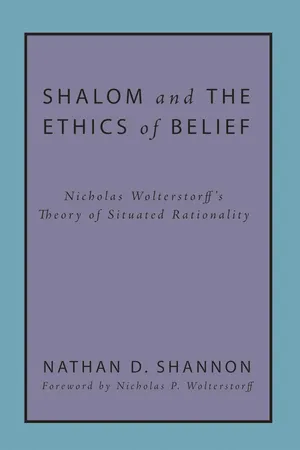
eBook - ePub
Shalom and the Ethics of Belief
Nicholas Wolterstorff’s Theory of Situated Rationality
- 216 pages
- English
- ePUB (mobile friendly)
- Available on iOS & Android
eBook - ePub
Shalom and the Ethics of Belief
Nicholas Wolterstorff’s Theory of Situated Rationality
About this book
Against the individualism and abstractionism of standard modern accounts of justification and epistemic merit, Wolterstorff incorporates the ethics of belief within the full scope of a person's socio-moral accountability, an accountability that ultimately flows from the teleology of the world as intended by its creator and from the inherent value of humans as bearers of the divine image. This study explores Nicholas Wolterstorff's theory of "situated rationality" from a theological point of view and argues that it is in fact a doxastic ethic based upon the theology of Wolterstorff's neo-Calvinist, Kuyperian background, which emerges in terms of his biblical ethic and eschatology of shalom. Situated rationality, the sum of Wolterstorff's decades-long work on epistemology and rationality is a shalom doxastic ethic--a Christian, common grace ethic of doxastic (even religious doxastic) pluralism.
Information
Topic
Teología y religiónSubtopic
Historia y teoría filosóficas1
Nicholas P. Wolterstorff, Christian Philosopher
The central concern of the present study is Nicholas Wolterstorff’s theory of situated rationality. In Wolterstorff’s view, the traditional focus on the justification of true beliefs displays Cartesian heritage in that its conceptions of the subject and the subject’s relation to its beliefs are treated as abstract and impersonal. Wolterstorff instead considers the subject within its full, individualized, social and moral context and argues that the chief epistemic merit—entitlement rather than justification—accrues to doxastic conduct that is morally defensible in a subject’s particular situation.
Beliefs are not justified abstractly. Rather, subjects are entitled to their beliefs (or their believings are entitled) in so far as they manage their doxastic affairs so as to meet the ethico-doxastic norms of their concrete situations as far as can be reasonably expected of them. Epistemic merit, therefore, is normative, and has to do principally with the subject’s proper doxastic conduct. This much is Cartesian. But for Wolterstorff the doxastic practices available to the subject and the relevant ethico-doxastic norms are situationally (rather than subjectively) constituted. Epistemic merit is normative but then also practical and situational.
In Wolterstorff’s view, furthermore, the availability of doxastic practices includes a situationally given, ethically significant assumption regarding the truth-conduciveness of such practices. Actual truth-conduciveness is not the principal factor in the ethico-doxastic significance for the subject of available doxastic practices; situationality is. So, as Wolterstorff claims, there are no specifically doxastic norms. Doxastic ethics are a refraction of the responsibilities and obligations bearing on a subject in terms of various relationships (to one’s self, to God, to others). Belief entitlement thus raises a rather expansive question of moral value and ethics, without an answer to which situated rationality drifts unsecured. The obvious candidate in Wolterstorff’s work for completing his theory of the ethics of belief is his notion of shalom. And so my thesis: Wolterstorff’s theory of situated rationality is a shalom doxastic ethic.
Our entry point is decidedly epistemological, but my thesis will require us to bring into view the relevant biblical, theological, ethical, and historical philosophical material. This being a daunting task, it will help to know something of Wolterstorff’s background and development. So we begin with a bit of intellectual biography.
1.1 Nicholas P. Wolterstorff, Christian Philosopher
In 2002, Nicholas P. Wolterstorff added “emeritus” to his title as Noah Porter Professor of Philosophical Theology at Yale University. The list of titles Wolterstorff has held throughout his career is long and prestigious. It includes Fulbright and National Endowment for the Humanities fellowships, a senior fellowship at the American Academy of the Arts and Sciences, and, most recently, a senior fellowship at the Institute for Advanced Studies in Culture at the University of Virginia. He has held endowed lectureships, among many others, at Oxford, the Free University of Amsterdam, Princeton, Yale, and St. Andrews, and teaching appointments at dozens of American universities. Wolterstorff has been awarded at least four honorary doctorates and has served as the president of the Society of Christian Philosophers and the American Philosophical Association’s Central Division. His publications include some two dozen books, over one hundred and fifty peer-reviewed articles, and countless short pieces on a wide range of current issues. In recent years, several volumes of Wolterstorff’s collected essays have been released, including one on epistemology, another on philosophical theology, another on justice and human dignity, and a fourth on liberal democracy, while the pace of production of new material remains steady.1
It is difficult to pinpoint Wolterstorff’s most influential, most significant, or most acclaimed publications or lectures. At least one reason for this is that he has made significant contributions in several different fields. The person interested in the arts would regard highly Wolterstorff’s Art in Action, a text just as fresh and insightful but more accessible than his Works and Worlds of Art.2 The philosophical theologian might argue that Wolterstorff’s writings on the doctrines of eternity and aseity, on theological predication, and on divine speech, cannot, in any fair assessment of Wolterstorff’s work, be overlooked.3 The philosopher or historian of philosophy would certainly find Wolterstorff’s work on Locke, including his John Locke and the Ethics of Belief and numerous articles, his work on Reid—again, a book, Thomas Reid and the Story of Epistemology, along with numerous shorter pieces—and indeed his incisive, critical writing on foundationalism, all deserving of mention.4 Wolterstorff has also been prolific on the topic of education, writing extensively on a Christian and specifically Calvinist view of public and higher education.5 He has written on political philosophy, engaging Robert Audi and Richard Rorty on the role of religion in public discourse,6 and his recent publication Justice: Rights and Wrongs offers a carefully researched account of the history of the concepts that constitute what Wolterstorff calls our “moral subculture,” including natural human rights and human dignity. And this is only a partial list.
Most crucial for the topic of this study is a connection I shall draw between two bodies of Wolterstorff’s work: one on rationality and another on the biblical notion of shalom. Exposition of Wolterstorff’s thought on these topics takes up much of the present work because together they constitute the proper framework for my thesis. The connection between them is, briefly, as follows.
For Wolterstorff, rationality has to do with the ethical significance of believing, and believing should be understood not as a stale, removed, purely intellectual disposition, but as a behavior embedded in a web of practices that are socially and culturally significant. Rationality addresses the moral significance of believing when believing is woven into the moral fabric of social living. And shalom, as we will see, is a grand, perhaps even eschatological, ethical vision, drawn from Christian sources, that conditions the full scope of human moral situationality and accountability.
This connection is essential to my thesis, but an additional benefit of clarifying the organic relation between Wolterstorff’s work in specifically these two areas is a glimpse into the structural unity of Wolterstorff’s thinking and writing as a whole. Over the course of my time producing the present study, I have come to understand Wolterstorff as a systematic and remarkably self-consistent thinker.7 I have also noted that many of his readers, who might benefit from one area of his work or another, show little appreciation for the substructure which unifies his diverse and varied work. A brief intellectual biographical sketch will help us begin to appreciate this, and begin even at this early stage to clarify my claim that there is an intimate connection between Wolterstorff’s theory of rationality and his notion of shalom.
Wolterstorff was born to Dutch immigrants during the Great Depression, in “a tiny farming village in the prairies of southwest Minnesota, Bigelow.”8 “We did not take means of sustenance for granted,” he recounts, “. . . my family was poor.”9 If they may have lacked materially, it seems the Wolterstorffs and their community were rich in tradition. Wolterstorff recounts in delightful detail the intense, resolute, even austere piety and the unshaken reverence for the Scriptures which permeated his childhood church and home.10 And he recalls with wonder and nostalgia the tough-minded and tough-spirited atmosphere of Bigelow and Edgerton, Minnesota.
It is equally remarkable that his early intellectual role models were almost to a person farmers and laborers as it is that their faith and tradition, looking back, thrived immune to, because either unaware of or uninterested in, the theological crises of modernity—critical threats to the trustworthiness of Scripture, scientific challenges to the theistic worldview, and so on. Years later, Wolterstorff would continue to reflect on the strangeness of simply claiming for oneself the right to ‘just talk about God.’11 Without a doubt, the Dutch Reformed tradition has been deeply formative in Wolterstorff’s thinking: “If you ask who I am, I reply: I am one who was bequeathed the Reformed tradition of Christianity.”12
Wolterstorff went on to undergraduate studies at Calvin College where he studied the intellectual legacy of both the Dutch Reformed tradition and of the wider Western world. At Calvin, Wolterstorff encountered a thriving Dutch neo-Calvinism.13 He also formed a few personal relationships there, such as a lasting friendship with Alvin Plantinga, that would become, over the years, considerable influences in the direction of his thought and career.
When reflecting on the intellectual forebears of Calvin College, Wolterstorff mentions Abraham Kuyper and Herman Dooyeweerd, in that order. What little Wolterstorff has written on Dooyeweerd has not been terribly appreciative; it might be fair to say that Wolterstorff will follow Dooyeweerd only as far as Dooyeweerd has followed Kuyper, but no further.14
Kuyper bequeathed to the North American Dutch Reformed world a sense of Christian Reformed identity which emphasized coordinately the integrity and totalism of Christian truth and life and the idea of the antithetical clash of religious (“regenerate” and “unregenerate”) presuppositions. A soteriological antithesis between the elect and non-elect, and the attendant antithesis between the cultural activity of the regenerate and the unregenerate—categories exhaustive of the human species—were determinative for Kuyper.15
By contrast, modern thought, Wolterstorff often explains, is captivated by the idea of an ultimate, platonic unity of humanity, accessible only by transcending (or perhaps by wishing away) the frailties and weaknesses of individuality and historical situatedness and arriving at the human being its...
Table of contents
- Title Page
- Foreword
- Acknowledgments
- 1. Nicholas P. Wolterstorff, Christian Philosopher
- 2. Situated Rationality and the Doxastic Self
- 3. Situated Rationality and Practices of Inquiry
- 4. The Comprehensive Ethic of Shalom
- 5. Theory and Praxis
- 6. A Shalom Doxastic Ethic and the Status of Christian Belief
- Bibliography
Trusted by 375,005 students
Access to over 1.5 million titles for a fair monthly price.
Study more efficiently using our study tools.
Frequently asked questions
Yes, you can cancel anytime from the Subscription tab in your account settings on the Perlego website. Your subscription will stay active until the end of your current billing period. Learn how to cancel your subscription
No, books cannot be downloaded as external files, such as PDFs, for use outside of Perlego. However, you can download books within the Perlego app for offline reading on mobile or tablet. Learn how to download books offline
Perlego offers two plans: Essential and Complete
- Essential is ideal for learners and professionals who enjoy exploring a wide range of subjects. Access the Essential Library with 800,000+ trusted titles and best-sellers across business, personal growth, and the humanities. Includes unlimited reading time and Standard Read Aloud voice.
- Complete: Perfect for advanced learners and researchers needing full, unrestricted access. Unlock 1.5M+ books across hundreds of subjects, including academic and specialized titles. The Complete Plan also includes advanced features like Premium Read Aloud and Research Assistant.
We are an online textbook subscription service, where you can get access to an entire online library for less than the price of a single book per month. With over 1.5 million books across 990+ topics, we’ve got you covered! Learn about our mission
Look out for the read-aloud symbol on your next book to see if you can listen to it. The read-aloud tool reads text aloud for you, highlighting the text as it is being read. You can pause it, speed it up and slow it down. Learn more about Read Aloud
Yes! You can use the Perlego app on both iOS and Android devices to read anytime, anywhere — even offline. Perfect for commutes or when you’re on the go.
Please note we cannot support devices running on iOS 13 and Android 7 or earlier. Learn more about using the app
Please note we cannot support devices running on iOS 13 and Android 7 or earlier. Learn more about using the app
Yes, you can access Shalom and the Ethics of Belief by Nathan D. Shannon in PDF and/or ePUB format, as well as other popular books in Teología y religión & Historia y teoría filosóficas. We have over 1.5 million books available in our catalogue for you to explore.