- 174 pages
- English
- ePUB (mobile friendly)
- Available on iOS & Android
eBook - ePub
About this book
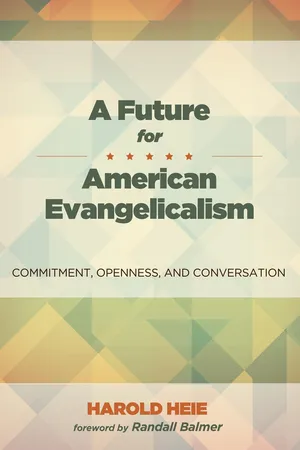
This book proposes that participation in "God's Project of Reconciliation" is the "Center" that can hold evangelical Christians together in the midst of great diversity in belief and ecclesiastical practices. The author envisions a vibrant future for the Evangelical movement if professing evangelicals can model that rare combination of deep commitment to their own beliefs; openness to listening to the beliefs of others; and willingness to engage in respectful conversation with those who disagree with them in place of the combativeness that has characterized too much of Evangelicalism in the recent past. The book models this type of conversation on such controversial issues as the exclusivity of Christianity, the inerrancy of the bible, Evangelicalism and morality, Evangelicalism and politics, scientific models on humanity, cosmic and human origins, and the future of evangelical higher education.
Information
Topic
Teologia e religioneSubtopic
Chiesa cristiana1
Introduction
American Evangelicalism and the Broader Christian Tradition
Diversity as a Hallmark of American Evangelicalism as a Movement
Evangelicalism is a worldwide movement, with some of its most robust streams presently flourishing in the global South. My project is limited to consideration of the evangelical movement in America.
Even within the American context, many of our contributors join the chorus of Christian scholars who note the difficulty, if not impossibility, of unambiguously defining “evangelical” or Evangelicalism.1 Amos Yong observes that “the question of What is Evangelicalism? rages on,” while Vincent Bacote suggests, “‘evangelical,’ like ‘postmodern,’ can mean both everything and nothing.” Corwin Smidt says that “it is not self-evident just to what one is referring when the terms ‘evangelical’ or ‘Evangelicalism’ are used.” John Wilson asserts that “we find in the history of Evangelicalism no single stance or attitude that can be called definitive for this particular stream of the faith.” Likewise, Peter Enns says that “defining ‘Evangelicalism’ in America is like trying to hit a moving target,” suggesting that when we try “to capture the essence of what Evangelicalism means,” we “often work off of impressions based on our own experiences.”
This ambiguity is not surprising, given the multiple roots of those who situate themselves as evangelicals, including those who trace their beliefs to the tenets of the Protestant Reformation; those who trace their expression of the Christian faith back to the revivalist movements in eighteenth-century America; those who, like me, are the descendants of Pietist immigrants to America from Scandinavia and Germany; those who associate Evangelicalism with particular institutions or leaders; those who trace their evangelical lineage to the fundamentalist movement that was a reaction to Protestant Liberalism and Modernism; and those who associate with the neo-evangelical movement that was a reaction to fundamentalism.
Consistent with these diverse streams, a number of our contributors suggest that Evangelicalism should be considered to be a “movement” that transcends particular Christian traditions or denominations. For example, as John Franke explains:
I have always had the sense that Evangelicalism is more like a particular movement within the larger history of the Church and the churches, rather than something more central. I have never understood the evangelical tradition as something distinct from other traditions but rather as a general movement within various traditions. So we see Presbyterians, Lutherans, Episcopalians, Anabaptists, Baptists, Pentecostals, etc., who also identify as evangelicals.
Viewing Evangelicalism as a movement in this way leads Franke to point us to the “diversity” in evangelical belief and practice: Evangelicalism is “a movement that crosses theological, denominational, confessional, and ideological boundaries. In so doing, it manifests diversity that has been an inherent part of the North American evangelical movement since its beginnings.”
Kyle Roberts also notes the “perplexingly variegated concoction of Christians” who are evangelicals, and he attributes this diversity to “the renewal and reformist impulses of the various evangelical streams,” which he notes with approval, saying that he resonates “in particular with Amos Yong and John Franke when they emphasize [these] . . . impulses” in their postings.
Consistent with the diversity in Evangelicalism pointed to by John Franke, Kyle Roberts suggests that “perhaps it’s time we think of ‘evangelical’ as an adjective—a qualifier nuancing a more central identity: Christian or Christ Follower.”
Echoing Peter Enns’ suggestion that when someone tries to capture the essence of what Evangelicalism means, he or she often works off of impressions based on personal experiences, Jeannine Brown observes that a “theme that emerged in the [electronic] conversation is that of social and theological location,” adding that “if Evangelicalism is a located stream within the Christian tradition, then an important invitation involves acknowledging that location with the broader Christian tradition.” Brown concludes that such acknowledgement of the “locatedness” of our expression of evangelical Christian faith could be the basis for a helpful dose of humility.
Responses to the Diversity within Evangelicalism
If we acknowledge the diversity within Evangelicalism, it is equally clear that evangelicals disagree on how to respond to that diversity. Some seek to eliminate Evangelicalism’s diversity, while others embrace it.
John Franke notes the tendency of many evangelicals to seek to eliminate diversity in evangelical belief and practice:
While the evangelical movement has been characterized by a rich ecumenical diversity, this does not mean that evangelicals are comfortable with this plurality. For the most part they are not. Instead, they tend to be committed to establishing the one true faith over against other versions. They pursue the one true way to be a Christian, the one right way to read the Bible, the one true system of doctrine, the one right set of practices.
This aversion to diversity on the part of some evangelicals has had two interrelated results. It has led to an attempt to establish “limits” or to tightly define “boundaries” beyond which a given belief or practice is unacceptable for an evangelical. This suggests a “policing” role. Kyle Roberts asserts that what has “empowered” that policing tendency is the “false narrative of a single ‘Evangelicalism,’” adding that greater appreciation for the Pietist and Pentecostal streams could “disabuse people” of this false narrative, possibly leading to “a better shot at shaking free of the police,” which we will discuss at length later.
Of course, the debate as to what these boundaries are is messy at best, leading to the second result of an aversion to diversity, as stated by Franke: “In their collective search [for the one true set of beliefs and practices] different groups have come up with alternative and competing conclusions. This has spawned a seemingly endless series of contentious and ill-tempered debates concerning theology, hermeneutics, ethics, and church practices.”
The sad result, according to Franke, is conflict and divisiveness within Evangelicalism. As he explains, “These conflicts have produced a divisive and contentious spirit among many evangelicals that has significantly compromised our witness to the gospel.”
Vincent Bacote does not paint so dire a picture of present-day Evangelicalism. He acknowledges the diversity, but he perceives a certain respect among those who hold to different beliefs and practices: “Part of the strength of Evangelicalism is the fact that it is a conservative Christian ecumenical movement that brings together a wide range of denominations while respecting (sometimes) differences in doctrinal emphasis and ecclesial practice.”2
Whatever level of divisiveness we perceive within present-day Evangelicalism caused by such an aversion to diversity, Franke points us to another possible response to that diversity. It is something to be embraced as “the blessing and intention of God.” He elaborates:
The diversity of biblical, theological, and confessional perspectives in Evangelicalism and the broader Christian tradition are a necessary and appropriate manifestation of the church. This is because no single linguistic context or interpretive community is able to bear fully adequate witness to the truth of the living God.
I personally embrace Franke’s view of the diversity within Evangelicalism as a gift from God, based on my own experience. In over-simplified terms, my in-depth immersion in three different streams of Evangelicalism has taught me to respect the unique emphases of each stream as capturing a portion—but not the entirety—of what Franke calls “the truth of the living God.” In my Pietistic Lutheran upbringing, I learned to value deeply-felt religious experience. Within the Reformed tradition, I learned to value the life of the mind. Within the Anabaptist tradition, I learned the importance of living out what you say you believe and feel. Yet I also saw firsthand some extreme attempts to marginalize those outside the given stream—falsely equating Pietism with mindless emotionalism, or the Reformed tradition with arid intellectualism, or the Anabaptist tradition with uninformed activism. Such extreme views fail to realize that all of these expressions of the Christian faith make an important contribution to a comprehensive understanding of what it means to be a “whole Christian person,” giving expression to the cognitive, affective, and volitional dimensions of personhood.
My enthusiasm in embracing Evangelicalism’s diversity as a gift from God is foundational to the message of this book. It is because I believe that those believers embedded in different streams of Evangelicalism have much to contribute to a full understanding of the Christian faith that I want each evangelical to express his or her commitments with clarity and deep conviction. At the same time, I want each evangelical to stay open to respectfully listening to and talking with those evangelicals who hold to differing beliefs and practices—the goal being that by learning from the best of each stream of Evangelicalism, we can gain a better understanding of the Truth as only God fully knows it.
The Policing Tendency from Both Ends of the Spectrum
Before I propose a strategy to facilitate respectful conversation among those embedded in different streams of Evangelicalism who, like me, wish to maximize the potential of the gift of diversity, I will say just a few words about the legitimate concerns of those evangelicals who worry about the diversity of evangelical belief, whether from the “right” or from the “left,” and who, therefore, want to tightly define and police the boundaries of acceptable evangelical belief and practice.
There are some developments in theology that are of great concern to many traditional evangelicals. These include current debates about the historicity of Adam and Eve and related issues concerning origins, theories of atonement that call into question the traditional evangelical view of the “substitutionary sacrifice of Jesus Christ,” and debates about the “modern study of Scripture,” the exclusivity of Christianity...
Table of contents
- Title Page
- Foreword
- Preface
- Acknowledgments
- 1. Introduction
- 2. Continuing the Conversation
- 3. Evangelicalism and the Exclusivity of Christianity
- 4. Evangelicalism and the Modern Study of Scripture
- 5. Evangelicalism and Morality
- 6. Evangelicalism and Politics
- 7. Evangelicalism and Scientific Models of Humanity and Cosmic and Human Origins
- 8. Evangelicalism and Higher Education
- 9. The Future of American Evangelicalism
- Bibliography
- Contributors
Trusted by 375,005 students
Access to over 1.5 million titles for a fair monthly price.
Study more efficiently using our study tools.
Frequently asked questions
Yes, you can cancel anytime from the Subscription tab in your account settings on the Perlego website. Your subscription will stay active until the end of your current billing period. Learn how to cancel your subscription
No, books cannot be downloaded as external files, such as PDFs, for use outside of Perlego. However, you can download books within the Perlego app for offline reading on mobile or tablet. Learn how to download books offline
Perlego offers two plans: Essential and Complete
- Essential is ideal for learners and professionals who enjoy exploring a wide range of subjects. Access the Essential Library with 800,000+ trusted titles and best-sellers across business, personal growth, and the humanities. Includes unlimited reading time and Standard Read Aloud voice.
- Complete: Perfect for advanced learners and researchers needing full, unrestricted access. Unlock 1.5M+ books across hundreds of subjects, including academic and specialized titles. The Complete Plan also includes advanced features like Premium Read Aloud and Research Assistant.
We are an online textbook subscription service, where you can get access to an entire online library for less than the price of a single book per month. With over 1.5 million books across 990+ topics, we’ve got you covered! Learn about our mission
Look out for the read-aloud symbol on your next book to see if you can listen to it. The read-aloud tool reads text aloud for you, highlighting the text as it is being read. You can pause it, speed it up and slow it down. Learn more about Read Aloud
Yes! You can use the Perlego app on both iOS and Android devices to read anytime, anywhere — even offline. Perfect for commutes or when you’re on the go.
Please note we cannot support devices running on iOS 13 and Android 7 or earlier. Learn more about using the app
Please note we cannot support devices running on iOS 13 and Android 7 or earlier. Learn more about using the app
Yes, you can access A Future for American Evangelicalism by Harold Heie in PDF and/or ePUB format, as well as other popular books in Teologia e religione & Chiesa cristiana. We have over 1.5 million books available in our catalogue for you to explore.