eBook - ePub
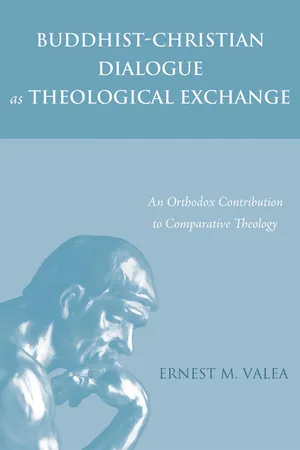
Buddhist-Christian Dialogue as Theological Exchange
An Orthodox Contribution to Comparative Theology
- 262 pages
- English
- ePUB (mobile friendly)
- Available on iOS & Android
eBook - ePub
Buddhist-Christian Dialogue as Theological Exchange
An Orthodox Contribution to Comparative Theology
About this book
This book is intended to encourage the use of comparative theology in contemporary Buddhist-Christian dialogue as a new approach that would truly respect each religious tradition's uniqueness and make dialogue beneficial for all participants interested in a real theological exchange.
As a result of the impasse reached by the current theologies of religions (exclusivism, inclusivism, and pluralism) in formulating a constructive approach in dialogue, this volume assesses the thought of the founding fathers of an academic Buddhist-Christian dialogue in search of clues that would encourage a comparativist approach. These founding fathers are considered to be three important representatives of the Kyoto School--Kitaro Nishida, Keiji Nishitani, and Masao Abe--and John Cobb, an American process theologian.
The guiding line for assessing their views of dialogue is the concept of human perfection, as it is expressed by the original traditions in Mahayana Buddhism and Orthodox Christianity. Following Abe's methodology in dialogue, an Orthodox contribution to comparative theology proposes a reciprocal enrichment of traditions, not by syncretistic means, but by providing a better understanding and even correction of one's own tradition when considering it in the light of the other, while using internal resources for making the necessary corrections.
Information
Topic
Theology & ReligionSubtopic
BuddhismPart 1
Contemporary Buddhist-Christian Dialogue and the Issue of Doctrinal Presuppositions
1
Buddhist-Christian Dialogue in the Context of the Three Classic Theologies of Religions—Exclusivism, Inclusivism and Pluralism—and Comparative Theology as a New Approach in Interfaith Dialogue
Both the Buddha and the Christ sent their disciples to proclaim their message to the ends of the earth.1 Does this mean that Buddhists and Christians should use dialogue as a means for converting the other to their own views? Seeking the best for one’s neighbour as Christian salvation or Buddhist enlightenment is understandable as motivation for those who seek to convert the other, but it is not what defines dialogue. In general terms, a real dialogue involves two sides in search of common ground, mutual understanding and peace. In my specific approach of dialogue as theological exchange, I follow James Heisig’s definition of dialogue, as it would apply in matters of doctrinal views in Buddhist and Christian traditions, as meaning “arguing, discussing, criticizing, and making up one’s own mind in words read and heard, spoken and written.”2 We can discern three well-defined stands currently expressed in Buddhist-Christian dialogue: exclusivism, inclusivism and pluralism.3 Fredericks defines them as attempts “to understand the theological meaning of the diversity of religions in keeping with the doctrinal requirements of a home tradition.”4 As such, these three categories are theologies of religions, for they follow a soteriological interest and try to answer the question of how can those of other religious traditions be saved?
1. Exclusivists hold that salvation or liberation can be attained only by following one’s own religious tradition. Christian exclusivists see Buddhists as lost and in need of conversion as the only means of avoiding eternal damnation, while Buddhist exclusivists see Christians as lost in ignorance and in need of converting to Buddhism to find enlightenment, as the only way to escape from the maelstrom of rebirth.
2. Inclusivists are more moderate with regard to the other traditions. They acknowledge a salvific or liberating truth in the other tradition, but only as an inferior path to one’s own. Christian inclusivists see salvation for Buddhists as mediated by Christ as the Logos at work in all humans. Buddhist inclusivists see Christ as one of the many bodhisattvas, who used skilful means for the Jews living in Palestine in the first century AD and for many others who did not come to know the path opened by the Buddha. Although salvation or liberation is possible for people of other faiths, it is nevertheless seen as an exception to the general rule.
3. Pluralists hold that Buddhism and Christianity are both valid as means for attaining salvation or liberation, for neither is superior to the other. Eventually both Christians and Buddhists will reach their expected destinations or even one situated beyond what they currently expect.
These short definitions do not reveal the complexities of each of the three typologies. In the following sections I will briefly summarize the thought of several important participants in Buddhist-Christian dialogue and assess the strengths and weaknesses of exclusivism, inclusivism and pluralism. I will focus as much as possible on Buddhist and Christian authors who have actually engaged in interfaith dialogue and avoid others who do not have a “hands on” approach to it. An exception to this course of action will be the next section, on exclusivism, for its proponents usually have little contact with the other traditions.
1.1 Exclusivism in Buddhist-Christian Encounter
Perry Schmidt-Leukel defines exclusivism as the belief that “salvific knowledge of a transcendent reality is mediated by only one religion.”5 All that is needed for salvation or liberation is already there in the tradition itself, and only there, so that any “help” from outside would only corrupt one’s way to achieving it. Of the four forms of dialogue mentioned by Dialogue and Proclamation, mainly the first two forms (of life and of action) are open for exclusivists.6 When exclusivists engage in a dialogue of theological exchange, interfaith dialogue can become a means for seeking the conversion of those of other traditions. This is not a negligible aspect. Barnes comments on the enthusiasm for dialogue today, saying that it “does give the impression that it is simply another tool” or “a more subtle way” for proselytising.7 Although this is a charge brought mainly to Christians, we will see that it applies equally to some Buddhists engaged in interfaith encounter.
Christian exclusivism is linked to the traditions in which no revelation at all is granted to other religions and, as a result, the human being is seen as totally incapable of relating to God. Unlike in Orthodox and Catholic Christianity, which hold that the image given to humans at creation is not completely destroyed by sin, Protestant theology holds that the fall has led to the total corruption of the human being. One of the strong voices of Protestant Christian exclusivism is Karl Barth. His rejection of other faiths as leading to salvation is based on a strong belief in God’s sovereignty to reveal himself, and in seeing the act of the creation of the world and of humankind as an act of his absolute free will.8 Since human beings are sinful and totally incapable of saving themselves by means of their own wisdom and strength, it is only God who can grant them salvation and only through Jesus Christ.9 As a result, all religions should be seen as mere human creations aimed at justifying us before God, and religion per se is deemed as “unbelief,”10 for it attempts to replace the divine revelation in Jesus Christ with “a human manufacture.”11 In Barth’s theological vision it would be meaningless to search for contact points with other religions, as any such attempt would only minimize the revelation we already have in Jesus Christ, God’s special revelation in human history.12
Although Barth seems to adopt a more universalistic approach to world religions in the later volumes of his Church Dogmatics,13 a universal redemption is seen as potential, and as such must be taken up personally by humans, Christians and non-Christians alike. Barth does not support a Spirit-centred...
Table of contents
- Title Page
- Acknowledgments
- Introduction
- Part 1: Contemporary Buddhist-Christian Dialogue and the Issue of Doctrinal Presuppositions
- Part 2: A Critical Assessment of the Founding Fathers of Contemporary Buddhist-Christian Dialogue as a Lead towards Comparative Theology
- Conclusion
- Bibliography
Trusted by 375,005 students
Access to over 1.5 million titles for a fair monthly price.
Study more efficiently using our study tools.
Frequently asked questions
Yes, you can cancel anytime from the Subscription tab in your account settings on the Perlego website. Your subscription will stay active until the end of your current billing period. Learn how to cancel your subscription
No, books cannot be downloaded as external files, such as PDFs, for use outside of Perlego. However, you can download books within the Perlego app for offline reading on mobile or tablet. Learn how to download books offline
Perlego offers two plans: Essential and Complete
- Essential is ideal for learners and professionals who enjoy exploring a wide range of subjects. Access the Essential Library with 800,000+ trusted titles and best-sellers across business, personal growth, and the humanities. Includes unlimited reading time and Standard Read Aloud voice.
- Complete: Perfect for advanced learners and researchers needing full, unrestricted access. Unlock 1.5M+ books across hundreds of subjects, including academic and specialized titles. The Complete Plan also includes advanced features like Premium Read Aloud and Research Assistant.
We are an online textbook subscription service, where you can get access to an entire online library for less than the price of a single book per month. With over 1.5 million books across 990+ topics, we’ve got you covered! Learn about our mission
Look out for the read-aloud symbol on your next book to see if you can listen to it. The read-aloud tool reads text aloud for you, highlighting the text as it is being read. You can pause it, speed it up and slow it down. Learn more about Read Aloud
Yes! You can use the Perlego app on both iOS and Android devices to read anytime, anywhere — even offline. Perfect for commutes or when you’re on the go.
Please note we cannot support devices running on iOS 13 and Android 7 or earlier. Learn more about using the app
Please note we cannot support devices running on iOS 13 and Android 7 or earlier. Learn more about using the app
Yes, you can access Buddhist-Christian Dialogue as Theological Exchange by Ernest M. Valea in PDF and/or ePUB format, as well as other popular books in Theology & Religion & Buddhism. We have over 1.5 million books available in our catalogue for you to explore.