- 520 pages
- English
- ePUB (mobile friendly)
- Available on iOS & Android
eBook - ePub
About this book
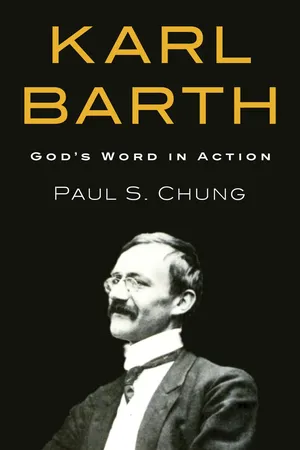
In this creative and original book, Paul S. Chung interprets Karl Barth as a theologian of divine action. Chung appreciates Barth's dogmatic theology as both contextual and irregular, and he retrieves the neglected sides of Barth's thought with respect to political radicalism, Israel, natural theology, and religious pluralism.
Information
Topic
Theology & ReligionSubtopic
Christian Theologyone Karl Barth’s Theology and Socialism in Safenwil: 1910–1918
Karl Barth’s Intellectual Background: A Biographical Sketch
Karl Barth was born in Basel, Switzerland, on May 10, 1886, where he also died on December 9, in 1968. In 1904 the young Barth began study at the University of Berne “with my father’s kind but earnest guidance and advice.” “What I owe to those Berne masters, despite everything, is that they taught me to forget any fears I might have had. They gave me such a thorough foundation in the earlier form of the “historical-critical school that the remarks of their later successors could no longer get under my skin or even touch my heart—they only got on my nerves.”1
In the winter of 1906 (on January 20) Barth delivered a lecture on “Zofingia and the Social Question.” Referring to Leonhard Ragaz, a staunch representative of Swiss religious socialism, Barth considered the social question to be “one link in the chain of development, or better the problem of mankind, which Jesus once posed to the ancient world.” By stopping a “robust gathering round the colours, whose essential national (!) task consists in handing down ‘honorable ancient student customs’ to posterity in as intact a form as possible,” Zofingia should become an association “filled with a new spirit, with the spirit of social responsibility towards the lower strata of society and above all towards ourselves.”2
As Barth argues, “We have to agree that the rift between Capital and Labour, Mammonism and pauperism, rich and poor . . . grows continually larger.”3 Although little social analysis is found here, Barth was aware of political realities as a task of Christian responsibility on the question of social class. After preliminary examination in Berne, and following his father’s advice, Barth went to Berlin, although he wanted to go Marburg. In time, Barth was enthusiastic about going up to Marburg, which he described as “my Zion.”4
By the early 1890s the theology of Albert Ritschl exercised a dominant influence upon the theological faculties in Germany. Members of Ritschl’s school included scholars such as Wilhelm Herrmann, Adolf von Harnack, Ferdinand Kattenbusch, Johannes Gottschick, Julius Kaftan, Friedrich Loofs, Theodore Haering, and Martin Rade. Die christliche Welt, the representative journal of the day, powerfully represented the view of the Ritschlian school. Although Ritschl was in conflict with Lutheran orthodoxy during this time, Ritschl found Luther himself to be a great figure to use in combat against Lutherans. It was Ritschl who paved the way for new Luther research in the early twentieth century in pupils such as Karl Holl. Moreover, he represented new historical work and exercised a strong impact upon church historians such as Harnack in view of the history of dogma and Ernst Troeltsch in the study of Christian social ethics.
According to Ritschl, Christianity finds its basis in historical study rather than in immediate religious experience. All theological assertions should be based on the historical life of Jesus; in fact his personal relationship with God, his obedience and trust, and his ethical vocation and fellowship with humankind are personal vehicles of God’s self-revelation. Justification and sanctification are the constructive principles underlying Christian doctrine. From the standpoint in which reconciliation involves an ethical commitment to the kingdom of God, the idea of the unio mystica has no place at all. Thus, the new relationship with God in reconciliation originates in the community of faith directed toward the kingdom of God.
Finally, the idea of the kingdom of God achieves the needed reconciliation between Christianity and culture. Lebensführung (i.e., a religious, ethical lifestyle) becomes a main focus for Ritschl in dramatizing justification, sanctification, and the kingdom of God.5
Seeing the kingdom realized through Christian vocation in the world, Ritschl moves to identify even Christian morality with the cultural consciousness of his day in Germany. As a theologian of culture, Ritschl has been often accused of becoming a strong representative of “Culture Protestantism,” a form of Christendom baptized by bourgeois Prussian society. Cultural Protestantism held that the ethical demands of Jesus and cultural values are in harmony; in cultural Protestantism the true ideal of life led to no potential conflict with social or cultural structures. While uncritical of the political social system in Prussia, Ritschl saw Bismarck’s policies as genuine progress, in contradistintion to the aristocratic conservatives and the social revolutionists.
Theologically, as a student of Herrmann, Barth was critical of Ritschl.6 According to Barth, Ritschl’s ideal of the Christian life is regarded as “the very epitome of the national-liberal German bourgeois of the age of Bismarck.”7 In the mid-1890s, Troeltsch had initiated and led the Religionsgeschichtliche Schule (history of religions school), focusing on a historical-critical basis that challenged dogmatic assumptions. The belief in the absoluteness of Christianity, which was based on a supernatural conception of revelation and thus at the heart of Ritschlism, became deeply questionable and was challenged by the historical-critical method of Troeltsch. In 1897 a split emerged between the older, dogmatically oriented school of Ritschlians and the younger, historical-critically oriented school of Religionsgeschichte.
In editing Die Christliche Welt Martin Rade supported younger radical members by accepting their contributions as part of the history of religions school. At the start of the twentieth century, Troeltsch emerged as the most important figure, exercising profound influence upon the theological situation in Germany. However, it was Herrmann, with his engaging style, who became the counterpart of Troeltsch, helping Barth to overcome relativism and historicism in theology.8 As a student of Herrmann at Marburg, Barth stated: “The name of Troeltsch, then at the heart of our discussions, signified the limit beyond which I thought I must refuse to follow the dominant theology of the age. In all else I was its resolute disciple”9
Karl Barth in Berlin
Characterizing the intellectual surroundings of Barth as a student in Germany was his pursuit and penetration of the poles between Ritschl and Troeltsch. Barth became a student with a high regard for Harnack in Berlin. He had little concern about Reinhold Seeberg. Instead of indulging in cultural life in Berlin, Barth saw and heard Harnack very thoroughly. “I . . . wisely avoided Seeberg, foolishly, alas, took no notice of Holl; and instead went enthusiastically to listen to Harnack (and equally keenly to hear Kaftan and Gunkel).”10 Harnack’s great lecture on the history of dogma touched Barth’s heart. According to his recollection, he heard Harnack’s argument directly in the classroom that “the dogma of the early period was a self-expression of the Greek spirit in the sphere of the gospel.”11 In Berlin, furthermore, Barth became preoccupied with the Ethics of Herrmann (1846–1922). Reflecting on this experience, Barth stated, “Herrmann was the theological teacher of my student years. The day twenty years ago in Berlin when I first read his Ethik [Ethics] I remember as if it were today. If I had the temperament of Klaus Harms, I could speak of Herrmann in the way he spoke of Schleiermacher, or I could say as Stilling did of Herder. ‘From this book I received the push into perpetual motion.’ With more restraint, but with no less gratitude, I can say that on that day I believe my own deep interest in theology began.”12
In addition to Immanuel Kant, Schleiermacher became the leading light for Barth during his student time in Berlin. Along with Herrmann’s Ethics, Barth purchased a copy of Schleiermacher’s Speeches on Religion to its Cultured Despisers. In the winter semester of 1906–1907 in Berlin Barth was interested in socialism. Incidentally, he participated in a series of lectures by Walter Simons on “Christianity and the Social Question.” According to Marquardt, Karl Vorländer’s book The New Kantian Movement in Socialism (Die neukantische Bewegung im Sozialismus) is located in Barth’s book shelf with the inscription: “Karl Barth. Cand. theol. Berlin WS 1906/07.”13 Barth would have read it during his time at Berlin. In addition, in 1906 W...
Table of contents
- Title Page
- Foreword
- Acknowledgements
- Introduction: Karl Barth in the Context of Competing Interpretations
- Abbreviations
- Chapter 1: Karl Barth’s Theology and Socialism in Safenwil: 1910–1918
- Chapter 2: Karl Barth and the First Edition of Romans (1919)
- Chapter 3: Karl Barth between Hope and Disillusionment: The Tambach Lecture of 1919
- Chapter 4: Karl Barth and the Second Edition of Romans (1922)
- Chapter 5: Karl Barth: Between the Times in Germany
- Chapter 6: Karl Barth and Theologia Naturalis
- Chapter 7: Martin Luther in the Theology of Karl Barth
- Chapter 8: Karl Barth as a Theologian Who Discovers Judaism for Christian Theology
- Chapter 9: The Liberative Dimensions in Barth’s Theology
- Conclusion: Karl Barth and an Unfinished Project for Religious Pluralism
- Bibliography
Trusted by 375,005 students
Access to over 1.5 million titles for a fair monthly price.
Study more efficiently using our study tools.
Frequently asked questions
Yes, you can cancel anytime from the Subscription tab in your account settings on the Perlego website. Your subscription will stay active until the end of your current billing period. Learn how to cancel your subscription
No, books cannot be downloaded as external files, such as PDFs, for use outside of Perlego. However, you can download books within the Perlego app for offline reading on mobile or tablet. Learn how to download books offline
Perlego offers two plans: Essential and Complete
- Essential is ideal for learners and professionals who enjoy exploring a wide range of subjects. Access the Essential Library with 800,000+ trusted titles and best-sellers across business, personal growth, and the humanities. Includes unlimited reading time and Standard Read Aloud voice.
- Complete: Perfect for advanced learners and researchers needing full, unrestricted access. Unlock 1.5M+ books across hundreds of subjects, including academic and specialized titles. The Complete Plan also includes advanced features like Premium Read Aloud and Research Assistant.
We are an online textbook subscription service, where you can get access to an entire online library for less than the price of a single book per month. With over 1.5 million books across 990+ topics, we’ve got you covered! Learn about our mission
Look out for the read-aloud symbol on your next book to see if you can listen to it. The read-aloud tool reads text aloud for you, highlighting the text as it is being read. You can pause it, speed it up and slow it down. Learn more about Read Aloud
Yes! You can use the Perlego app on both iOS and Android devices to read anytime, anywhere — even offline. Perfect for commutes or when you’re on the go.
Please note we cannot support devices running on iOS 13 and Android 7 or earlier. Learn more about using the app
Please note we cannot support devices running on iOS 13 and Android 7 or earlier. Learn more about using the app
Yes, you can access Karl Barth by Paul S. Chung in PDF and/or ePUB format, as well as other popular books in Theology & Religion & Christian Theology. We have over 1.5 million books available in our catalogue for you to explore.