eBook - ePub
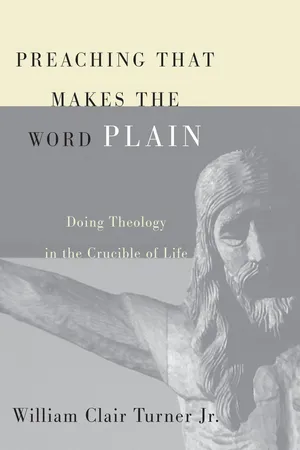
Preaching That Makes the Word Plain
Doing Theology in the Crucible of Life
- 130 pages
- English
- ePUB (mobile friendly)
- Available on iOS & Android
eBook - ePub
About this book
This work includes essays in preaching method and a series of sermons on Romans 10, a mini-treatise on preaching. It reflects on the tasks of preaching and teaching preaching as a form of communication that is critical to the life of the church. Despite the numerous existing volumes, useful texts are still needed. The quest is for methods of preparation that can be applied with consistency, and that suggest habits for labor, which can be tedious or cause tasteless outcomes.
The volume is intended as a contribution to replenishing voices that already have spoken ably and eloquently. It is located in the praxis of one who preaches with weekly regularity, while at the same time teaching homiletics. It aims at absorbing and synthesizing proven methods, while relating them to a generation that lives in the tensions of faithfulness to the gospel of Jesus Christ, the decline of a Christian consensus in the culture, the rise of secularism, and competition from other religions. Added to that is the challenge of vying for space in the public sphere with countless social prophets, such as talk show hosts, radio commentators, screen writers, and entertainers with various agendas.
What one finds in the following pages is a venture of service to the newly called, the fledgling preachers, the veterans, as well as those who teach. It dares to challenge proverbs like, "It is better caught than taught," or "Those who know don't tell, and those who tell don't know." It risks a word in an attempt to speak reflectively about a task that is daunting to the novice and as near to a veteran as a second skin. It is a brazen attempt to step out of "comfortable skin" to tell another how it feels from the inside. It hazards a gesture to say how to do the work with confidence without becoming arrogant.
How do you scratch the pad or go to a blank computer screen from week to week? By what means does one glean and give a fresh word before the exhaustion of delivering the last word has abated? Web sites that supply sermons are in the public domain and can easily be discovered. The challenge for those who mount the pulpit from week to week does not relent.
The labor reflected in these pages is born of the bias that all preaching can be improved with study, reflection, and critical assistance.
Information
Topic
Theology & ReligionSubtopic
Christian Ministrypart i
Conceiving the Task
one preaching that makes the word plain
The essential nature of Christian preaching cannot be overstated, no matter how many times the articulation is made. It is God’s appointed means to proclaim redemption for the world. It has pleased God through the foolishness of preaching to save those who believe. Faith comes by hearing the word of God, but for there to be hearing, there must be a preacher. By preaching the church has lived; by preaching she is revived. Though archaic in form, no adequate replacement has been found. By now those who would embark upon such a quest should well be weary of their failed effort.
Concerns for understanding, clarity, relevance, and concreteness sound all but tautological in the matter of preaching. It is God’s address to particular human creatures, at a particular time, and under particular circumstances. This is not to say that no factors pertaining to preaching are timeless, or that one generation cannot benefit from the truth deposited in a preceding one. But it is given with the very nature of preaching that it be contemporary, relevant, and pointed accurately at the environment in which it is uttered.
Preaching makes Christ present among the people. The ether in which it thrives is the life of worship within a doxological and obedient community. It is given power by the very breath of God. It is spoken into huddled and fearful masses; it calls men and women from their idols; it encourages the faith of those who have believed; it witnesses to the work of the Father and the completion of all things in the Son that the creation may be a habitation of God in the Spirit. Indeed, one would do well to question an utterance offered as preaching if it is not fresh, relevant, and understood.
Preaching Is to Be Understood
The notion of Preaching to be Understood is probably not articulated better than in a book by James Cleland that bears that name.1 Dean of the chapel at Duke University in the sixties, he had the unenviable task of preaching to college students in a rebellious generation. But, wonder of all wonders, he was one of the few in his era who could pull off that chore—namely, filling the chapel. On the surface was the charm of a man who looked like a leprechaun, and accompanying that pose was a thick Scottish brogue. But below the surface was a notion of preaching that is all but obvious: it is to be understood. The visual image he gave to press that notion into the imagination of the developing preacher is the geometrical shape known as an ellipse.
Rather than having a center like the circle, the ellipse has two foci. One of the foci is the text of scripture, the other is the contemporary situation (or the context).2 Together they portend the circumference of the ellipse, which Cleland called the preached word. It is not to be confused with the “read word”; neither is it to be confused with the word of prophecy that comes by direct revelation. There is interpenetration between the two texts, and it occurs in the person of the preacher, who is one from among the people. By its very nature, preaching is a hermeneutical act: it translates; it makes relevant; it puts truth into context; it makes the word of God concrete.
Cleland introduced the notion of “bifocality” to describe this model. His position is that no matter where one is located along this circumference, what one has is the word. What I want to press here is how the passion to be understood translates into methodological questions in the work of exegesis. That is, how does one exegete both within tension, and with intention? This is the task to which I now want to turn with undivided attention.
Exegeting Within Tension
All reading and exegeting of scripture is within the tension of an utterance that is at once for God and for the people. Gardner Taylor makes much of the audacity of the creature to speak for God, who is everlasting, holy, the creator.3 And yet, with nothing to say for God, the preacher has nothing worth listening to as preaching. Preachers are not isolated selves, mere Cogitos who know their existence through thinking. No, preachers have feet of clay. Preachers are human, frail, and flawed. They dwell among people of unclean lips, and they know it. Preachers eat cornbread and watermelon, navy beans and rice, fried chicken and catfish, sweet potatoes and collard greens. And yet they stand in the divine counsel and tremble as they hear from heaven. Or, they proceed to speak without hearing and tremble at the prospect of their own judgment. They know the blood of the lost is required at their hands if they do not speak; and they know the hearer may well demand their blood when they do utter what God gives.
The first thing that must be said about exegeting within tension is that there is tension within the “spine” of every sermon. In this regard the sermon differs from the mere telling of a biblical story, the narrating of selected verses, or a personal testimony. Because of this tension inherent within the sermon, reflection, analysis, and design are to a sermon what the backbone is to a living creature that is able to stand up and walk. The thesis makes a claim about God from within a tradition of faith that has specific consequences for those who hear. The challenge might be the call to repent. It may be a summons to deepen faith by growing in knowledge or appropriating what is known. It may be a rebuke for disobedience, a clarification of the distinction between the word of the Lord and the word of the land. The claim may be to compel obedience and service, but the consequences are always present. The spine distributes the thought throughout the discourse, making obvious why what is said is more than the opinion of the preacher.
The tension—just as the spine does for the human body—makes the sermon a discourse toward which there cannot be indifference. By means of it a sermon can be reduced to its skeleton—its summary, its points, its moves. Tension is what makes it hold together and stick. Or, tension is what makes it “snap back,” so it can get up, go somewhere, get in the “grill,” the business, in one’s face or space. Preaching done within tension can convict, comfort, and console or it can motivate, enrage, empower, and deliver. But it should not allow for claims of misunderstanding or indifference.
The second thing that must be said about preaching within tension is that Christian preaching, without exception, is grounded in the scriptures. The scriptures are the revealed written word of God. They are given by inspiration of God for doctrine, correction, and reproof. As the writer of 2 Peter puts it, “holy men of God” were moved by the Holy Ghost to make a record of what the Spirit inspired in them (2 Pet 1:19–21). The same Spirit illumines the mind of the preacher, yet the interpretation is not a private affair. It is done within tension: there is a community of interpretation (a koinonia of the Spirit) without which this work cannot be done, and there is a witness in those who are convicted and hear what the Spirit has to say to the church.
The word spoken in preaching is brought out of the scriptures. This work, known as “exegesis,” is not to be confused with “eisigesis,” which means to read into. Eisigesis occurs when we know before we consult the scriptures, or when we know the meaning of a text before taking the time to listen to the text as a subject with integrity. There is value in bringing out all that is given in a text for the sake of knowledge. But a tension is present in the task of preaching. What is brought out of the text for the purpose of preaching has a concrete focus given by the historicity of the text and the community to which it is spoken.
A critical element of tension is to be observed at this point. It occurs at the boundary between exegetical irrelevance and eisigesis. Exegetical irrelevance goes beyond the parameters observed by the written text into detail that has no bearing on the claim being made by God or for the people of God. Eisigesis disregards the claim in favor of the preacher’s interest. The tension is located where the claim of the text confronts and engages the concrete issues and interests of those who hear preaching. In eisigesis the text is tortured to make it say what the preacher has predetermined. This occurs when we already know what we want to say and find “a word” in the text on which to hang it, or when we string together a set of texts to “flip and hop”—sometimes from Genesis to Revelation. The exegetical tension out of which empowered preaching emerges comes from waiting on the word we could not find without the disciplines of consecrated listening.
Such listening can be compared to the “tuning action” required for the old fashion radio and television. Before there was digital capacity, one had to turn a knob to get the true wave. When the tuning was not precise one would get static on the radio, or what looked like snow on the black and white television screen. Even when tuned, the dial would sometimes slip, and the static and snow would return. Consecrated listening is the first step toward encoding the speech of preaching so it strikes the listening ear with digital precision. We preach to a generation that does not desire to do the work of tuning.
The scriptures reveal who God is, who we are, and what we need to know. The tension in which preaching occurs pivots on the axiom that what we are given is what we need. The implication of preaching grounded in the scriptures is that there is a word in the given text—a word those who are present need to hear. The first work of the preacher is “tuning the ear” to hear with clarity. This is an immersion that may be called “synesthesia,” in that there is a total participation in the “ether of the word” that cannot be reduced to a single sense. This is on the order of “tasting to see,” “looking to hear,” or “smelling to be touched.” It is being handled by the word of life to know what to say to particular people.
Exegeting the scriptures for preaching is not to be reduced to the historical and critical methods developed in the nineteenth and twentieth centuries. They have their place, but they do not replace nearly twenty centuries of the church’s exegetical work. Nor do these methods guarantee the healthy tension required for twenty-first-century preaching. They are good for what they were designed to do. They identify the sources that feed into the books of the canon, showing parallels with other ancient literature. They identify the form of the literature, so we can distinguish one genre from another. Critical study exposes the institutions within ancient Hebrew culture, comparing it with customs of surrounding peoples. By means of these studies we learn the interconnections between what we now distinguish as religious teaching and practice, from political, economic, and social structures and patterns. Examining how the sources were edited serves to indicate the issues that were pressing for the compiler and help us to know the theology that operates in a given book. Language study is crucial for knowing the meaning of words in their origin, root meaning, and the world of images out of which they emerged. This component of exegesis is crucial, and it must never be set aside or diminished. But it must be kept in tension with other knowledges to serve the purposes of preaching.
If we are to preach within tension, we must also be attentive to the times and seasons in which we preach. Before the departure of the Lord at the end of his earthly ministry, the disciples asked Jesus whether the moment preceding his ascension was the time when he would restore the kingdom to Israel. His answer was that it was not for them to know the times and seasons the Father had reserved for his power. Rather, they would receive power after the Holy Ghost came upon him to be witnesses in Jerusalem, Judea, Samaria, and the utmost parts of the earth. The Lord did not say it was not for them to know the times and seasons in which they carried forth the ministry given to them, however. Indeed, the Spirit was given precisely so they might know their times and seasons.
The times and seasons of the text and the context must be exegeted for preaching to be focused and clear. For the text of scripture, the critical methods identified with biblical scholarship are indispensable. Along with them, however, come all of the theological disciplines, as well as the emancipating knowledges coming from the human sciences, and the critical knowledge of the natural sciences.
The manner in which the scriptures have been interpreted in the long history of the church is utterly consequential for preaching in the twenty-first century. Indeed,...
Table of contents
- Title Page
- Introduction
- Part One: Conceiving the Task
- Chapter 1: Preaching That Makes the Word Plain
- Chapter 2: From Scribble to Script: A Spirituality of Preaching
- Chapter 3: Nuts and Bolts: A How-To Guide for Preachers
- Part Two: The Practice of Preaching
- Chapter 4: The Word of Faith
- Chapter 5: Going to the Outer Limits
- Chapter 6: The Suppressed Side of Christmassed side of christmas
- Chapter 7: Riches from the Manger
- Chapter 8: Emancipating the Proclamation
- Chapter 9: Tidings of Good Things
- Chapter 10: The Work of Faith
- Chapter 11: The Good News of Divine Provocation
- Bibliography
Trusted by 375,005 students
Access to over 1.5 million titles for a fair monthly price.
Study more efficiently using our study tools.
Frequently asked questions
Yes, you can cancel anytime from the Subscription tab in your account settings on the Perlego website. Your subscription will stay active until the end of your current billing period. Learn how to cancel your subscription
No, books cannot be downloaded as external files, such as PDFs, for use outside of Perlego. However, you can download books within the Perlego app for offline reading on mobile or tablet. Learn how to download books offline
Perlego offers two plans: Essential and Complete
- Essential is ideal for learners and professionals who enjoy exploring a wide range of subjects. Access the Essential Library with 800,000+ trusted titles and best-sellers across business, personal growth, and the humanities. Includes unlimited reading time and Standard Read Aloud voice.
- Complete: Perfect for advanced learners and researchers needing full, unrestricted access. Unlock 1.5M+ books across hundreds of subjects, including academic and specialized titles. The Complete Plan also includes advanced features like Premium Read Aloud and Research Assistant.
We are an online textbook subscription service, where you can get access to an entire online library for less than the price of a single book per month. With over 1.5 million books across 990+ topics, we’ve got you covered! Learn about our mission
Look out for the read-aloud symbol on your next book to see if you can listen to it. The read-aloud tool reads text aloud for you, highlighting the text as it is being read. You can pause it, speed it up and slow it down. Learn more about Read Aloud
Yes! You can use the Perlego app on both iOS and Android devices to read anytime, anywhere — even offline. Perfect for commutes or when you’re on the go.
Please note we cannot support devices running on iOS 13 and Android 7 or earlier. Learn more about using the app
Please note we cannot support devices running on iOS 13 and Android 7 or earlier. Learn more about using the app
Yes, you can access Preaching That Makes the Word Plain by William Clair Turner Jr. in PDF and/or ePUB format, as well as other popular books in Theology & Religion & Christian Ministry. We have over 1.5 million books available in our catalogue for you to explore.