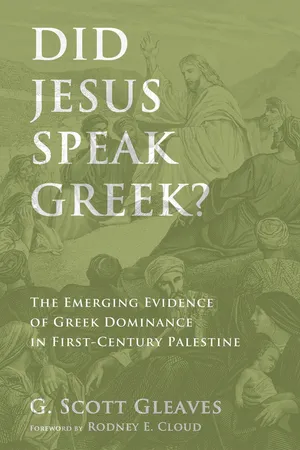
eBook - ePub
Did Jesus Speak Greek?
The Emerging Evidence of Greek Dominance in First-Century Palestine
- 240 pages
- English
- ePUB (mobile friendly)
- Available on iOS & Android
eBook - ePub
Did Jesus Speak Greek?
The Emerging Evidence of Greek Dominance in First-Century Palestine
About this book
Did Jesus speak Greek? An affirmative answer to the question will no doubt challenge traditional presuppositions. The question relates directly to the historical preservation of Jesus's words and theology. Traditionally, the authenticity of Jesus's teaching has been linked to the recovery of the original Aramaic that presumably underlies the Gospels. The Aramaic Hypothesis infers that the Gospels represent theological expansions, religious propaganda, or blatant distortions of Jesus's teachings. Consequently, uncovering the original Aramaic of Jesus's teachings will separate the historical Jesus from the mythical personality. G. Scott Gleaves, in Did Jesus Speak Greek?, contends that the Aramaic Hypothesis is inadequate as an exclusive criterion of historical Jesus studies and does not aptly take into consideration the multilingual culture of first-century Palestine. Evidence from archaeological, literary, and biblical data demonstrates Greek linguistic dominance in Roman Palestine during the first century CE. Such preponderance of evidence leads not only to the conclusion that Jesus and his disciples spoke Greek but also to the recognition that the Greek New Testament generally and the Gospel of Matthew in particular were original compositions and not translations of underlying Aramaic sources.
Information
CHAPTER 1
Did Jesus and His Disciples Speak Greek?
What languages were spoken in first-century Palestine? Did Jesus and his disciples speak and teach in Greek? If so, do we have in the NT historical preservations of their actual communication? These questions have generated a rich debate through the years. It has been the general consensus among scholars that in order to recover the real Jesus of history it is necessary to uncover the Aramaic behind the Greek. For example, Maurice Casey makes this statement:
If therefore we wish to recover the Jesus of History, we must see whether we can reconstruct his sayings, and the earliest accounts of his doings, in their original Aramaic. This should help us to understand him within his own cultural background.1
Greater recognition, however, should be given to the fact that many languages were current in Palestine during the time of Jesus. While it is generally agreed that Aramaic and Hebrew were key languages of the period, it is my purpose to demonstrate the widespread use of Greek and to argue that Jesus not only spoke Greek but also taught in Greek. Consequently, the Gospels may contain the very words that Jesus spoke instead of translations into Greek of Jesus’ original words in Aramaic.2
Joseph Fitzmyer argues that there are three important stages in the gospel tradition. First, stage one refers to the Aramaic period of the actual ministry and teachings of Jesus (1–33 CE), a period before the Gospels were written. Second, stage two represents the Apostolic period when the disciples and apostles taught and preached about the words and deeds of Jesus (33–66 CE). Third, stage three (66–95 CE) represents the canonical Gospel period reflecting a development of Greek writing. Fitzmyer’s point is to remind readers not to confuse later Greek tradition with the early Aramaic of stage one. To do so is to “fall into the danger of fundamentalism.”3
I find Fitzmyer’s stages of gospel tradition unconvincing. They may reveal a bias toward a history-of-religions approach by incorrectly presupposing that Aramaic was the dominant language of Palestine and that the Greek compositions of the Gospels represent an advancement (stage three) in gospel tradition. If Jesus did indeed speak Greek, then we may have “direct access to the original utterances of our Lord and not only to a translation of them.”4 Consequently, much more than just a few Aramaic words and expressions can be connected to the Jesus of history. Porter’s observation is therefore insightful:
It is not possible to settle the various issues regarding the linguistic milieu of first-century Palestine, as Fitzmyer rightly notes, except to say that the archaeological, linguistic and sociological evidence seems to indicate that the region was multilingual, including at least Aramaic and Greek in widespread and frequent use. . . . Therefore, the likelihood that Jesus, along with most Gentiles and Jews, was multilingual himself is strong.5
A General Overview of the Languages of Palestine in the First Century CE
There is no doubt that Jesus spoke Aramaic. Jesus would have spoken a form of Middle Aramaic called Palestinian Aramaic. Fitzmyer indicates that there were five dialects of Middle Aramaic: (1) Palestinian, (2) Nabatean (around Petra in modern Jordan), (3) Palmyrene (central Syria), (4) Hatran (eastern Syria and Iraq), and (5) Syriac (northern Syria and southern Turkey).6 Prior to 1947 CE, the date when the DSS were discovered, Palestinian Aramaic was supported only by a meager number of inscriptions on tombstones and ossuaries. Consequently, Gustaf Dalman argued that though Jesus may have known Hebrew and more than likely spoke Greek, he nonetheless certainly taught in Aramaic.7
However, since 1947 CE, many literary texts have been discovered that shed light on the dialect of Aramaic spoken by Palestinian Jews prior to and contemporaneous with Jesus.8 The DSS reveal that Aramaic may have been the dominant language,9 but the evidence reveals that it was not the only language spoken.10 Therefore one cannot conclusively argue that Jesus spoke only Aramaic.11 Palestine was multilingual in the first and second centuries CE.12 Hebrew was the language employed by the Essenes who settled at Qumran (adjacent to the caves where the DSS were found) in order to preserve the sacred Law (i.e., the Torah) of the Jews.13 Hebrew by this time had become the language associated with temple rituals and worship in synagogues where the Law and Prophets (the Torah and the Nevi’im) were read. The majority of the Jews no longer understood Hebrew.14
Aramaic, the sister language of Hebrew, was by necessity learned by Jews in Babylonian captivity (sixth century BCE) because it was the lingua franca of the empire.15 Fitzmyer stated that “the use of Hebrew does not seem to have been widespread” as a spoken language after the Jews returned home.16 Hebrew was customarily...
Table of contents
- Title Page
- Foreword
- Acknowledgments
- Abbreviations
- Introduction
- Chapter 1: Did Jesus and His Disciples Speak Greek?
- Chapter 2: The Emerging Dominance of Greek in First-Century CE Palestine
- Chapter 3: The Linguistic Proficiency in Greek of Some of the Primary Disciples of Jesus
- Chapter 4: Aramaic and Portions of the Greek New Testament
- Conclusion
- Bibliography
Trusted by 375,005 students
Access to over 1.5 million titles for a fair monthly price.
Study more efficiently using our study tools.
Frequently asked questions
Yes, you can cancel anytime from the Subscription tab in your account settings on the Perlego website. Your subscription will stay active until the end of your current billing period. Learn how to cancel your subscription
No, books cannot be downloaded as external files, such as PDFs, for use outside of Perlego. However, you can download books within the Perlego app for offline reading on mobile or tablet. Learn how to download books offline
Perlego offers two plans: Essential and Complete
- Essential is ideal for learners and professionals who enjoy exploring a wide range of subjects. Access the Essential Library with 800,000+ trusted titles and best-sellers across business, personal growth, and the humanities. Includes unlimited reading time and Standard Read Aloud voice.
- Complete: Perfect for advanced learners and researchers needing full, unrestricted access. Unlock 1.5M+ books across hundreds of subjects, including academic and specialized titles. The Complete Plan also includes advanced features like Premium Read Aloud and Research Assistant.
We are an online textbook subscription service, where you can get access to an entire online library for less than the price of a single book per month. With over 1.5 million books across 990+ topics, we’ve got you covered! Learn about our mission
Look out for the read-aloud symbol on your next book to see if you can listen to it. The read-aloud tool reads text aloud for you, highlighting the text as it is being read. You can pause it, speed it up and slow it down. Learn more about Read Aloud
Yes! You can use the Perlego app on both iOS and Android devices to read anytime, anywhere — even offline. Perfect for commutes or when you’re on the go.
Please note we cannot support devices running on iOS 13 and Android 7 or earlier. Learn more about using the app
Please note we cannot support devices running on iOS 13 and Android 7 or earlier. Learn more about using the app
Yes, you can access Did Jesus Speak Greek? by G. Scott Gleaves in PDF and/or ePUB format, as well as other popular books in Theology & Religion & Biblical Criticism & Interpretation. We have over 1.5 million books available in our catalogue for you to explore.