- 320 pages
- English
- ePUB (mobile friendly)
- Available on iOS & Android
eBook - ePub
About this book
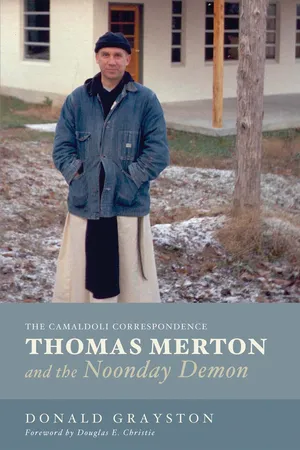
How did Thomas Merton become Thomas Merton? Starting out from any one of his earlier major life moments--wealthy orphan boy, big man on campus, fervent Roman Catholic convert, new and obedient monk--we find ourselves asking how by his life's end he had grown from who he was then into a transcultural and transreligious spiritual teacher read by millions. This book takes another such starting point: his attempt in the mid-1950s to move from his abbey of Gethsemani, in Kentucky--a place that had become, in his view, noisy beyond bearing--to an Italian monastery, Camaldoli, which he idealized as a place of monastic peace. The ultimate irony: Camaldoli at that time, bucolic and peaceful outwardly, was inwardly riven by a pre-Vatican II culture war; whereas Gethsemani, which he tried so hard to leave, became, when he was given his hermitage there in 1965, his place to recover Eden. In walking with Merton on this journey, and reading the letters he wrote and received at the time, we find ourselves asking, as he did, with so much energy and honesty, the deep questions that we may well need to answer in our own lives.
Information
Topic
Theology & ReligionSubtopic
Religious Biographies1
The Noonday Demon: acedia
The noonday demon: we meet it first in the Hebrew Bible, in Ps 90:6, as it is numbered in the Vulgate of St. Jerome (91:6 in the King James and subsequent English translations). The Hebrew reads mi-ketev yashud tsohorayim: “from destruction that despoils at midday.”20 Then in the third century before the common era, the Hebrew Bible was translated into Alexandrian Greek, a translation called the Septuagint (“the work of the seventy” translators). There the verse reads, apo pragmatos diaporeuomenou en skotei apo symptwmatos kai daimoniou mesembrinou: [you need not fear] “the pestilence that walks in darkness, nor the destruction that wastes at noonday.” The Vulgate’s reference to the noonday demon, the daemonium meridianum, comes from Jerome’s translation of the Septuagint into Latin, in which he has personified the word daimonion. There we find these words: Non timebis . . . ab incursu et daemonio meridiano (“You will not fear . . . because of assault [or invasion, incursion] and the noonday demon”). The element of demonic personification holds firm in the Douay translation of 1609, where the Latin is translated literally—“the noonday devil”—but in the King James Version of 1611, the translation follows the Hebrew: “the destruction that wasteth at noonday”; and this is echoed in the most commonly used contemporary translation, the New Revised Standard Version, as “the destruction that wastes at noonday.” Particularly through the influence of the Vulgate, however, “the noonday demon” has come down to us through the Desert Fathers and Mothers, the Christian hermits of Egypt, Syria, and Palestine in the fourth and later centuries, who found it had strong resonance with their ascetical experience.
When we come to Evagrius Ponticus and later writers, we will encounter the noonday demon as specifically responsible, so to speak, for acedia, the production of which in the lives and hearts of human beings in general and monks and hermits in particular is its accepted task. The term has a Greek antecedent, akedia, from kedos, meaning grief or anxiety; and with the alpha-privative negating the root word, a-kedia means a lack of concern or anxiety, a kind of listlessness or disconnection.21 We can stretch these meanings to connect with what the word comes to mean in the Latin tradition; but it would be simpler to say that the word as it moves from Greek into Latin takes on a different tone and acquires different shades of meaning. The one related term in English that I would encourage my readers to set aside is sloth, the name by which it is commonly known in the received lists of the seven deadly sins. I say this because in contemporary English, sloth immediately connotes laziness, which, as we will see when we reflect on the place of acedia in the life of Thomas Merton, is as far as possible from describing Merton’s situation. I find support for this in John Eudes Bamberger’s translation of Evagrius’ ascetical treatise, The Praktikos.22 There he gives English translations for the names of the other deadly sins, but retains the Latin for acedia; for, as he says, it “is such a complex reality and the term has such a technical significance [for Evagrius] that it seems best always to retain it without translation.”23 Kathleen Norris supports this view in a quotation from Andrew Crislip: “The very persistence of the term ‘acedia’ betrays the fact that none of the modern or medieval glosses adequately conveys the semantic range of the monastic term.”24
Evagrius Ponticus (345–99) was born in Pontus, now northern Turkey, into a family of Greek ethnicity. After his student days, he was ordained a lector by St. Basil the Great, and may have considered a monastic vocation at that time. But he went instead to Constantinople, attracted by its stimulating intellectual life. There he fell in love with a married woman, an experience that resulted in his decision to move to Jerusalem. Once more he fell into worldly ways, but after an experience of conversion, went to the desert of Nitria, in Egypt, where he joined a group of hermits, living there until his death. He was the first, as John Eudes Bamberger tells us, “to write extensively on the spirituality of the desert and the first to reduce to a system a monastic ascetic and mystical theology which included many elements of desert wisdom,”25 the system that we find in The Praktikos. Although it is believed he did not join St. Basil’s community because of its socially oriented activities, once in the desert his view shifted to an appreciation of a psychology of a practical and experiential kind, as The Praktikos demonstrates.
And why were the monks in the desert at all? Because they were resisting the co-opting of the Church by the newly “Christian” empire, and the luxurious lives to which many bishops and other clerics had quickly become accustomed. By going to the desert, a fearful place where, they believed, demons lived, they went to be closer to Christ himself, who had gone to the desert to be tempted by Satan, over whom the gospel tells us he was victorious (Matt 4:1–11), notably through his use of scripture in refuting Satan’s temptations. A belief in demons, differently understood at different times, had been part of Greek culture since the time of Plato. Their existence was an accepted aspect of human experience, and was confirmed for the monks by their presence in the ministry of Jesus as recorded in the New Testament. Once in the desert, the monks found that as external distractions diminished, interior distractions, the work of the demons, increased, “and they began to study their thoughts as they arose, noting which were life-giving and which destructive”26—that is, which ones came from the demons (the passionate thoughts, the logismoi27) and which ones from God. They were learning how to “discern the spirits” (1 Cor 12:10; 1 John 4:1).
Evagrius’ demonology was central to his theology and his proto-psychology. He describes angels as made of fire, human beings as made of earth, and the demons as made of ice-cold air.28 Here is what he says about them:
We must take care to recognize the different types of demons and note the special times of their activity . . . so that when these var...
Table of contents
- Title Page
- Permissions
- Foreword
- Preface
- Acknowledgments
- Abbreviations
- Introduction: The Roses at the Hermitage
- Chapter 1: The Noonday Demon: acedia
- Chapter 2: Thomas Merton: non finis quaerendi
- Chapter 3: The Greater acedia: What the Letters Tell Us
- Chapter 4: Acedia and the Will of God
- Chapter 5: The End of the Dream of Camaldoli
- Chapter 6: After the Dream
- Chapter 7: Solitude and Love
- Bibliography
Trusted by 375,005 students
Access to over 1.5 million titles for a fair monthly price.
Study more efficiently using our study tools.
Frequently asked questions
Yes, you can cancel anytime from the Subscription tab in your account settings on the Perlego website. Your subscription will stay active until the end of your current billing period. Learn how to cancel your subscription
No, books cannot be downloaded as external files, such as PDFs, for use outside of Perlego. However, you can download books within the Perlego app for offline reading on mobile or tablet. Learn how to download books offline
Perlego offers two plans: Essential and Complete
- Essential is ideal for learners and professionals who enjoy exploring a wide range of subjects. Access the Essential Library with 800,000+ trusted titles and best-sellers across business, personal growth, and the humanities. Includes unlimited reading time and Standard Read Aloud voice.
- Complete: Perfect for advanced learners and researchers needing full, unrestricted access. Unlock 1.5M+ books across hundreds of subjects, including academic and specialized titles. The Complete Plan also includes advanced features like Premium Read Aloud and Research Assistant.
We are an online textbook subscription service, where you can get access to an entire online library for less than the price of a single book per month. With over 1.5 million books across 990+ topics, we’ve got you covered! Learn about our mission
Look out for the read-aloud symbol on your next book to see if you can listen to it. The read-aloud tool reads text aloud for you, highlighting the text as it is being read. You can pause it, speed it up and slow it down. Learn more about Read Aloud
Yes! You can use the Perlego app on both iOS and Android devices to read anytime, anywhere — even offline. Perfect for commutes or when you’re on the go.
Please note we cannot support devices running on iOS 13 and Android 7 or earlier. Learn more about using the app
Please note we cannot support devices running on iOS 13 and Android 7 or earlier. Learn more about using the app
Yes, you can access Thomas Merton and the Noonday Demon by Donald Grayston in PDF and/or ePUB format, as well as other popular books in Theology & Religion & Religious Biographies. We have over 1.5 million books available in our catalogue for you to explore.