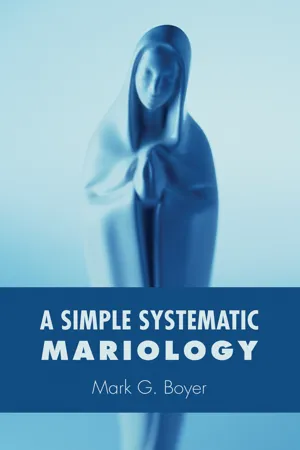
- 76 pages
- English
- ePUB (mobile friendly)
- Available on iOS & Android
eBook - ePub
A Simple Systematic Mariology
About this book
Mary, the mother of Jesus, is known in the Catholic Church as Our Lady of Grace, Our Lady of Fatima, Our Lady of Mount Carmel, Our Lady of Sorrows, Our Lady of Guadalupe, Our Lady of Lourdes, Our Lady of the Rosary, Our Mother of Perpetual Help, and more. Her various titles describe her various functions within the Church.
Many books on Mariology, the study or doctrine relating to the Virgin Mary, either treat the liturgical aspects or the devotional aspects of the topic. Here, they are brought together in one seamless presentation.
A good Mariology begins with a good Christology. Out of Mariology, firmly grounded in and flowing from Christology, there arise the liturgical and devotional aspects of the life of the Church. The Litany of the Blessed Virgin Mary (Litany of Loreto) summarizes the attributes of Mary of Nazareth from both liturgy and devotion. This book looks at those attributes individually and collectively, and demonstrates how they are contained in the solemnities, feasts, memorials, and optional memorials of the Blessed Virgin Mary throughout the liturgical year in the Scripture texts. Where applicable, devotionals seeking Mary's intercession are included.
Information
Topic
Theology & ReligionSubtopic
Christian Church1
Lord, have mercy
Lord, have mercy. Christ, have mercy.
Lord, have mercy. Christ, hear us.
Christ, graciously hear us.
God the Father of Heaven, have mercy on us.
God the Son, Redeemer of the world, have mercy on us.
God the Holy Spirit, have mercy on us.
Holy Trinity, One God, have mercy on us.
Lord, have mercy. Christ, hear us.
Christ, graciously hear us.
God the Father of Heaven, have mercy on us.
God the Son, Redeemer of the world, have mercy on us.
God the Holy Spirit, have mercy on us.
Holy Trinity, One God, have mercy on us.
Litany of the Blessed Virgin Mary (Litany of Loreto)
Reflection: The Litany of the Blessed Virgin Mary (Litany of Loreto), like all other litanies, is addressed to the Trinitarian God—Father, Son, Holy Spirit—imploring mercy. The refrain, “Lord, have mercy,” is a plea to God, asking that people do not get what they deserve. Many people think that “Lord, have mercy” seeks forgiveness from the Triune God, but in reality it asks God not to treat them the way they deserve to be treated, namely, as sinners deserving punishment. Likewise, the refrain, “Christ, have mercy,” begs the Son of God not to give people what they deserve. It is followed by “Christ, hear us,” which further emphasizes the request for mercy.
Thus, the litany begins: Lord, have mercy. Christ, have mercy. Lord, have mercy. Christ, hear us. Christ, graciously hear us. The Litany of the Blessed Virgin Mary in the “Order of Crowning an Image of the Blessed Virgin Mary” begins in a similar way: Lord, have mercy. Lord, have mercy. Christ, have mercy. Christ, have mercy. Lord, have mercy. Lord, have mercy.
After requesting mercy, the litany invokes the Trinitarian persons by name, as does the Nicene Creed or Profession of Faith, continuing to plead for mercy. It should be noted that in Trinitarian theology the Father in heaven is attributed with creation, the Son is attributed with redemption, and the Holy Spirit is attributed with sanctification. Thus, the litany continues: God the Father of Heaven, have mercy on us. God the Son, Redeemer of the world, have mercy on us. God the Holy Spirit, have mercy on us. Holy Trinity, One God, have mercy on us. The only difference in The Litany of the Blessed Virgin Mary in the “Order of Crowning an Image of the Blessed Virgin Mary” is “God our Father in heaven” instead of “God the Father of heaven.”
In one grand chorus of praise the litany begins, beseeching that God—Father, Son, and Holy Spirit—do not deal with people as they deserve. Once people have implored God’s Trinitarian mercy, then they ask the Blessed Virgin Mary to pray for them. Here it is important to note that people do not pray to Mary as if she were a goddess. People implore Mary to pray for them to God. The Catechism states that Mary is invoked under the titles of “Advocate, Helper, Benefactress, and Mediatrix.”1 Because of her singular role in redemption, Mary is ranked first of all the saints. Because of her rank, she presents the needs of people to God. It is not that people cannot present their own needs to God; Mary lends assistance in this process. The Prayer of Blessing in “Order for the Blessing of an Image of the Blessed Virgin Mary” in the Book of Blessings declares that “the blessed Virgin Mary intercedes as Mother” in God’s heavenly city.2 The Catechism states that “her prayer cooperates in a unique way with the Father’s plan of loving kindness.”3 “In the faith of this humble handmaid, the Gift of God [that is, the Holy Spirit] found the acceptance he had awaited from the beginning of time.”4 The Catechism adds that “Mary prays and intercedes in faith . . . .”5 Thus, in both litanies, Mary is asked to “pray for us.”
Journal/Meditation: What does it mean for you to ask God to have mercy on you? For what do you need to implore the Trinity not to give you what you deserve?
Prayer: Holy Trinity, One God, I cry to you: Have mercy on me. Father, who created me, have mercy on me. Jesus, who redeemed me, have mercy on me. Holy Spirit, who fills me with grace, have mercy on me. Hear my prayer and that of the Blessed Virgin Mary in the name of Christ, my Lord, who lives and reigns with you, Father, and the Holy Spirit, in eternal Trinity, forever and ever. Amen.
1. Catechism, par. 969.
2. Blessings, par. 1286.
3. Catechism, par. 2617.
4. Ibid.
5. Ibid., par. 2618.
2
Holy
Holy Mary, pray for us.
Holy Mother of God, pray for us.
Holy Virgin of virgins, pray for us.
Holy Mother of God, pray for us.
Holy Virgin of virgins, pray for us.
Litany of the Blessed Virgin Mary (Litany of Loreto)
Reflection: In the Litany of the Blessed Virgin Mary (Litany of Loreto), the Virgin of Nazareth is referred to first as Holy Mary. On May 31, the Church marks the Feast of the Visitation of the Blessed Virgin Mary. In the passage from Luke’s Gospel assigned to this feast, Elizabeth utters a beatitude in honor of Mary’s visit: “Blessed are you among women, and blessed is the fruit of your womb” (Luke 1:42). This verse is used in the traditional prayer known as the Hail Mary. In the second half of the prayer, the pray-ers, referring to Mary as the Holy Mother of God, state, “Holy Mary, Mother of God, pray for us sinners, now and at the hour of our death.” Likewise, in the prayer known as the Salve Regina (Hail, Holy Queen), the pray-ers refer to her as the Virgin Mary and the Holy Queen.6 An antiphon in honor of Mary begins, “Holy Mary, be a help to the helpless, a strength to the fearful, a comfort to the sorrowful,” and another antiphon states, “O Holy Mary, most compassionate of the compassionate, and holiest of all the holy, make intercession for us.”7 This last phrase, make intercession for us, echoes the refrain in the litany, namely, pray for us.
On September 12, the Church may observe the Optional Memorial of the Most Holy Name of Mary which venerates the holy and glorious name of the Blessed Virgin Mary, the Mother of God. On January 1, the Solemnity of Mary, the Holy Mother of God, the Church proclaims the ever-Virgin Mary to be the Mother of God’s Son and the Mother of the Church. This is echoed in an antiphon which begins, “O Holy Mother of God, who did worthily deserve to conceive him whom the whole world cannot contain.”8 It is also found in an act of consecration to the Blessed Virgin by St. Francis de Sales, which calls her “Most Ho...
Table of contents
- A Simple Systematic Mariology
- Introduction
- 1. Lord, have mercy
- 2. Holy
- 3. Mother
- 4. Virgin
- 5. Miscellaneous
- 6. Queen
- 7. Conclusion
- Appendix 1
- Appendix 2
- Appendix 3
- Appendix 4
- Appendix 5
- Bibliography
Trusted by 375,005 students
Access to over 1.5 million titles for a fair monthly price.
Study more efficiently using our study tools.
Frequently asked questions
Yes, you can cancel anytime from the Subscription tab in your account settings on the Perlego website. Your subscription will stay active until the end of your current billing period. Learn how to cancel your subscription
No, books cannot be downloaded as external files, such as PDFs, for use outside of Perlego. However, you can download books within the Perlego app for offline reading on mobile or tablet. Learn how to download books offline
Perlego offers two plans: Essential and Complete
- Essential is ideal for learners and professionals who enjoy exploring a wide range of subjects. Access the Essential Library with 800,000+ trusted titles and best-sellers across business, personal growth, and the humanities. Includes unlimited reading time and Standard Read Aloud voice.
- Complete: Perfect for advanced learners and researchers needing full, unrestricted access. Unlock 1.5M+ books across hundreds of subjects, including academic and specialized titles. The Complete Plan also includes advanced features like Premium Read Aloud and Research Assistant.
We are an online textbook subscription service, where you can get access to an entire online library for less than the price of a single book per month. With over 1.5 million books across 990+ topics, we’ve got you covered! Learn about our mission
Look out for the read-aloud symbol on your next book to see if you can listen to it. The read-aloud tool reads text aloud for you, highlighting the text as it is being read. You can pause it, speed it up and slow it down. Learn more about Read Aloud
Yes! You can use the Perlego app on both iOS and Android devices to read anytime, anywhere — even offline. Perfect for commutes or when you’re on the go.
Please note we cannot support devices running on iOS 13 and Android 7 or earlier. Learn more about using the app
Please note we cannot support devices running on iOS 13 and Android 7 or earlier. Learn more about using the app
Yes, you can access A Simple Systematic Mariology by Mark G. Boyer in PDF and/or ePUB format, as well as other popular books in Theology & Religion & Christian Church. We have over 1.5 million books available in our catalogue for you to explore.