- 250 pages
- English
- ePUB (mobile friendly)
- Available on iOS & Android
eBook - ePub
About this book
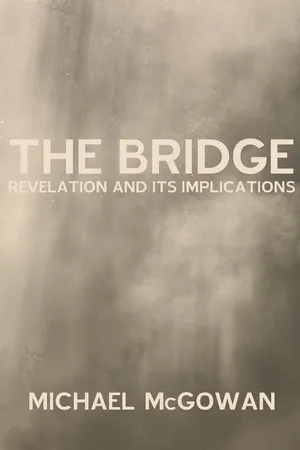
Philosophers of religion and theologians have long wrestled with the concept of revelation. Does God reveal truth to human subjects primarily through sacred texts or audible voices? Through inner experiences or pronouncements of religious leaders? What is the relationship between the truths given in revelation and those discoverable by reason? Revelation is a challenge not only to scholars, but also for churchgoers. How can the same God command one person to do one thing and another to do something quite different?
In The Bridge, Michael McGowan explores how a number of great twentieth- and twenty-first-century thinkers understand the concept of revelation. Using insights from their work and some recent advances in literary theory and communication studies, he constructs a model of revelation in which "symbol" and "narrative" figure heavily. Ancient ideas are given new life in this contemporary explication of the nature of revelation, God as the Revealer, and revelation's implications.
Information
Topic
FilosofíaSubtopic
Ética y filosofía moralPart One
Chapter 1
The Mediated Word
Rome and Revelation
“Eminenza, Eminenza!”
In his 2008 apostolic journey to the United States, Pope Benedict XVI went out of his way to visit one of his Cardinals—Avery Dulles—whose health prevented Dulles from joining in the events that other Cardinals attended. Anne Marie Kirmse describes the situation: “The pope literally bounded into the room with a big smile on his face. He went directly to where Cardinal Dulles was sitting, saying, ‘Eminenza, Eminenza.’ . . . Cardinal Dulles kissed the papal ring and smiled back at the pope.”
At one point during the meeting, the pope was given a copy of Cardinal Dulles’ latest book, Church and Society, a compilation of his public lectures delivered at Fordham University over two decades. The pontiff was intrigued by Dulles’ book, even going so far as to interrupt Dulles’ remarks to repeatedly ask about it. Benedict “eagerly paged through it, and was touched by Cardinal Dulles’ inscription to him. The pope seemed disappointed when an aide took the book from him.” Kirmse thinks “if the pope had his way, he would have sat down and started reading it immediately. Before leaving, he blessed Cardinal Dulles, assuring him of his prayers for him, and encouraged him in his sufferings.”59
Dulles died less than one year later leaving a legacy as one of the great twentieth- and twenty-first-century thinkers in the Catholic tradition. With respect to revelation, Dulles literally “wrote the book,” which explains in part the pope’s excitement to see him and receive a compilation of his public addresses.
Pope Benedict XVI is not without his own theological prowess. On November 18, 1965, toward the end of the Second Vatican Council, Pope Paul VI promulgated the bishops’ “Dogmatic Constitution on Divine Revelation” in a document simply titled, Dei Verbum, the “word of God.”60 Using this document as one of its chief sources, Joseph Ratzinger (i.e., Benedict XVI) chaired a committee to write the Catechism of the Catholic Church, which Pope John Paul II proclaimed to be “a statement of the Church’s faith and of catholic doctrine, attested to or illumined by Sacred Scripture, the Apostolic Tradition, and the Church’s Magisterium. [It is] a sure norm for teaching the faith and thus a valid and legitimate instrument for ecclesial communion.”61 In these documents, prominent Catholic leaders outline what they perceive to be Catholic teachings about revelation. Of course, there are scholars who consider themselves “Catholic” whose views bear little to no resemblance to the views outlined in these documents. It appears, therefore, that the term “Catholic” is not understood univocally, especially on the issue of revelation.
This chapter explores the concept of revelation in contemporary Catholic philosophy of religion and theology as expressed Dulles’ work. Additionally, it compares Dulles’ views of revelation with those of two other prominent Catholic thinkers: Karl Rahner and the aforementioned Joseph Ratzinger. After first discussing the difficulty of defining who is and is not a “Catholic” thinker, the chapter describes the context of Dulles’ own view by outlining the five “models” of revelation on which he maps his own view. Third, the bulk of the chapter is intended to explore Dulles’ contribution to the idea of revelation in his own “symbolic mediation” approach. Fourth, Rahner and Ratzinger serve as interlocutors for Dulles; the former sought to bridge two positions he found unacceptable and the latter includes a dialectic of revelation and concealment. Fifth, the three thinkers are evaluated in terms of their similarities and tensions as well as the potential of their approaches for reimagining revelation today.
Defining Catholicism
Before explicating the how Dulles, Rahner and Ratzinger understand revelation, a few preliminary remarks are in order to show some of the difficulties involved in treating “Catholicism” in such broad strokes, most significantly with respect to who “qualifies” as a suitable “Catholic” thinker. “Catholic” is itself a widely varying identification, as there are philosophers and theologians who self-identify as such with very little in common. Its lower case-c meaning, “universal,” does not represent the diversity within its branch of Christianity today. Although any division risks gross oversimplification of an extremely complex taxonomy, for the purposes of this chapter Catholic theologians will be divided into two camps: orthodox and progressive. The key difference is the epistemological “center” of their work, that which they view as the sine qua non of their tradition.
One can conceive of “orthodox” Catholicism as that brand of Catholic teaching in which tradition is given great and measurable weight in philosophical and theological adjudication as opposed to experience.62 Catholicism conceived this way means that the Magisterium is given a powerful voice in the views parishioners are encouraged to accept or reject. Obviously included on the list of “orthodox” Catholic theologians are Popes and Cardinals (e.g., Ratzinger and Dulles). As Richard McBrien notes, in “the strictest sense of all . . . the term magisterium has been applied exclusively to the teaching authority of the pope and the bishops.”63 Dulles is also an orthodox thinker insofar as he supports the “teaching authority of the church.” In his Models of the Church, Dulles discusses the Catholic Church in relation to the “institutional” model, in which “the Church is . . . a unique type of school—one in which the teachers have the power to impose their doctrine with juridical and spiritual sanctions. Thus teaching is juridicized and institutionalized.”64 Dulles also makes clear his view on the teaching authority of the Church, as he refers to the magisterium as the “teacher and guardian of the faith.”65 In short, “orthodox” Catholic philosophers and theologians hierarchically prioritize tradi...
Table of contents
- Title Page
- Preface
- Acknowledgments
- Introduction
- Part One
- Chapter 1: The Mediated Word
- Chapter 2: The External Word
- Chapter 3: The Written Word
- Part Two
- Chapter 4: The Big Picture
- Chapter 5: Making Connections
- Chapter 6: Leveling the Field
- Conclusion
- Bibliography
Trusted by 375,005 students
Access to over 1.5 million titles for a fair monthly price.
Study more efficiently using our study tools.
Frequently asked questions
Yes, you can cancel anytime from the Subscription tab in your account settings on the Perlego website. Your subscription will stay active until the end of your current billing period. Learn how to cancel your subscription
No, books cannot be downloaded as external files, such as PDFs, for use outside of Perlego. However, you can download books within the Perlego app for offline reading on mobile or tablet. Learn how to download books offline
Perlego offers two plans: Essential and Complete
- Essential is ideal for learners and professionals who enjoy exploring a wide range of subjects. Access the Essential Library with 800,000+ trusted titles and best-sellers across business, personal growth, and the humanities. Includes unlimited reading time and Standard Read Aloud voice.
- Complete: Perfect for advanced learners and researchers needing full, unrestricted access. Unlock 1.5M+ books across hundreds of subjects, including academic and specialized titles. The Complete Plan also includes advanced features like Premium Read Aloud and Research Assistant.
We are an online textbook subscription service, where you can get access to an entire online library for less than the price of a single book per month. With over 1.5 million books across 990+ topics, we’ve got you covered! Learn about our mission
Look out for the read-aloud symbol on your next book to see if you can listen to it. The read-aloud tool reads text aloud for you, highlighting the text as it is being read. You can pause it, speed it up and slow it down. Learn more about Read Aloud
Yes! You can use the Perlego app on both iOS and Android devices to read anytime, anywhere — even offline. Perfect for commutes or when you’re on the go.
Please note we cannot support devices running on iOS 13 and Android 7 or earlier. Learn more about using the app
Please note we cannot support devices running on iOS 13 and Android 7 or earlier. Learn more about using the app
Yes, you can access The Bridge by Michael W. McGowan in PDF and/or ePUB format, as well as other popular books in Filosofía & Ética y filosofía moral. We have over 1.5 million books available in our catalogue for you to explore.