- 242 pages
- English
- ePUB (mobile friendly)
- Available on iOS & Android
eBook - ePub
About this book
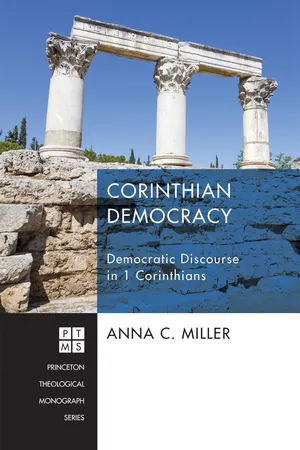
In this innovative study, Anna Miller challenges prevailing New Testament scholarship that has largely dismissed the democratic civic assembly--the ekkl?sia--as an institution that retained real authority in the first century CE. Using an interdisciplinary approach, she examines a range of classical and early imperial sources to demonstrate that ekkl?sia democracy continued to saturate the eastern Roman Empire, widely impacting debates over authority, gender, and speech. In the first letter to the Corinthians, she demonstrates that Paul's persuasive rhetoric is itself shaped and constrained by the democratic discourse he shares with his Corinthian audience. Miller argues that these first-century Corinthians understood their community as an authoritative democratic assembly in which leadership and "citizenship" cohered with the public speech and discernment open to each. This Corinthian identity illuminates struggles and debates throughout the letter, including those centered on leadership, community dynamics, and gender. Ultimately, Miller's study offers new insights into the tensions that inform Paul's letter. In turn, these insights have critical implications for the dialogue between early Judaism and Hellenism, the study of ancient politics and early Christianity, and the place of gender in ancient political discourse.
Information
Table of contents
- Title Page
- Acknowledgments
- Abbreviations
- Introduction
- Chapter 1: The Ekklēsia in Greek Education
- Chapter 2: The First-Century Ekklēsia in the Writings of Dio and Plutarch
- Chapter 3: Moses in the Ekklēsia: Josephus’ Use of Democratic Discourse
- Chapter 4: Speech and Wisdom of the Corinthian Ekklēsia
- Chapter 5: The Gendering of Democratic Participation
- Chapter 6: “As in all the Ekklēsiai of the Saints”: 1 Cor 12–14
- Conclusion
- Bibliography
Trusted by 375,005 students
Access to over 1.5 million titles for a fair monthly price.
Study more efficiently using our study tools.
Frequently asked questions
Yes, you can cancel anytime from the Subscription tab in your account settings on the Perlego website. Your subscription will stay active until the end of your current billing period. Learn how to cancel your subscription
No, books cannot be downloaded as external files, such as PDFs, for use outside of Perlego. However, you can download books within the Perlego app for offline reading on mobile or tablet. Learn how to download books offline
Perlego offers two plans: Essential and Complete
- Essential is ideal for learners and professionals who enjoy exploring a wide range of subjects. Access the Essential Library with 800,000+ trusted titles and best-sellers across business, personal growth, and the humanities. Includes unlimited reading time and Standard Read Aloud voice.
- Complete: Perfect for advanced learners and researchers needing full, unrestricted access. Unlock 1.5M+ books across hundreds of subjects, including academic and specialized titles. The Complete Plan also includes advanced features like Premium Read Aloud and Research Assistant.
We are an online textbook subscription service, where you can get access to an entire online library for less than the price of a single book per month. With over 1.5 million books across 990+ topics, we’ve got you covered! Learn about our mission
Look out for the read-aloud symbol on your next book to see if you can listen to it. The read-aloud tool reads text aloud for you, highlighting the text as it is being read. You can pause it, speed it up and slow it down. Learn more about Read Aloud
Yes! You can use the Perlego app on both iOS and Android devices to read anytime, anywhere — even offline. Perfect for commutes or when you’re on the go.
Please note we cannot support devices running on iOS 13 and Android 7 or earlier. Learn more about using the app
Please note we cannot support devices running on iOS 13 and Android 7 or earlier. Learn more about using the app
Yes, you can access Corinthian Democracy by Anna C. Miller in PDF and/or ePUB format, as well as other popular books in Théologie et religion & Critique et interprétation bibliques. We have over 1.5 million books available in our catalogue for you to explore.