- 136 pages
- English
- ePUB (mobile friendly)
- Available on iOS & Android
eBook - ePub
About this book
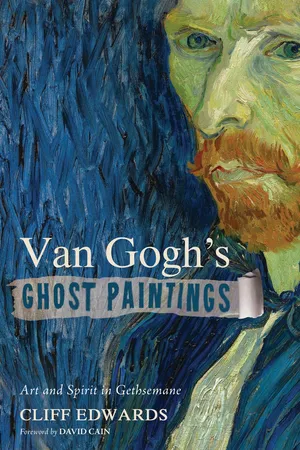
One of the most significant and revealing paintings by the world famous artist Vincent van Gogh was never seen by anyone but the artist himself. The painting was so important to the artist that he painted it twice. He was so conflicted about the painting that he destroyed it twice. Cliff Edwards argues these two unique paintings Vincent created and destroyed are at least as important to understanding the artist and his work as are the two thousand or more paintings and drawings that do exist. In Van Gogh's Ghost Paintings, Edwards invites his readers on a journey that begins in a Zen master's room in Japan and ends at a favorite site of the artist, a ruined monastery and its garden in the south of France. Recovering the intent of van Gogh and the nature of his "ghost paintings" becomes a "zen koan" waiting to be solved. The solution offers access to the deepest levels of the artist's life as painter and spiritual pilgrim. The journey leads to the artist's choice of the biblical theme of the Garden of Gethsemane. The answer to the mystery of the lost paintings illuminates the relationship of joy and suffering, discovery and creation, religion and the arts in van Gogh's life and work. In this fascinating book Edwards solves a long-ignored mystery that provides a critical key to the relation of van Gogh's religion and art.
Information
Topic
Theology & ReligionSubtopic
History of Religion1
Locating the Ghost Paintings
Imagine that one of the most significant and revealing paintings by the world-famous artist Vincent van Gogh was never seen by anyone but the artist himself. Imagine that it was so important to the artist that he painted it twice, but he was so conflicted about it that he destroyed it twice. Those imaginings are reality. I call those paintings Van Gogh’s “ghost paintings.”
Vincent, as the artist preferred to be called, composed those two paintings during his most creative year as an artist. It was 1888, the same year he painted his Sunflowers, The Yellow House, The Bedroom, numerous blossoming orchards and fields of wheat, flower gardens and harvest scenes, fishing boats on the Mediterranean, and portraits of peasants, housewives, a postal worker, and children.
What is especially puzzling about Vincent creating and destroying his ghost paintings is that never before had he ever composed such a painting, and never again would he attempt such a painting. Those two destroyed paintings were unique among all his works. The closest he would come to those paintings was a copy of a work by Delacroix, but that was a copy, and that was not the subject he would choose for his own work.
I believe the two unique paintings Vincent created and destroyed are at least as important to understanding the artist and his work as are the two thousand or more paintings and drawings that do exist. I believe devoting attention to the ghost paintings will reveal an illuminating new dimension of Vincent’s struggle to discover the spiritual dimension of art for the culture of his day and ours. I believe that hidden in those paintings and their story is Vincent’s final word on “the art of life.”
For me, the ghost paintings are much like Edgar Allan Poe’s “Purloined Letter,” hidden in such plain sight that their very existence, brief though it might have been, has remained largely invisible to us. My guess is that you have never heard of them, and I know you have never seen them. Yet I am convinced those two works did much to determine the course of Vincent’s art for the last two years of his brief life as artist. In those two paintings he struggled with the meaning and direction of his intended contribution as an artist. The struggle and provisional solution arrived at by Vincent as revealed in those two works and their destruction played a critical role in the future direction of art, and contributed to the future relationship of religion and spirituality to the arts.
Let us go to the hiding place of those paintings and allow the artist himself to tell us their secret. On Sunday, July 8 or Monday, July 9 of 1888, worn out by a day of painting outside the city of Arles in Provence, just thirty miles from the Mediterranean, Vincent likely sat at a table in the Café de la Gare, on the ground floor of the Ginoux Inn. He often ate, drank, and wrote letters to his brother Theo at one of the café tables. One can see the very setting in the painting he titled Café de la Nuit (The Night Café). Upstairs was his rented room, filled with paintings drying before he could roll them up and send them to his brother Theo. Vincent was writing a six-page letter to Theo, manager of an art gallery on Montmartre in Paris. Most of the six pages dealt with responses to a now lost letter by Theo inquiring about debts Vincent may have left behind when he departed their apartment on February 19 for the sixteen-hour train trip to the south of France. Vincent informed Theo that he owed nothing to the paint-dealer Père Tanguy, but did owe Bing’s Art Nouveau Shop for Japanese prints he had taken on consignment. Then, after commenting on newly completed drawings and a collection of recent paintings that were drying, Vincent began on page three of the letter some nine lines that are likely to surprise anyone who has studied the 1,500 or more drawings and paintings Vincent had completed from his beginning as an artist in 1880 to the moment he wrote that letter in the summer of 1888. He describes this painting whose subject matter stands alone among all his works. In a deceptively off-hand manner, he writes:
I’ve scraped off one of the large painted studies. A Garden of Olives—with a blue and orange Christ figure, a yellow angel—a piece of red earth, green and blue hills. Olive trees with purple and crimson trunks, with grey green and blue foliage. Sky lemon yellow.
I scraped it off because I tell myself it’s wrong to do figures of that importance without a model. (Letter 637)
Vincent then abruptly turns to other subjects: the likelihood of Gauguin joining him at the Yellow House in Arles, news of other artists, Bing’s collection of Japanese prints, and Pierre Loti’s novel about Japan, Madame Chrysanthemum.
Vincent confesses he had destroyed his large painting of Jesus and an angel in the Garden of Olives, or Gethsemane. But his confession has its peculiarities. He had been worried that the expense for tubes of paint was driving his brother, who paid for them, to illness. He suggested to Theo that perhaps it would be best to give up painting in favor of the far less expensive pursuit of drawing (Letters 601, 615). Yet he admits here to the purposive loss of a good deal of paint. Even his use of the words “I tell myself” in “I tell myself it’s wrong to do figures of that importance without a model” gives the impression that he is involved in a conflict within himself regarding his painting the figures of Christ and an angel. Perhaps he is hiding more than he is revealing regarding the significance of this painting and his decision to destroy it.
Nevertheless, we might treat the destruction of this one painting of a single scene selected from the life of Christ as an impulsive singularity among all his works if it were not for the fact that another surprise awaits us. Seventy-five days later, after some thirty-three more letters to Theo, Vincent has a second confession to make. On September 21, 1888, Vincent was in the midst of “a passion to make—an artist’s house,” planning his sunflower decorations for the Yellow House, just a block from the café where he rooms and where he writes his letters to Theo. He is ecstatic that he will finally have a studio-home that will bring him “great peace of mind.” In the midst of his euphoria, he makes his second confession:
For the second time I’ve scraped off a study of a Christ with the angel in the Garden of Olives. Because here I see real olive trees. But I can’t, or rather, I don’t wish, to paint it without models. But I have it in my mind with color—the starry night, the figure of Christ blue, the strongest blues, and the angel broken lemon yellow. And all the purples from blood red purple to ash in the landscape. (Letter 685)
About two weeks later, on October 5, both the Garden of Olives or Gethsemane paintings were still on his mind when he wrote his young artist friend, Emile Bernard:
I mercilessly destroyed an important canvas—a Christ with the angel in Gethsemane—as well as another one depicting the poet with a starry sky—because the form hadn’t been studied from the model beforehand, necessary in such cases—despite the fact that the color was right. (Letter 698)
It appears that for over three months the Gethsemane painting with Christ and an angel had haunted Vincent. The first version with its yellow sky had over time transformed to a “starry night” scene. He admits that his Gethsemane painting was an “important canvas” and that “the color was right.” The impulse to paint it remained too strong to resist, yet the conflicting feelings about having such a painting among his works necessitated the destruction of the second painting following in the wake of the destruction of the first. He has, of course, told us that he doesn’t “wish to paint it without models,” but why then attempt it twice? Further, what might he have imagined his models for such a painting would be? Would he have accepted someone who matched his imagined image of Christ or an angel? Or had he perhaps expected a vision of the scene to come to him in his act of painting? Further, Vincent tells us that his seeing “real olive trees” encouraged him to do the paintings. He would, in fact, draw and paint eighteen works focused on olive trees during his months in the asylum. Are those “olive trees” further attempts at the Mount of Olives Gethsemane scene? Might the very absence of Christ and an angel add to our sense of Vincent’s struggle with the meaning of Gethsemane for himself as artist? Is there a movement toward a “negative way” to call the sacred to mind, a presence of Christ and angel as absent, refused, or erased essential to the depth of Vincent’s search for a spirituality for the art of the future? Should showing a place in nature reflecting the Gethsemane scene bring the narrative to our memory? Or has Vincent refused the story as a visual narrative in favor of the here and now of actual olive orchards?
Exactly what is it about painting Jesus and the angel in Gethsemane that led to this double creation and double destruction during the height of the artist’s creativity? Why had he never composed a scene from the life of Christ before, and why would he never compose such a scene again? These are all questions for which we will seek answers, or at least direction. I believe our very asking of these questions will take us more deeply than ever into the imagination and intentions of one of the greatest Western artists, and so into art as “spiritual biography” and an illumination of human creativity and the quest for meaning.
2
A Zen Master’s Question
Before attempting answers to the several questions I’ve raised regarding the ghost paintings, allow me to introduce a quite different sort of question, one that is often addressed to me. I lecture on Vincent’s art, life, and spiritual quest in museums, university classrooms, and religious institutions, in this country and abroad. During a question and answer period, I can count on one of the first questions asked to be some variation on the following: “What led you to get so interested in the painter Van Gogh?” Such a question might be expected, especially from those who know that my early studies and much of my teaching and writing have focused on the religious classics of the world’s religions, especially on the relationship between Asian religious texts and practices and Western religious texts and practices. I believe my answer to that often-asked question may help you locate me and the direction my passion for the life and work of Vincent van Gogh has taken.
My early studies and degrees were in biblical studies and the history and literature of the world’s religions, largely at Northwestern University, the University of Strasbourg in France, the University of Neuchatel in Switzerland, and Hebrew Union School of Bible and Archaeology in Jerusalem. But my growing interest in comparing Asian religions with Western traditions led me to travel to Japan, where I became interested in Buddhist religious art. That is when I was introduced to a zen master who was custodian of one of the world’s most famous zen paintings.
It was the question posed by that zen master over a bowl of tea that initiated the journey of discovery that led to my passion for Vincent van Gogh’s life and work and that has brought me to the book you have in hand. In 1971, fresh out of my Western studies, I traveled to Japan on a grant and was studying the Japanese language in a Kyoto language school. My teacher asked if I would be interested in teaching English to a zen monk. The monk was from a famous zen monastery in the city, Daitokuji, and was being sent to America to found a zen temple. I knew that a famous abbot at Daitokuji not only knew a great deal about the zen arts, but had in his temple treasury one of the most famous of all zen ink-paintings, Mu-ch’i’s Six Persimmons. I traded English lessons for an introduction to my student’s abbot, Kobori-Sohaku. The day came when I was ushered into his private chamber. Sitting on tatami mats, he served tea, and asked how he might help me. When I asked permission to see the famous zen ink painting, he smiled, and said, “If you can answer my question, I might be able to open our treasury and let you view the painting. My question is, why do the Japanese want to see Van Gogh’s Sunflowers and you want to see Mu-ch’i’s Persimmons? I will make it a simple koan. A Van Gogh sunflower and a Mu-ch’i persimmon: are they the same or different?” Perhaps there was some immediate response in koan style that might have suited the moment. But my thoughts were on how little I knew about either Van Gogh or the Japanese people’s views on art. I promised Abbot Kobori I would attempt someday to solve his koan. That was the start of my life-long study of Van Gogh.
Beginning as an attempt to understand the relationship between Vincent’s art and Japanese art, my interest broadened into a study of Vincent’s spiritual quest and his way of seeing the world and living his life. After a stay at Daitokuji, I traveled to Amsterdam and Otterlo in Holland to see the greatest collections of Van Gogh’s art, and to view some of his original letters to brother Theo. While in Amsterdam I bought my first set of volumes containing the letters of Van Gogh. Studying his letters fascinated me, for much of my early education had focused on interpreting the New Testament, and the New Testament is composed largely of letters. From Holland I traveled to Paris, and was fortunate enough to arrive during a major exhibition of Impressionist art at a museum on the Place de la Concorde. A banner over the exhibit contained a Van Gogh quotation: “We love Japanese art. All the Impressionists have that in common.” A poste...
Table of contents
- Title Page
- Dedication
- Foreword
- Acknowledgments
- Chapter 1: Locating the Ghost Paintings
- Chapter 2: A Zen Master’s Question
- Chapter 3: Quest for the Artist
- Chapter 4: The Pilgrimage from Paris to Arles
- Chapter 5: Gethsemane in the Bible
- Chapter 6: Agony and the Angel at Gethsemane
- Chapter 7: Vincent in Arles
- Chapter 8: Montmajour and the Two Gardens
- Chapter 9: Rembrandt’s Christ and Vincent’s Quandary
- Chapter 10: Yellow House to Asylum
- Chapter 11: Crisis after Crisis
- Chapter 12: Refusing Medieval Tapestries
- Chapter 13: The Secret Life of Artistic Creation
- Chapter 14: Empty Shoes on Empty Paths
- Afterword
- Select Bibliography
- Figure 1: “Christus Consolator,” after a painting by Ary Scheffer
- Figure 2: “Still Life with Bible and Zola Novel,” painting by Vincent van Gogh
Trusted by 375,005 students
Access to over 1.5 million titles for a fair monthly price.
Study more efficiently using our study tools.
Frequently asked questions
Yes, you can cancel anytime from the Subscription tab in your account settings on the Perlego website. Your subscription will stay active until the end of your current billing period. Learn how to cancel your subscription
No, books cannot be downloaded as external files, such as PDFs, for use outside of Perlego. However, you can download books within the Perlego app for offline reading on mobile or tablet. Learn how to download books offline
Perlego offers two plans: Essential and Complete
- Essential is ideal for learners and professionals who enjoy exploring a wide range of subjects. Access the Essential Library with 800,000+ trusted titles and best-sellers across business, personal growth, and the humanities. Includes unlimited reading time and Standard Read Aloud voice.
- Complete: Perfect for advanced learners and researchers needing full, unrestricted access. Unlock 1.5M+ books across hundreds of subjects, including academic and specialized titles. The Complete Plan also includes advanced features like Premium Read Aloud and Research Assistant.
We are an online textbook subscription service, where you can get access to an entire online library for less than the price of a single book per month. With over 1.5 million books across 990+ topics, we’ve got you covered! Learn about our mission
Look out for the read-aloud symbol on your next book to see if you can listen to it. The read-aloud tool reads text aloud for you, highlighting the text as it is being read. You can pause it, speed it up and slow it down. Learn more about Read Aloud
Yes! You can use the Perlego app on both iOS and Android devices to read anytime, anywhere — even offline. Perfect for commutes or when you’re on the go.
Please note we cannot support devices running on iOS 13 and Android 7 or earlier. Learn more about using the app
Please note we cannot support devices running on iOS 13 and Android 7 or earlier. Learn more about using the app
Yes, you can access Van Gogh’s Ghost Paintings by Cliff Edwards in PDF and/or ePUB format, as well as other popular books in Theology & Religion & History of Religion. We have over 1.5 million books available in our catalogue for you to explore.