A nuclear Israel waits for its Messiah, a nuclear America eagerly anticipates the second coming of Christ, and a nuclear Iran believes it can expedite the return of the hidden or twelfth imam. Are apocalyptic expectations, like all other ideologies, simply evolution’s way of keeping the human population in check?
Is religion true? Does God exist? What happens to us when we die? What should the afterlife mean for us while we are alive? Are these the greatest of all questions, and if so, why?
After thousands of years and countless religious traditions, why does the world continue to hunger for spiritual truth? Why are religious lives so often filled with doubt, worry, and dark nights of the soul?
Do you believe in pregnant virgins? Do you believe in the incarnation of an immutable God? Do you believe that an eternal God died? Do you believe Jesus redeemed an Israel that has totally rejected him? Do you believe a loving Jesus will return to bring the world to a tragic end? Do you believe that contradictions can’t both be true?
Do you believe the human anatomy is designed for meditation or mobility? If God had indeed chosen the prophet Muhammad to warn the people, why didn’t Muhammad warn Muslims not to split Islam into Sunni and Shiite?
It has been said that if we don’t challenge our beliefs, our beliefs will eventually challenge us. Disillusionment with religion, not to mention global crises, is forcing believers to question the basis of their faith. Socrates on Judaism, Christianity, and Islam addresses those who are unsatisfied with the belief systems they encountered in orthodox religions. This book will assist searchers as they embark on their solitary quest for spiritual discovery.
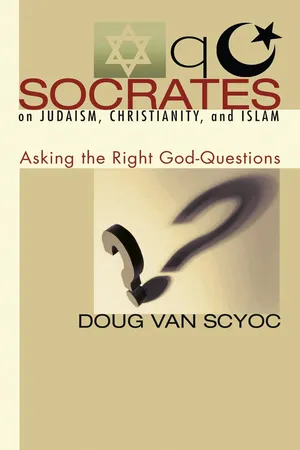
eBook - ePub
Socrates on Judaism, Christianity, and Islam
Asking the Right God-Questions
- 112 pages
- English
- ePUB (mobile friendly)
- Available on iOS & Android
eBook - ePub
About this book
Information
Topic
Theology & ReligionSubtopic
Christian Theology chapter 1
Seeking God in Truth
An ancient skull from a remote monastery mocks me. It says, “I was once like you—soon, you will be like me.” The face of death haunts me in the winter of my life; hearing its footsteps compels me to seek God. Pursuing the divine, somehow, brings peace of mind.
I’m being facetious. The truth is that my sugarcoated Christian world was shattered years ago when I heard a Holocaust survivor and Nobel Laureate say, “All the killers were Christians” and “Hate is a Christian problem.” Shocked and deeply offended, I spent the next several years researching Christian history only to find the supreme Christian value of love literally drowning in a pool of blood. Millions of men, women, and children had been slaughtered by those baptized in the name of Jesus Christ. It hurt to hear people say that they didn’t think the world could bear another two thousand years of “Christian love.”
For whatever reason, there seemed to be a serious disconnection between the “good news” of the Christian gospel and the catastrophic events that accompanied it. A Native American Indian once said, “When the white men first came, we had the land and they had the Bible; now, they have the land and we have the Bible.” Was it ever really about God and love, or has it always been about land and economic calculations?
I tried to find encouragement in the sacred Scriptures—the source of divine inspiration. What I discovered instead was the God of Israel commanding the Israelites to exterminate men, women, children, and infants (1 Sam 15:3). Isaiah 34:6 reminds us that “the sword of the LORD is bathed in blood.” In modern-day Israel, I listened intently as a Jewish woman referenced the Hebrew Bible to justify the displacement of Palestinian Arabs. She claimed that God had given his holy people all the land.
Is the God of the universe a real estate deity who favors some of the world’s children while rejecting others? The reality is that Jerusalem, God’s city, is a place cursed by religious enmity, and the Holy Land continues to be a region where one hates one’s fellow human to the greater glory of God. Will their refusal to love their neighbor continue to kill them, and us, forever?
The holiness of Israel has been characterized by its separateness from other peoples. The stress on exclusion and concern with difference persists today. Many white militia movements also embrace this exclusive concept of religious or racial purity. The more identity people have, the more likely they are to hate their neighbors. Jesus taught us to love our neighbors, and even our enemies, because he knew that the truly sacred does not divide. The sooner humanity wakes up to this fact, the better.
The sorrow of the universe is ignorance. Ignorance stems from our constant susceptibility to deception, our passive acceptance of beliefs, and our conditioned existence. Suffering, more often than not, is the result of our ignorance. The song of the universe is truth. But what is truth in a world where nothing is what it seems? The sun appears to rise and fall and yet, in reality, it is a fixed star. At the end of the day, the fatherhood of God has not produced the brotherhood of man.
Thanks to the media, the image of a person holding an AK-47 rifle in one hand and the Qur’an in the other has been etched in the popular imagination. What we in the West fail to understand is that the vast majority of Muslims perceives Christianity as a religion in competition with Islam and that Western values are recognized as a threat to Islamic society. Many Christians also perceive Islam, the fastest growing religion in the world today, as a threat to global salvation. There can be no doubt that the point of contact between the Christian message and the Islamic world is a head-on collision.
Despite such issues as the Christian Crusades and Islamic terrorism, Muslim-Christian relations have not always been negative. Akbar the Great, a Muslim ruler, left a powerful epitaph at the Gates of Victory:
Jesus, peace be upon him, said this, “The world is a bridge—cross it, but build no house upon it. The world endures for but an hour—spend it in devotion. The rest is unseen.”
Losing My Religion to Find God?
To believe or not to believe?—that is the question. I’ve often wondered: did I abandon God or did he abandon me? What does it mean to have a religious or mystical experience? For that matter, what does it mean to have a déjà vu experience? While reading the New Testament late one evening in the spring of 2002, a Spirit touched my soul in a way that radically transformed my life. It was that unsolicited and mystifying experience that launched my relentless quest for the divine.
Did Jesus reveal that another God existed who had never been mentioned in the Holy Bible? Before he left the world, Jesus said, “I am returning to my Father and your Father, to my God and your God” (John 20:17). Jesus had a God? Can a God have a God in monotheism? Am I worshiping God in truth if I am worshiping Jesus instead of Jesus’s God?
Jesus depicted a compassionate God who is loving, forgiving, and merciful. Is there a deity beyond what some scholars refer to as the brutal, partial, and murderous God of sacred Scripture? If there is, I had to find him. But isn’t the quest for God the biggest wild goose chase in history? Why did Jesus say, “Seek God’s kingdom and righteousness” (Matt 6:33) instead of “Go to church and read the Bible”?
Unfortunately, exclusive claims and defense mechanisms inherent in organized religion and various sacred texts ensure that truth is always easier to know than to seek. Does the solitary quest for spiritual discovery threaten religious institutional control? Is the shield of faith for the vast majority simply the will to avoid knowing the truth?
Does faith allow one to believe in spite of overwhelming contradictions, absurdities, and doubts? Is faith just another word for false hopes and beliefs? Why do some people accuse the faithful of ignoring all the hatred, slaughter, intellectual oppression, and viciousness of the Bible and its God? Is there a strong tendency among believers to close their minds to every fact that does not suit their personal prejudices or spiritual indoctrination?
It is human nature to cling to beliefs that offer the most comfort and security. Religious convictions, however, can be extremely dangerous. The blind leading the blind in unadulterated fanaticism have left millions dead in their wake. Wrong beliefs have led human beings to create a world of turmoil, suffering, and tragedy. There are those (Christians) who place their faith in a human sacrifice and there are those (Muslims) who sacrifice themselves for virgins in paradise. Sacrifice is a primitive rite of sacred destruction prevalent in virtually every religious tradition. Wasn’t it God who said, “I desire mercy not sacrifice” (Hosea 6:6)?
Will you remain in a state of passive dependence, or can you handle the truth? An honest and extensive search for God is akin to a prolonged chipping away of the soul. It has been said that the finest steel is forged in the fieriest furnace. Living in harmony with the truth is liberating, whereas living in doubt with an illusion is hell.
There are at least three prerequisites for seeking God in truth. First, you must be able to free your mind from all fixed conceptions. Second, you must be willing to overcome ignorance in order to awaken to truth. Third, you must have the fortitude to continue the quest for there is much to bear and the road can be treacherous.
To coast through life in ignorance, ignoring ultimate questions, is to miss the whole point of being alive. It makes sense to ensure that our beliefs are as true as they can be. Often, however, we are incapable of recognizing the twisted state of our view of reality.
The myths that bind us most are those we do not perceive. How can we be certain that our convictions are not mere delusions? Intellectual and spiritual darkness stems from ignorance and religious indoctrination. Ironically, numerous personal truths are inevitably exposed as personal ignorance in an in-depth probe for God.
Beginning at the End: Apocalyptic and Messianic Expectations?
In Judeo-Christianity, an initial search for God usually begins with the Holy Bible. At the end of such a quest, one is forced to ask a very difficult question: Is the biblical God a reneger? In other words, how does a person who believes in the literal truth of the Bible reconcile the God of Noah—who promised that he would never again doom the earth or annihilate all living things—with the apocalyptic God of Daniel or Revelation—who wills a final genocide and the violent end of the world?
Why didn’t God tell Noah that at the end of time he was really planning to wreak havoc on all but a few faithful Christians? The greatest story ever told begins with a global genocidal flood and ends with a terrible destruction of the earth and a ravaging of humanity. If the biblical God is love, where is the love?
After more than two thousand years, the human fascination—more often an obsession—with the end times continues. The book of Revelation, the last and most dangerous book of the Bible, remains a powerful force today. One Christian cult society, with over six million members, spends an inordinate amount of time each year peddling its interpretation of these dark prophecies door to door. The authors of the Left Behind series have sold more than 60 million copies of their work.
Apocalyptic imagery has captured the imagination of tens of millions of people, some of whom have followed its prophecies to tragic end. Apocalyptic prophecy has been linked to the recent fire that engulfed the Branch Davidians and to the conflagration that destroyed ancient Rome in AD 64. Some scholars believe that there was an early Christian summons to turn prophecy into reality by setting fire to the evil Roman capital and burning it to a cinder. Did the Roman emperor Nero persecute Christians throughout the empire because of their insurgency in Rome?
Bible-code research and analysis is now being used—in addition to apocalyptic literature, sermons, and door-to-door sales—to fuel the ongoing belief that we are indeed living in the end times and that the book of Revelation is going to be fulfilled, quite literally, in our lifetime. Millions of Christians are fearful that their nonbelieving friends and loved ones will soon be “left behind.” Are these fears rational? What does it mean to live a life in fear of Armageddon and hell? What happens to people who spend their lives spinning in the neurosis of sin and salvation?
Modern scholarship suggests that the book of Revelation is not a prophecy about the end of the world but merely an attack on ancient Rome and an interpretation of the book of Daniel. The book of Daniel was directed against Greek oppression of the Jewish people while the book of Revelation was aimed at Roman domination.
Biblical scholars point out that the “Four Horsemen of the Apocalypse”—the Bible’s most terrifying figures and the ones responsible for the ravaging of humanity—first appear in the book of Zechariah. Scholars also agree that the Jewish writer Enoch borrowed images from Greek mythology. These images resonated through apocalyptic literature down to the book of Revelation (e.g., Revelation 20:1–3 says, “The head angel who rebels against God is thrown down to earth in a pit called Hades.”). The concept of angels, devils, heaven, and hell and the dream of victory in the war between God and Satan are also Greek in origin. Did John, the mysterious author of Revelation, simply copy and modify the Old Testament text for the first century?
It was customary for pre-Christian Roman emperors to be declared gods and worshipped after their death; they also had temples and cults dedicated to them. Was Revelation merely an urgent message or warning for a tiny minority of first-century Christians in danger of being seduced by the rampant paganism of emperor worship? Is the worship of the beast symbolic of the worship of the Roman emperor? Was the message designed to scare insiders into staying on the straight and narrow path? Were the visions less about predicting the future and more about chastising those who joined the cult of the divine emperor?
Megiddo, the bloodiest place in ancient Palestine, is believed to be the battlefield of Armageddon and the setting for end of the world. Rome’s Sixth Legion, infamous for brutalizing its victims and striking terror throughout the empire, was stationed at Megiddo. Was Armageddon simply another image meant to evoke hatred for the Romans?
Does the whore of...
Table of contents
- Title Page
- Preface
- Acknowledgments
- Introduction
- Chapter 1: Seeking God in Truth
- Chapter 2: Truths That Set Me Free
- Chapter 3: Building a Faith on Solid Rock
- Epilogue
Trusted by 375,005 students
Access to over 1.5 million titles for a fair monthly price.
Study more efficiently using our study tools.
Frequently asked questions
Yes, you can cancel anytime from the Subscription tab in your account settings on the Perlego website. Your subscription will stay active until the end of your current billing period. Learn how to cancel your subscription
No, books cannot be downloaded as external files, such as PDFs, for use outside of Perlego. However, you can download books within the Perlego app for offline reading on mobile or tablet. Learn how to download books offline
Perlego offers two plans: Essential and Complete
- Essential is ideal for learners and professionals who enjoy exploring a wide range of subjects. Access the Essential Library with 800,000+ trusted titles and best-sellers across business, personal growth, and the humanities. Includes unlimited reading time and Standard Read Aloud voice.
- Complete: Perfect for advanced learners and researchers needing full, unrestricted access. Unlock 1.5M+ books across hundreds of subjects, including academic and specialized titles. The Complete Plan also includes advanced features like Premium Read Aloud and Research Assistant.
We are an online textbook subscription service, where you can get access to an entire online library for less than the price of a single book per month. With over 1.5 million books across 990+ topics, we’ve got you covered! Learn about our mission
Look out for the read-aloud symbol on your next book to see if you can listen to it. The read-aloud tool reads text aloud for you, highlighting the text as it is being read. You can pause it, speed it up and slow it down. Learn more about Read Aloud
Yes! You can use the Perlego app on both iOS and Android devices to read anytime, anywhere — even offline. Perfect for commutes or when you’re on the go.
Please note we cannot support devices running on iOS 13 and Android 7 or earlier. Learn more about using the app
Please note we cannot support devices running on iOS 13 and Android 7 or earlier. Learn more about using the app
Yes, you can access Socrates on Judaism, Christianity, and Islam by Doug Van Scyoc in PDF and/or ePUB format, as well as other popular books in Theology & Religion & Christian Theology. We have over 1.5 million books available in our catalogue for you to explore.