Harry S. Guntrip was best known for his affiliation with two famous psychoanalysts from what is known as the British Independent tradition of psychoanalysis in England: Ronald Fairbairn and Donald Winnicott. This book traces the various influences on the development of his clinical and theological thinking in context of the historical tension between religion and psychoanalysis. The central feature of his development will be demonstrated as a series of polarities, both theoretical and personal, conflicts with which he wrestled theologically, psychologically, and interpersonally on the professional level and in his own personal psychoanalyses. A critical evaluation of the outcome of Guntrip's own personal psychoanalyses with Fairbairn and Winnicott will demonstrate the autobiographical nature of his theoretical analysis of schizoid phenomena: a psychological state of self-preoccupation and way of being in the world.
--from the Introduction
eBook - ePub
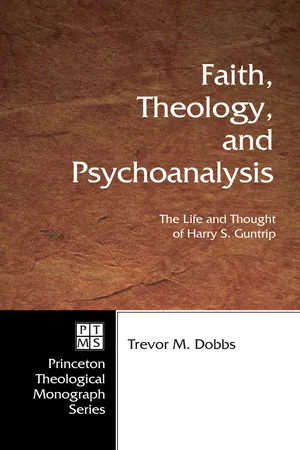
Faith, Theology, and Psychoanalysis
The Life and Thought of Harry S. Guntrip
- 202 pages
- English
- ePUB (mobile friendly)
- Available on iOS & Android
eBook - ePub
About this book
Information
Topic
Theology & ReligionSubtopic
Christian MinistryPart One

The Nature of Theology and Philosophy in Relation to Psychoanalysis
The first two chapters will introduce the dynamics inherent in the first polarity of this study: theological philosophy in dynamic tension with psychoanalysis. Chapter one will identify the philosophical and theological traditions that underlie the psychoanalytic tradition. This chapter will analyze the history of the development of psychoanalytic theory according to a spectrum embodied by two polar opposites: the classic and the romantic views. The ideal type of the classic vision is represented by the stoic and rationalistic Freudian tradition, while the ideal type of the romantic vision is represented by the spontaneous and optimistic Kohutian tradition. The parallel representative versions of the classic Kleinian and the romantic Winnicottian traditions within British psychoanalysis will be delineated. The philosophical traditions that underlie each of these psychoanalytic viewpoints will be articulated.
Chapter two will examine the opposite side of the coin identifying the psychological traditions that underlie the classic and romantic theological traditions of England and Europe, as well as the theopathology of these traditions from a psychoanalytic viewpoint.
The first polarity within the psychoanalytic tradition that I will examine is between what Guntrip called the rational and mechanistic theories in contrast to the dynamic and personal points of view. I shall begin with polarity within Freud himself.
1
The Philosophy and Theology of Psychoanalysis
The Polarity within Psychoanalysis between the Classic and Romantic Philosophical Worldviews
The Polarity within Freud
Peter Gay, in his biography of Freud, details Freud’s ambivalence about philosophy by highlighting Freud’s theoretical denial that psychoanalysis is a worldview, or Weltanschauung. Freud disassociated himself from philosophy in an attempt to establish credibility for psychoanalysis within the “scientific” community. Freud steeped himself in literature and history, describing himself as one who “‘found my way back to my earliest path,’ which was to ‘understand something of the riddles of the world in which we live and perhaps even to contribute something to their solution.’ In a word, he was returning to philosophy at last.”1 Yet Freud sought to reflect, if not identify with, the worldview of the Cartesian and positivistic philosophy of the scientific community of his day. René Descartes, famous for his dictum, I think, therefore I am, reflected this rationalistic and reductionistic thinking of the Enlightenment of the eighteenth century. His counterpart, Blasé Pascal, also a philosopher and mathematician of that period, embodied the intuitive response in his: The heart has its reasons of which Reason knows not. Gay frames this analysis of the philosophy (and thereby the theology) of psychoanalysis by identifying this ambivalence within Freud: consciously a rationalist, yet a philosopher, which is to say, a lover of wisdom (philo-sophia) at heart, the unconscious romantic.
Guntrip himself framed this ambivalence within Freud, citing a bifurcation of his theory into two main groups: “(1) the id-plus-ego-control apparatus, and (2) the Oedipus complex of family object relationship situations with their reappearance in treatment as transference and resistance.”2 He cites Heinz Hartmann, the central figure of American Ego Psychology, as the one who developed this line in Freud, where the picture of the psyche is a mechanism for maintaining homeostatic organization: “the autonomous system-ego and its apparatuses.” Guntrip sees Melanie Klein in England picking up the other line of Freud’s thought where the superego that “enshrines the fact of personal object-relations” is the “starting point of all of her new developments.”3 Guntrip saw Freud “trying to ride two horses at once, that of mechanistic theory with his economic and topographical points of view, and that of personal theory in his dynamic point of view worked out on the basis of psychogenetic processes in the medium of family relationships.”4
The Classic and Romantic Visions in Psychoanalysis
In his historical survey of the development of psychoanalytic theory, Personality Structure and Human Interaction,5 Guntrip employed a Hegelian dialectic in summing up object relations theory as the synthesis between Freudian instinct theory and the American Interpersonal-Cultural theory of Sullivan and Horney. Guntrip saw these two traditions as reductionistic in opposite directions, with the Freudian thesis trapped within a deterministic intrapsychic world, and the Interpersonalist antithesis limited to the environment of external interactions. Guntrip offered object relations theory as the synthesizing bridge between the two. Carlo Strenger makes a similar argument that a dialectical tension characteristic of psychoanalytic thought has existed since the 1920s.
Strenger himself is trained as both a philosopher and a psychoanalytic psychotherapist, teaching in the graduate program for history and philosophy of science at Hebrew University in Jerusalem. In his ponderous work, Between Hermeneutics and Science, he initially set out to answer the philosophical critiques by Grunbaum that psychoanalysis is a non-scientific discipline. He describes his own process of taking an intellectual and rational stance that would logically dispatch the critics of psychoanalysis “on a relatively high level of abstraction,”6 a position that he would refer to in another context as the stoic and intellectualized “classic vision” in philosophy.7 Yet the experience of his own analysis as well as working with his own patients brought this lofty effort down to earth.
I saw patients in psychoanalytic therapy and I went through my own analysis. The movement between daily clinical work and my own experience as an analysand on the one hand, and theoretical reflection about what I was doing and experiencing on the other, were both fruitful and at times difficult. If one writes purely about theoretical issues, one is less bothered by reality, so to speak. The sheer inner coherence of one’s ideas is what counts. It is more difficult to come to grips with and make sense of one’s own experience as it is lived and yet maintain a sense of direction about the theoretical view one wants to propound.8
Strenger here is describing the strong temptation within himself to retreat into “the sheer inner coherence of one’s ideas,” what Guntrip would call a Schizoid phenomena, rather than “come to grips with and make sense of one’s own experience as it is lived.” He asserts that “none of the philosophical models of what scientific knowledge is has turned out to be very useful in understanding what we actually do,” referring to both scientists and psychoanalysts. On the one hand, psychoanalysts have felt that the criticisms leveled against the discipline were based on a misconception of what they actually do. On the other, Strenger notes that psychoanalysts have not been open to criticism from the outside to be able to make use of it “in sharpening our understanding of what psychoanalytic thinking is all about.”9 His contribution to this gap is to offer his own model that attempts to bridge this distance between abstracted ideas and lived experience. “By integrating my clinical experience with a mo...
Table of contents
- Title Page
- Acknowledgments
- Note to the Reader
- Preface
- Introduction
- Part One: The Nature of Theology and Philosophy in Relation to Psychoanalysis
- Chapter 1: The Philosophy and Theology of Psychoanalysis
- Chapter 2: The Psychoanalysis of Theology and Philosophy
- Part Two: Historical Contexts of Guntrip’s Psychology and Theology
- Chapter 3: History of the British Independent Tradition in England
- Chapter 4: The Psychology and Theology of John Macmurray
- Chapter 5: Fairbairn’s Theological Roots and Impact on Guntrip
- Chapter 6: The Influence of D. W. Winnicott on Harry Guntrip
- Chapter 7: Guntrip’s Relationship with Fairbairn and Winnicott
- Part Three: Guntrip’s Theology as Internal Object to His Psychoanalytic Psychology
- Chapter 8: Guntrip’s Psychoanalytic Theology
- Chapter 9: Paradox
- Glossary
- Bibliography
Trusted by 375,005 students
Access to over 1.5 million titles for a fair monthly price.
Study more efficiently using our study tools.
Frequently asked questions
Yes, you can cancel anytime from the Subscription tab in your account settings on the Perlego website. Your subscription will stay active until the end of your current billing period. Learn how to cancel your subscription
No, books cannot be downloaded as external files, such as PDFs, for use outside of Perlego. However, you can download books within the Perlego app for offline reading on mobile or tablet. Learn how to download books offline
Perlego offers two plans: Essential and Complete
- Essential is ideal for learners and professionals who enjoy exploring a wide range of subjects. Access the Essential Library with 800,000+ trusted titles and best-sellers across business, personal growth, and the humanities. Includes unlimited reading time and Standard Read Aloud voice.
- Complete: Perfect for advanced learners and researchers needing full, unrestricted access. Unlock 1.5M+ books across hundreds of subjects, including academic and specialized titles. The Complete Plan also includes advanced features like Premium Read Aloud and Research Assistant.
We are an online textbook subscription service, where you can get access to an entire online library for less than the price of a single book per month. With over 1.5 million books across 990+ topics, we’ve got you covered! Learn about our mission
Look out for the read-aloud symbol on your next book to see if you can listen to it. The read-aloud tool reads text aloud for you, highlighting the text as it is being read. You can pause it, speed it up and slow it down. Learn more about Read Aloud
Yes! You can use the Perlego app on both iOS and Android devices to read anytime, anywhere — even offline. Perfect for commutes or when you’re on the go.
Please note we cannot support devices running on iOS 13 and Android 7 or earlier. Learn more about using the app
Please note we cannot support devices running on iOS 13 and Android 7 or earlier. Learn more about using the app
Yes, you can access Faith, Theology, and Psychoanalysis by Trevor Dobbs in PDF and/or ePUB format, as well as other popular books in Theology & Religion & Christian Ministry. We have over 1.5 million books available in our catalogue for you to explore.