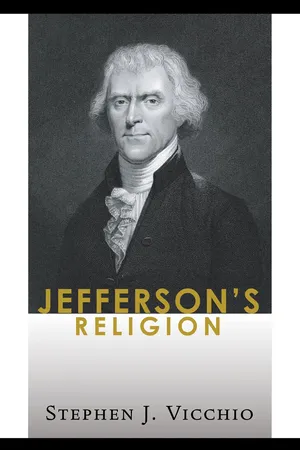
Thomas Jefferson's views have led many to conclude that he was an atheist, as recently as in the work of Christopher Hitchens. But the third President has also been labeled a deist, a Unitarian, and a Christian. Philosopher and theologian Stephen Vicchio takes on the challenge of analyzing Jefferson's writings in detail to see if any of these appellations is fitting. The author finds that Jefferson's two volumes on the New Testament Gospels (A Syllabus of an Estimate of the Merit of the Doctrines of Jesus and The Life and Morals of Jesus of Nazareth) reveal a great deal concerning the theological perspective of this famous American statesman.
- 158 pages
- English
- ePUB (mobile friendly)
- Available on iOS & Android
eBook - ePub
Jefferson's Religion
About this book
Information
Topic
Theology & ReligionSubtopic
Christian Theology1
Was Thomas Jefferson an Atheist?
There is no proof for that hypothesis.
—Pierre Simon LaPlace (in response to Napoleon’s objection that LaPlace has omitted God in his Celestial Mechanics)
What can be asserted without proof can be dismissed without proof.
—Christopher Hitchens
“Less Than Miraculous”
Some have made the love of God the foundation of morality. If we did a good act merely from the love of God and a belief that it is pleasing to Him, whence arises the belief of the atheist? Is it idle to say, as some do, that no such being exists . . . Diderot, D’Alembert, D’Holbach, Condorcet, are known to have been among the most virtuous of men. Their virtue, then, must have had some other foundation than the love of God.
—Thomas Jefferson
Letter to Thomas Law (June 13, 1814)
Introduction
In January, 2001, during a broadcast of ABC’s television coverage of President George W. Bush’s first inaugural, Peter Jennings, the ABC anchor, made a comment that Thomas Jefferson was an atheist. The comment came in connection with a discussion of Jefferson’s religious beliefs, and the actual comment was “Not many Americans, of course, knew that Thomas Jefferson was an atheist.”1 This accusation of Mr. Jennings about our third President was not the first time Jefferson had been called a non-believer. Indeed, from Jefferson’s own time to the present, a number of thinkers have thought, or accused, Thomas Jefferson of atheism.
In this chapter, we will explore the history of the claim that Thomas Jefferson did not believe in God. We will begin with a section on accusations of Jefferson’s atheism in his own time. In a second section in this chapter, we will explore several references to atheism that Jefferson makes in his letters and other writings. In a third section, we will examine some contemporary claims made by journalists that Jefferson was an atheist.
In a concluding section of this chapter, we will supply abundant evidence that Jefferson was not an atheist. Indeed, we will offer substantial proof that the answer to the question posed by the title of this chapter is a resounding No!
Jefferson, Atheism, and His Own Time
Thomas Jefferson in his own time, and for many years after his death, was accused of being an atheist. Many of the attacks on Jefferson’s religion had, as their origins, Jefferson’s opponents in the election for president of the United States in 1800. Dozens of pamphlets and newspaper articles, in cities along the eastern coast, attacked Jefferson as a “French infidel and atheist.”2 Many sermons were preached in Jefferson’s day that if he were elected, he would banish God, overthrow the church, and destroy belief in the Bible as the word of God.3 Some Jefferson scholars report that prior to the election of 1800, many believers hid their Bibles under mattresses and other places, in the event that Jefferson were to be elected.4
The Reverend Thornton Stringfellow, a prominent Virginia divine of Jefferson’s day, tells us, “Mr. Jefferson did not bow to the authority of the Bible, and on this subject I do not bow to him.” The International Cyclopedia, a nineteenth-century American encyclopedia edited by Daniel Coit Gilman, president of Johns Hopkins University, tells us, “In religion it is probable that he [Jefferson] was not far from what was then known and execrated as a Freethinker.”
In New England, Rev. John Mason called Jefferson “a confirmed infidel,” known for “vilifying the divine word, and preaching insurrection against God.”5 Thomas Robins, a young Connecticut preacher of Jefferson’s day, called Jefferson a “howling atheist.”6 Timothy Dwight, the president of Yale in a 1798 speech referred to Jefferson as an atheist.7 Dwight wrote:
It cannot be necessary to adopt any train of reasoning to show that a man who disbelieves the inspiration and divine authority of scripture—who not only denies the divinity of our Savour, but reduces him to the grade of an uneducated, ignorant and erring man—who calls the God of Abraham (the Jehovah of the Bible) a cruel and remorseless being, cannot be a Christian.8
Timothy Dwight’s remarks were typical of New England clergy of the day. The Reverend Bird Wilson, an Episcopal minister and historian, several years after Jefferson’s death, wrote, “The founders of our nation were nearly all Infidels.”9 Presumably Thomas Jefferson was one of the people the Rev. Wilson had in mind.
Indeed, among Jefferson’s opponents in the election of 1800 none were as fervent as the New England clergy, especially in Connecticut where Congregationalism was the established church. These ministers were solidly biblical in their theology, and solidly Federalist, that is, anti-Jeffersonian, in their politics.
Alexander Hamilton, in his collected published works, called Jefferson an “atheist and fanatic.”10 Daniel Webster, after a visit to Monticello, reported that Jefferson has a preference for “French opinions, morals, and religion.”11 There is no doubt that what Hamilton had in mind was the atheism of Voltaire, the Marquis LaPlace, and others.
In a letter to Mrs. Harrison Smith from August 6, 1816, Jefferson responds to these charges of irreligion made against him by the New England clergy:
The priests indeed have heretofore thought proper to ascribe to me religious, or rather anti-religious sentiments, of their own fabric, but such as soothed their resentments against the act of Virginia for establishing religious freedom. They wish him to be thought atheist, deist, or devil, who could advocate freedom from their religious dictations.12
Again, in discussing infidels, Jefferson suggests that if there were no priests, there would be no infidels:
My opinion is that there would have never been an infidel, if there had never been a priest. The artificial structures they have built on the purest of all moral systems, for the moral purpose of deriving peace and power, revolt those who speak for themselves, and who read in that system only what is really there. These, therefore, they brand with such nick-names as their enmity chooses gratuitously to impart.13
Clearly, Jefferson is referring here to the treatment he has been given by the clergy. From the election of 1800 to his death, Jefferson continuously remarks on the clergy, in general, referring to their indictment of Jefferson’s atheism, or, that the clergy themselves have missed the genuinely true doctrines of religion.
In a letter to John Adams from July 5, 1814, Jefferson refers to the Christian clergy:
The Christian priesthood, finding the doctrines of Christ leveled to every understanding, and too plain to need explanation, saw in the mysticism of Plato materials with which they might build up an artificial system, which might from its indistinctness, admit everlasting controversy, give employment...
Table of contents
- Title Page
- Introduction
- Chapter 1: Was Thomas Jefferson an Atheist?
- Chapter 2: Was Thomas Jefferson a Unitarian?
- Chapter 3: Was Thomas Jefferson a Deist?
- Chapter 4: Was Thomas Jefferson a Christian?
- Chapter 5: In What Did Thomas Jefferson Not Believe?
- Chapter 6: What Were Thomas Jefferson’s Religious Beliefs?
- Select Bibliography
Trusted by 375,005 students
Access to over 1.5 million titles for a fair monthly price.
Study more efficiently using our study tools.
Frequently asked questions
Yes, you can cancel anytime from the Subscription tab in your account settings on the Perlego website. Your subscription will stay active until the end of your current billing period. Learn how to cancel your subscription
No, books cannot be downloaded as external files, such as PDFs, for use outside of Perlego. However, you can download books within the Perlego app for offline reading on mobile or tablet. Learn how to download books offline
Perlego offers two plans: Essential and Complete
- Essential is ideal for learners and professionals who enjoy exploring a wide range of subjects. Access the Essential Library with 800,000+ trusted titles and best-sellers across business, personal growth, and the humanities. Includes unlimited reading time and Standard Read Aloud voice.
- Complete: Perfect for advanced learners and researchers needing full, unrestricted access. Unlock 1.5M+ books across hundreds of subjects, including academic and specialized titles. The Complete Plan also includes advanced features like Premium Read Aloud and Research Assistant.
We are an online textbook subscription service, where you can get access to an entire online library for less than the price of a single book per month. With over 1.5 million books across 990+ topics, we’ve got you covered! Learn about our mission
Look out for the read-aloud symbol on your next book to see if you can listen to it. The read-aloud tool reads text aloud for you, highlighting the text as it is being read. You can pause it, speed it up and slow it down. Learn more about Read Aloud
Yes! You can use the Perlego app on both iOS and Android devices to read anytime, anywhere — even offline. Perfect for commutes or when you’re on the go.
Please note we cannot support devices running on iOS 13 and Android 7 or earlier. Learn more about using the app
Please note we cannot support devices running on iOS 13 and Android 7 or earlier. Learn more about using the app
Yes, you can access Jefferson's Religion by Stephen J. Vicchio in PDF and/or ePUB format, as well as other popular books in Theology & Religion & Christian Theology. We have over 1.5 million books available in our catalogue for you to explore.