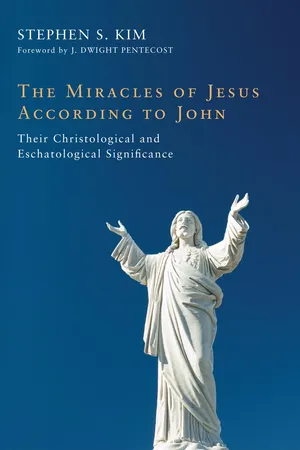
eBook - ePub
The Miracles of Jesus According to John
Their Christological and Eschatological Significance
- 240 pages
- English
- ePUB (mobile friendly)
- Available on iOS & Android
eBook - ePub
The Miracles of Jesus According to John
Their Christological and Eschatological Significance
About this book
In our age of theological relativism, Jesus' question to His own disciples continues to ring true: "Who do the people say that the Son of Man is?" Through Jesus' seven miracles and His seven "I Am" sayings, the apostle John provides a clear answer to that all-important question. Furthermore, what do Jesus' miracles represent? Are they designed to point to something or someone? In our "supernatural-crazed" culture that affects even evangelical Christianity, it is refreshing to be reminded that biblical miracles were never arbitrary but were always purposeful, authenticating God's message and His messenger(s). In the Gospel of John, the miracles of Jesus are both Christological, that is, they highlight Jesus' Person, and eschatological, that is, they foreshadow the work the Messiah will do in His future Advent. The miracles remind us that God's desire for every believer is first and foremost a spiritual relationship with Him through His Son. Furthermore, Jesus' miracles also remind us that God's work in and for every believer will be fully and ultimately realized in the everlasting life.
Information
1
Introduction
The Presence and Significance of the Old Testament in the Fourth Gospel
The Gospel of John stands unique in many ways in comparison to the Synoptic Gospels. One of the ways in which the Fourth Gospel distinguishes itself from the Synoptics is in its relative infrequency of quotations or direct references to specific Old Testament passages. For instance, C. K. Barrett observes 124 direct references to the Old Testament in the Gospel of Matthew, 70 in the Gospel of Mark, 109 in the Gospel of Luke, but only 27 direct references to the Old Testament in the Gospel of John.1 However, it would be erroneous to conclude based on these facts alone that the writer of the Fourth Gospel had a more limited knowledge of the Old Testament than the other three evangelists.2 Even a casual reading of this Gospel reveals that it is replete with allusions and imagery of the Hebrew Bible.3 Although the author of the Fourth Gospel does not directly quote Old Testament passages nearly as frequently as the other gospel writers, still his writing as a whole is immersed in Old Testament theology. As Barrett insightfully observes concerning the Fourth Evangelist, “For him the Old Testament was itself a comprehensive unity, not a mere quarry from which isolated fragments of useful material might be hewn.”4 In other words, this Gospel breathes the Old Testament from start to finish.
The Fourth Gospel, which is characterized by its many uses of symbolic language, is immersed in allusions and imagery of the Hebrew Bible. In fact, the frequency of John’s allusions to the Old Testament is surpassed only by the Gospel of Matthew. Graham Scroggie attributes 63 Old Testament references to the Gospel of Mark, 129 to Matthew, 90 to Luke, and 124 to John.5
Thus, the Gospel of John is second only to Matthew in the frequency of his allusions to the Old Testament.6 Alfred Plummer is right in saying that “the Fourth Gospel is saturated with the thoughts, imagery, and language of the Old Testament.”7 And, B. F. Westcott is not exaggerating when he confesses, “Without the basis of the Old Testament, the Gospel of St. John is an insoluble riddle.”8 In other words, the richness of John’s theology could not be fully comprehended without an adequate knowledge of the Old Testament, whose theology is drawn first and foremost from its deep reservoir. Gerald Borchert concurs that the Hebrew Scriptures play a significant part in the Fourth Gospel: “It is my firm conviction that the place to begin a reflection on the milieu of the Fourth Gospel is with the Old Testament. But the test of John’s pervading milieu is not to be measured in terms of direct quotation from the Old Testament because John has fewer quotations than the other Gospels. Yet this Gospel literally breathes the influence of Israel’s textbook.”9
For evidence that the Gospel of John is saturated in Old Testament theology, one needs to look no farther than the opening section of the Gospel, commonly known as the “Prologue” (1:1–18). Emphasizing the eternality of Jesus Christ, the apostle John begins with the words, “In the beginning was the Word, and the Word was with God, and the Word was God. He was with God in the beginning” (John 1:1). These words beckon for a comparison to the opening words of the Hebrew Bible, “In the beginning God created the heavens and the earth” (Gen 1:1). Furthermore, the beginning words of the Fourth Gospel shed further light on the creation account of Genesis 1, namely, that God the Father created the world through the Son (cf. Col 1:16–17; Heb 1:2). Thus, God the Son, the eternal Word who was coexistent with the Father in the beginning, is also revealed to be the Creator. This connection is summarized well by Bruce Waltke: “The creation account of the Old Testament finds its full explication in Jesus of Nazareth, the God-man. He is the Creator, the One full of light, life, wisdom, and goodness. As man, He is the One who is bringing the earth under His dominion. . . . John wrote about Him as the Creator.”10
The use of the word lo/goj in John 1:1 also ties itself to Genesis 1:3, where it describes God’s creative acts by the simple yet powerful command of His Word.11 Although scholars have proposed various hypotheses concerning the origin of the lo/goj, its nearest and most logical antecedent is again the Old Testament and the Hebrew term rbd (“dabar” meaning Word).12
It is especially true in the Old Testament Prophets, where their writings often begin with the words, “the Word of the LORD came to . . .”13 These words also confirm the opening words of the Epistle to the Hebrews: “In the past God spoke to our forefathers through the prophets at many times and in various ways, but in these last days he has spoken to us by his Son, whom he appointed heir of all things, and through whom he made the universe” (Heb 1:1–2).
The key words and concepts in the remaining parts of the Prologue also reveal their rich heritage from the Old Testament, and they are all developed further in the Gospel narrative itself. Words such as “dwelt” (e0skh/nwsen), “glory” (do&can), “grace and truth” (xa&ritoj kai\ a0lhqei/aj), and “only begotten” (monogenh\j), are all familiar words and phrases in the Greek translation of the Old Testament (LXX). They are introduced in the Prologue and developed further in the Gospel narrative. Furthermore, key concepts in the Prologue such as the “witness” (marturi/a) motif, “light and life” (fw~j kai\ zwh\) relationship, and “law and grace” (no/moj kai\ xa/rij) comparison, all find their antecedents primarily in the Old Testament.14 These are also introduced in the Prologue and developed further in the Gospel. In sum, then, the Prologue is a sample of the richness of Old Testament theology that the Fourth Evangelist develops in his Gospel. The rest of the Gospel is also flooded with unmistakable references to the Old Testament. The section immediately following the Prologue, commonly referred to as the “Testimonium” (1:19–51), includes testimonies by John the Baptist and Jesus’ followers that highlight Jesus’ messianic descriptions from the Hebrew Bible. Significant terms such as “the Lamb of God” (o3 a2mno\j tou= qeou=) (v. 29), “the Messiah” (to\n Messi/an) (v. 41), “the one Moses wrote about in the Law, and about whom the prophets also wrote” ( 4On e1grayen Mwu+sh=j e0n tw~| no/mw| kai\ oi9 profh=tai eu9rh/kamen) (v. 45), “the Son of God” (o3 ui9o\j tou= qeou=), and “the King of Israel” (o3 basileu\j tou= I)srah/l) (v. 49), all find their source in the Hebrew Bible’s description of the coming Messiah.15 Furthermore, this section concludes with Jesus’ clear reference to Jacob’s dream and his encounter with heaven (Gen 28) and how, as the Son of Man (Dan 7:13), He is the essence and embodiment of the coming messianic revelations (v. 51).
The sign-miracles (shmei=a) in the “Book of Signs” (John 2–12)16 and their attendant contexts in the form of narratives and discourses which demonstrate Jesus to be the promised Messiah of the Hebrew Scriptures and the divine Son of God (cf. 20:30–31), find their primary source of evidence from the Old Testament in supporting that claim.17 For instance, the first miracle of Jesus’ transforming water into wine in chapter 2 clearly anticipates the joy and abundance in the messianic kingdom described in the Prophets (Isa 25:6; 27:2–6). Also, in connection with the first miracle, the temple cleansing by Jesus in John 2:12–22 anticipates the coming of the Messiah in His eschatological kingdom, when He is expected to begin His ministry in the temple to purify the nation Israel (Mal 3:1–3).18 And, Jesus’ teaching to Nicodemus concerning being “born again/from above” in chapter 3 also hearken back to Old Testament truth of spiritual rebirth (Isa 44:3; Ezek 36:25–27). Further, the unmistakable comparison of Jesus Himself with the raised serpent in the wilderness (Num 21:9) as the basis of forgiveness and eternal life highlights the fulfillment of His messianic work of sacrificial redemption on the cross (Isa 53). Also, Jesus’ gift of the living water to the Samaritan woman in chapter 4 brings to mind passages in the Old Testament anticipating the joy from the well of God’s salvation in the eschatological kingdom (Isa 12:3), “the fountain of living waters” (Jer 2:13; 17:13), and God’s invitation to the thirsty to come to the waters He freely offers (Isa 55:1).19 Furthermore, the miracle of healing the official’s son in chapter 4:46–54, which brings the “Cana Cycle”20 (chaps. 2–4) to a close, demonstrates yet another important aspect of the Messiah’s role as predicted by the Old Testament prophets, namely, His authority to bring healing and deliverance from the brink of death (Isa 53:4; 61:1).21
The sign-miracles and their attendant narratives and discourses in John 5–12 are all set in the context of Jewish feasts, namely, the Sabbath, the Passover, and the Tabernacles, as they also signify the anticipatory characteristics and activities of the Messiah.22 They also refer to the Old Testament as the primary antecedent. Thus, it is imperative to comprehend the basic Old Testament background behind the feasts, as the sign-miracles and their attendant narratives and discourses are pitted against it. For example, the miracle of healing of the lame man at the Pool of Bethesda in chapter 5, although it is set in the context of an “unnamed feast,” the emphasis is on the fact that Jesus healed on the Sabbath.23 This miracle provides a glimpse of yet another aspect of the Messiah’s work, namely, the healing of the blind, the dumb, the mute, and the lame (Isa 35:5–6; 61:1).
The following sign-miracles in these chapters are also set in the context of Old Testament feasts. For instance, the two sign-miracles recorded in John 6, with the “Bread of Life” discourse in between, take place during the Passover. The miracle of feeding the five thousand during the Passover brought natural comparison of Jesus with another “sign” worker, Moses, who predicted that a prophet like him would arise (Deut 18:15). People reasoned that, since Moses had fed the people in the wilderness and also delivered them out of the Egyptian bondage, Jesus could also lead the nation out of their Roman bondage since He also fed the people.24 The Passover background of this miracle is unmistakably tied to Israel’s deliverance from the Egyptian bondage under Moses’s leadership. Moses, as the prophet of God, also worked “sign” miracles to demonstrate divine authority (Deut 34:11). Apart from the “signs” he performed in Egypt, he also performed great “signs” in the wilderness for the benefit of the nation. Throughout the wilderness dwelling, Israel received “bread from heaven” that fed the nation. Jesus’ performing the miracle of feeding the five thousand is a “sign” to reveal His messianic identity, for there are indications in the Scriptures that the messianic age would be accompanied by signs like those of the Mosaic period.25 As the Hebrew prophets declared long ago, God’s deliverance for Israel at the Messiah’s advent will be characterized by signs and wonders that were present when Moses led the nation out of Egypt (Mic 7:15; Isa 48:20–21). The feeding of the multitudes thus anticipates the day when God will abundantly provide for His people in the eschatological banquet.
Continuing the same theme of relating the days of Moses with the coming eschatological age by the similarity of their miracles, the subsequent sign of Jesus’ walking on the Sea of Galilee (John 6:16–21) reveals yet another aspect of His identity as the promised Messiah and the unique Son of God. Yahweh’s provision for His people in leading them through the Red Sea and exhibiting His control over nature finds similar parallel with Jesus’ walking on the Sea of Galilee to protect His disciples. What is even more re...
Table of contents
- Title Page
- Dedication
- Foreword
- Preface
- Acknowledgements
- Reference Abbreviations
- Chapter 1: Introduction
- Part One: Introduction of Jesus’ Miracles in the Fourth Gospel
- Chapter 2: Shmei~a in the Fourth Gospel
- Chapter 3: The Prologue (1:1–18)
- Chapter 4: The Testimonium (1:19–51)
- Chapter 5: The First Sign: Changing Water into Wine (2:1–11)
- Part Two: The Seven Sign-Miracles of Jesus in the Fourth Gospel
- Chapter 6: The Second Sign: Healing the Official’s Son (4:43–54)
- Chapter 7: The Third Sign: Healing the Lame Man (5:1–16)
- Chapter 8: The Fourth Sign: Feeding the Five Thousand (6:1–15)
- Chapter 9: The Fifth Sign: Walking on the Sea (6:16–21)
- Chapter 10: The Sixth Sign: Healing the Man Born Blind (9:1–41)
- Chapter 11: The Seventh Sign: Raising Lazarus from the Dead (11:1–44)
- Chapter 12: The Significance of John 12 and John 13–20 in their Relationship to the “Book of Signs”
- Part Three: Conclusion of Jesus’ Miracles in the Fourth Gospel
- Chapter 13: Conclusion and Summary
- Bibliography
Trusted by 375,005 students
Access to over 1.5 million titles for a fair monthly price.
Study more efficiently using our study tools.
Frequently asked questions
Yes, you can cancel anytime from the Subscription tab in your account settings on the Perlego website. Your subscription will stay active until the end of your current billing period. Learn how to cancel your subscription
No, books cannot be downloaded as external files, such as PDFs, for use outside of Perlego. However, you can download books within the Perlego app for offline reading on mobile or tablet. Learn how to download books offline
Perlego offers two plans: Essential and Complete
- Essential is ideal for learners and professionals who enjoy exploring a wide range of subjects. Access the Essential Library with 800,000+ trusted titles and best-sellers across business, personal growth, and the humanities. Includes unlimited reading time and Standard Read Aloud voice.
- Complete: Perfect for advanced learners and researchers needing full, unrestricted access. Unlock 1.5M+ books across hundreds of subjects, including academic and specialized titles. The Complete Plan also includes advanced features like Premium Read Aloud and Research Assistant.
We are an online textbook subscription service, where you can get access to an entire online library for less than the price of a single book per month. With over 1.5 million books across 990+ topics, we’ve got you covered! Learn about our mission
Look out for the read-aloud symbol on your next book to see if you can listen to it. The read-aloud tool reads text aloud for you, highlighting the text as it is being read. You can pause it, speed it up and slow it down. Learn more about Read Aloud
Yes! You can use the Perlego app on both iOS and Android devices to read anytime, anywhere — even offline. Perfect for commutes or when you’re on the go.
Please note we cannot support devices running on iOS 13 and Android 7 or earlier. Learn more about using the app
Please note we cannot support devices running on iOS 13 and Android 7 or earlier. Learn more about using the app
Yes, you can access The Miracles of Jesus According to John by Stephen S. Kim in PDF and/or ePUB format, as well as other popular books in Theology & Religion & Biblical Criticism & Interpretation. We have over 1.5 million books available in our catalogue for you to explore.