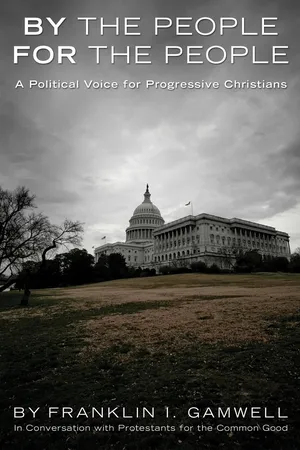
eBook - ePub
By the People, For the People
A Political Voice for Progressive Christians
- 152 pages
- English
- ePUB (mobile friendly)
- Available on iOS & Android
eBook - ePub
About this book
What vision for our political life does Christian faith affirm and how might its principles be applied to specific political issues? In speaking to these questions, this book defends a third alternative to the liberal and conservative ideals so influential in American public life, and, in the process, criticizes the so-called Christian Political Right for misunderstanding what Christian faith means for politics. Christians worship the God of all-embracing love who wills that all people flourish here in this world through a beloved community. Because this God is ever-present in the deepest experience of all people, the true vision for our common life can be discerned and applied through politics by way of full and free discussion and debate. Democracy is, then, the political form of the beloved community, and justice means empowering all to achieve in ways that enhance human mutuality. This theological account is articulated in relation to diverse contemporary issues: abortion, same-sex marriage, affirmative action, campaign finance reform, economic inequality, and our nation's responsibilities within the wider world. The writings herein represent the author's engagement with Protestants for the Common Good, a Chicago-based organization that seeks to educate and mobilize Christians for democratic politics, and contains some of the official political statements of that organization.
Information
Topic
Theology & ReligionSubtopic
PoliticsPart One
Theological Self-Understanding
1
How Faith Matters for Democracy
The founders of Protestants for the Common Good (PCG) perceived a special need for their venture, and their three principal reasons remain compelling today. First, Christian faith includes a vision for the human community and the common good profoundly at odds with certain alternative ideals widely influential in recent United States politics and implicated in some of its deepest faults. But, second, many so-called mainline Christian churches whose members might be expected to express this vision have, in fact, failed to appreciate and teach the relation between faith and democratic citizenship. Moreover, and third, the Christians who have been most visible and influential in our public life during the past several decades have represented the so-called Christian Political Right, which misrepresents the Christian faith and its ideal for human community. I seek here to clarify the understanding of Christian faith PCG intends to express in its activities and why that understanding is politically important.
In presenting the theology of PCG, I will mention some things to be discussed at greater length in subsequent writings and will, from time to time, footnote the relevant materials. Although my presentation here is not an official statement, it does, I am persuaded, identify convictions implied by PCG’s commitment to politics in accord with the democratic ideal, and I anticipate substantial agreement among my colleagues. Accordingly, I will speak here of PCG’s theological beliefs, doing so with the proviso that what I offer is my own accounting of them.
According to some recent observers, the Christian Political Right has passed its zenith and no longer enjoys the power it exercised during the past ten or twenty years. Various reasons for this change are noted, including, for one, the movement’s intimacy with the now widely unpopular administration of George W. Bush. Another is the increasing diversity of political purposes within the evangelical Christian community, from which the Christian Political Right has drawn its principal strength. Here at the outset, let me stress that I do not equate the Christian Political Right with evangelical Christianity. Many churches and individuals who call themselves evangelicals have not pursued the distinctive political agenda of the Christian Political Right. This may be increasingly true more recently, although the movement continues to be, I am persuaded, a significant force in American politics, perhaps now especially in certain state and local politics. Be that as it may, PCG’s theological convictions and their contemporary significance can be more vividly displayed in contrast to Christian Political Right, and I will proceed by way of that contrast.
Theology on the Christian Political Right
Wherever it is found, Christian faith affirms the religious significance of Jesus, and basic disagreements among Christians typically involve differing accounts of this belief. On the Christian Political Right, Jesus is the Christ because he was both human and divine, God’s son, and through his sacrifice, God opened for humans what otherwise would be unavailable because our sin would prevent it, namely, the chance for ultimate worth or what Christians call salvation. True relation to God first became possible when God became human in Jesus. Salvation depends, therefore, on accepting Jesus as one’s personal Savior. With this acceptance, we receive the promise of eternal life or life everlasting, and Christian discipleship during life on this earth is preparation for true fulfillment in the next world.
For many who see their Christian faith in this way, the life of preparation centers on the church, where the chance for salvation is preached and faith is cultivated and sustained. This focus does not forget the commandment to love those outside the church, to love one’s neighbor as oneself. To the contrary, charity toward all people is exhorted and practiced. But love for one’s neighbor seeks above all to bring about her or his personal acceptance of Jesus as Savior and thus the neighbor’s inclusion within the Christian fellowship. In this sense, God created the larger world as the stage on which the church may effect its higher purpose, namely, salvation to eternal life. So, the Christian community’s integrity and growth is God’s primary purpose and a Christian’s primary moral concern. Given these convictions, discipleship often comes to mean cultivating and enacting the moral character through which orientation to eternal life is upheld and thus worldly temptations are conquered, that is, temptations to find happiness or fulfillment in this life or this world, especially in the pleasures or power it purports to give. Life within the earthly city makes one ready for the heavenly city, and this bearing is kept secure by certain personal virtues. These include habits exhibited in family commitment and sexual control, taking responsibility for oneself, willingness to work with diligence, obedience to law and local mores, and charity toward victims of misfortune or those who suffer. Moreover, the expressions of one’s moral character should be based on personal piety and thus should also include witness to salvation through Jesus Christ.
To first appearances, this focus on the church and its nurture of a faithful life may seem to call for passivity toward, even withdrawal from, politics—and, in fact, many who populated the Christian Political Right as it emerged in the later twentieth century belonged to churches in which faith was previously separated from politics. “Religion and politics don’t mix” was a favorite dictum of those churches in the mid-twentieth century. Nonetheless, the very reasons for that divorce—namely, primary moral concern with the church’s higher purpose and thus with cultivation of the personal virtues—led these same Christians to take up a political agenda once the following perception was added: those who became the Christian Political Right increasingly saw our society as pervasively corrupted by secularism or “secular humanism” and its permissive sanction for life aimed at satisfying worldly wants.
A society of this kind, they believed, is itself displeasing to God because it fosters in its members devotion to worldly things, deepening their sin. But this social context is the more intolerable because it is a hostile stage for the church. The work of evangelism is impeded when secularistic life styles become brazen among those whom Christians seek to convert, and those already being saved within the church can be sorely tempted away from the pious life. There is a special threat to the raising of Christian children, and this is why the prohibition of prayer in the public schools and their refusal to teach creationism alongside evolution are such vital issues on the Christian Political Right.
Moreover, secularism in the later twentieth century was seen as a siege against an earlier American culture. On this view, the United States was born based on Christian principles, and its earlier moral culture largely endorsed the virtues of self-control, personal responsibility, and diligent work important to the pious life. Indeed, the separation of church and state first given full articulation in our Bill of Rights was, we are told, itself an endorsement of the Christian worldview. The church was not separated for the sake of the state; the state was separated for the sake of the church—in recognition of the church’s higher purpose, to which the state must not pretend to be equal because the larger society properly provides only the stage for God’s primary purpose. Religious freedom, in other words, was meant as freedom for the church to realize its centrality in the divine plan. In this sense, American democracy in the form intended at the nation’s beginning represents the ideal civil order, and this is why prayer in the public schools is not seen to be inconsistent with religious freedom.
Given their perception of America’s moral decay, those who became the Christian Political Right turned from disinterest in politics to vigorous political participation in order to reform a social and cultural context that had become decadent and hostile to those personal virtues essential for the Christian mission. This is why the movement’s political purposes center on giving governmental support for so-called traditional values. Now, clearly, there is every reason to agree that dedication to intimate relationships, taking responsibility where one can, willingness to work, and charity toward those who suffer are essential to a good society. But the Christian Political Right is marked by the view that lives of personal moral character are enough to have a good society, by its belief in, as we may say, the sufficiency of private virtue. So, the movement’s political agenda is largely exhausted by issues such as abortion, same-sex relationships, what is taught in the schools, the disciplines of law and order, rolling back the welfare state, and governmental favoritism toward religion.1
And because this reform is seen as reclaiming America’s earlier moral culture, the ringing critique of secularistic society is quite compatible with what could at first blush seem incongruous, namely, ringing endorsement of America’s special goodness as it went to war in Iraq and, more generally, sought to spread American-style politics in a supposed global war for world supremacy with Muslim extremists. Because, for these Christians, our nation’s beginnings recognized the subservience of society to the church, and our democracy as originally intended represents the ideal form of civil order, they are zealous believers in American exceptionalism—the view that America was born for a unique task in world history, a God-given vocation to spread American-style democracy as the background for the spread and triumph of Christian faith. Support for this providential mission internationally, then, goes hand-in-glove with resisting the enemy of “secular humanism” domestically.2
We can now restate the theology backing this political agenda. For those on the Christian Political Right, Jesus in his life and death and resurrection originates the possibility of salvation, and for this reason, proper relation to God is impossible without accepting Jesus as one’s personal Savior. In a word, the significance of Jesus is exclusive; that is, no other person or event or context can be efficacious for salvation. There can be no salvation outside confession of Jesus as one’s Lord. With this belief, the Christian Political Right expresses in its own way an understanding of Christian faith shared by many other contemporary Christians who may depart from the specific political views we have reviewed. But the point is this: those political views depend on Christian exclusivism. Some Christian exclusivists are not on the Christian Political Right, but no one can consistently stand over there without asserting the necessity of Jesus for salvation. Why? Because only such a theology warrants the privileged role of the church in God’s plan for the world—and in turn, this higher purpose of the church warrants the political agenda focused on governmental endorsement of certain personal virtues, the moral character whereby piety subdues temptations to seek happiness or fulfillment in this life or this world.
Theology at Protestants for the Common Good
At this point, some may be perplexed and wanting to ask: but don’t all Christians believe in the necessity of Jesus for salvation? No, they do not, and the theology backing PCG is a case in point. PCG does indeed affirm the religious significance of Jesus but denies Christian exclusivism. On this understanding of Christian faith, Jesus does not originate but, rather, decisively illuminates the possibility of salvation. To illuminate means here to re-present or present again clearly what is already present but only dimly apprehended in the experience of every human in every moment. What Christians see through Jesus, we believe, is the God of all-embracing love, and nothing less than an omnipresent offer of salvation is consistent with God’s omnipresent love. So, to be human at all is to experience, at the deepest level and behind everything else we might encounter, the God who unceasingly calls every person to true faith. Awareness of God occurs, Reinhold Niebuhr said, “as an overtone . . . in all experience.”3 All humans continually receive the chance to accept God’s love as our assurance of ultimate worth, that is, assurance of everlasting significance for all that we are and do. Because the source of our ultimate worth is also the ground of our ultimate commitment, this ever-present chance to accept God’s love is also the chance to love God with all our hearts and souls and minds and strength by loving all the world God loves, all our neighbors as ourselves. God’s love accepted is salvation, and the freedom to live with integrity by living for God is the very definition of what it means to be human.
At the same time, we humans are prone in our deepest decisions to rebel against God by taking our own narrow advantage or the interest of some particular group to be all-important, as if it could give ultimate worth. We do not love all that God loves but, rather, love without reservation our own success or our own power or our own race or our own nation—and, thereby, we abuse ourselves and debase the human community through ex...
Table of contents
- Title Page
- Foreword by John R. Buchanan
- Preface
- Part One: Theological Self-Understanding
- Part Two: Ideals of the Common Good
- Part Three: Issues of the Common Good
- Part Four: Official Statements of Protestants for the Common Good
- Bibliography
Trusted by 375,005 students
Access to over 1.5 million titles for a fair monthly price.
Study more efficiently using our study tools.
Frequently asked questions
Yes, you can cancel anytime from the Subscription tab in your account settings on the Perlego website. Your subscription will stay active until the end of your current billing period. Learn how to cancel your subscription
No, books cannot be downloaded as external files, such as PDFs, for use outside of Perlego. However, you can download books within the Perlego app for offline reading on mobile or tablet. Learn how to download books offline
Perlego offers two plans: Essential and Complete
- Essential is ideal for learners and professionals who enjoy exploring a wide range of subjects. Access the Essential Library with 800,000+ trusted titles and best-sellers across business, personal growth, and the humanities. Includes unlimited reading time and Standard Read Aloud voice.
- Complete: Perfect for advanced learners and researchers needing full, unrestricted access. Unlock 1.5M+ books across hundreds of subjects, including academic and specialized titles. The Complete Plan also includes advanced features like Premium Read Aloud and Research Assistant.
We are an online textbook subscription service, where you can get access to an entire online library for less than the price of a single book per month. With over 1.5 million books across 990+ topics, we’ve got you covered! Learn about our mission
Look out for the read-aloud symbol on your next book to see if you can listen to it. The read-aloud tool reads text aloud for you, highlighting the text as it is being read. You can pause it, speed it up and slow it down. Learn more about Read Aloud
Yes! You can use the Perlego app on both iOS and Android devices to read anytime, anywhere — even offline. Perfect for commutes or when you’re on the go.
Please note we cannot support devices running on iOS 13 and Android 7 or earlier. Learn more about using the app
Please note we cannot support devices running on iOS 13 and Android 7 or earlier. Learn more about using the app
Yes, you can access By the People, For the People by Franklin I. Gamwell in PDF and/or ePUB format, as well as other popular books in Theology & Religion & Politics. We have over 1.5 million books available in our catalogue for you to explore.