eBook - ePub
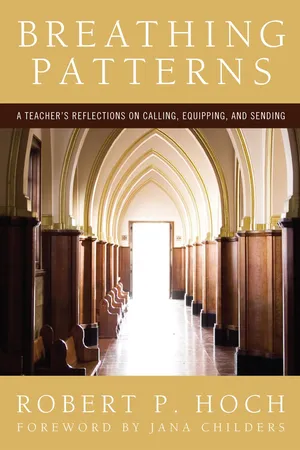
Breathing Patterns
A Teacher's Reflections on Calling, Equipping, and Sending
- 174 pages
- English
- ePUB (mobile friendly)
- Available on iOS & Android
eBook - ePub
About this book
Preaching to the "choir" is always complicated, but especially so when that choir happens to be a seminary community. In this collection of sermons, delivered in the chapel of the University of Dubuque Theological Seminary (PCUSA), Robert P. Hoch, Assistant Professor of Homiletics and Worship, weaves together life experiences, careful readings of the Scripture, and pastoral wisdom for the benefit of seminarians, pastors, and educators. Often poetic, Dr. Hoch's sermons are crafted so that they speak not only to the peculiar life of a seminary community, but more broadly to the larger life of the church. Beyond the sermons themselves, readers will hear Dr. Hoch's reflections on individual sermons, reflections that sometimes betray the sermon behind the sermon. Whether as a student, seasoned pastor, or officer in the church, readers will find in these pages a partner with whom they can share the journey of faith.
Information
Topic
Theology & ReligionSubtopic
Christian ChurchPart One
Calling
I
And Jesus said to them, “Follow me and I will make you fish for people.” And immediately they left their nets and followed him. (Mark 1:17–18)
Walking into the seminary building on our campus, you immediately encounter a display case containing an assortment of items, seemingly random and unrelated; they might look curious, strangely left behind, perhaps appearing somewhat like the shoreline of the Sea of Galilee might have to a passerby after Jesus called the first disciples, its shore littered with abandoned nets, fishing gear, empty boats, as well as a few bewildered parents. While there are not many nets on this midwestern shore, one does get a sense of what students have left behind as they made their way to seminary: there’s a child’s drawing of a girl in a green dress, wearing a princess crown, a pink flower held in her right hand, and a note at the bottom in the careful handwriting of a preschooler: “To: Christine.” On the other side of the case, you see a beadwork necklace, displaying Nez Perce colors and symbols, an eagle occupying the middle of a large circular pendant. From there, your eyes might drop to the lower part of the case, where you would notice business cards and licenses, documents, symbols of skills and credentials, dropped like leaves to the ground. Another flyer bears photos of a modest, well-looked-after home, a “For Sale” sign posted on its front lawn. Someone else has filled a glass vial with soil from Montana, earth from a place once called home. The shores of seminaries are littered with memories, bits of life, symbols, authorities, skills, relationships, lands, and peoples—left behind but perhaps not entirely forgotten.
When I was a boy, we sometimes went to an abandoned cannery town on the Eyak River, near Cordova, Alaska. Devastated by the 1964 earthquake, this particular village was left landlocked, effectively ending its role in the once-thriving fishing industry of the Prince William Sound. On weekends, my stepfather would take us there, up the river in an airboat, skimming over water and land almost like they were the same thing, the roar of the engine overpowering the wax my mother stuffed into our ears in a vain attempt to preserve our hearing. But when the engine idled down, finally going silent, there was no sound at all except the visible echoes of someone’s yesterday: dishes still in the cupboard; a dining-room table surrounded by upended chairs; labels for canned salmon scattered on the floor; a salt shaker in the shape of a teddy bear, its gold enamel worn to white from use at table; rooms where the floorboards creaked, and homes where paint peeled and windows were broken; abandoned walkways, forgotten docks, and the quiet way of the river.
II
They say a place never quite leaves you. And if you leave it, you will always bear its memory, a peculiar ache difficult to explain.
Difficult to explain, it may well be, but it is almost commonplace in today’s culture of displacement, an experience which, according to some, is among the defining characteristics of the modern age: “War, mass expulsion, famine, environmental degradation, human rights violations, and fear of oppression have sent millions upon millions of men, women, and children into exile.”1 Ours, we are told, is the age of the refugee.2 A refugee community: forced out of homes, into camps or reservations, into the anonymity of the inner city or the homogeneity of the suburbs, out of our cultural skins not by choice but just to survive. Among survivors, the memory of place persists, something like the way Jadranka, a Bosnian refugee from the Balkan war, describes her people’s experience of exile:
They’re like people who have lost a limb. Amputees. They can still feel their homeland, even though it’s gone. It tingles. Subconsciously they know everything was destroyed, but as long as they’re in a camp they can dream it’s still there. Those who integrate into society know they’ll never go back, those in camps all believe they will return.3
An amputee: a person known to the world, and perhaps even to oneself, by the character of his or her disfigurement.
The comparison may seem peculiar, thinking of calling as an experience of the displaced, but there is something about it that holds. To be sure, there are differences. Those who enter seminary respond to God’s call freely, unlike a refugee community driven from its home by alien forces. Even when students come from a Native community, the “rez” for example, or out of the persecution experienced by African Christians in the Sudan, they do so as an expression of hope and not as a surrender to despair. Nevertheless, a called community carries with it a memory of a place and a people, often a people for whom disfigurement is not marginal but, rather, primary to its experience. More pointedly, and reaching all of us with fearful consequence, it remains that we who are called are summoned by Christ and his cross, living into a community that is known by a peculiar marginality as well as a scandalous promise.
Somehow, despite the superficiality of the church, our memory clings to us still, in part by way of the memory of Scripture. As a background for the display case mentioned earlier is a large poster, showing a road disappearing into a featureless horizon. Over that horizon are the following words from Mark 8:34: “[Jesus] called the crowd with his disciples, and said to them, ‘If any want to become my followers, let them deny themselves and take up their cross and follow me.’” The juxtaposition of the empty horizon and Jesus’ call to discipleship strikes me as telling: while the future of the captive often appears bleak and without meaning, for the one who follows Jesus the horizon changes by virtue of what we are told to take as well as by the One we are called to follow.
Too often, when people speak of their “calling” it bears little resemblance to the stunning, ultimately scandalous invitation we hear in Mark. “I’m called to rural ministry,” or “to urban ministry,” or “hospital chaplaincy”—these sound all too much like an undergraduate talking about whether she or he will major in biology or psychology, something chosen as a matter of preference, or ability, or, more likely, profitability. It also bears the imprint of the culture of specialists, in which each specific profession claims exclusive forms of knowledge, knowledge inaccessible to those in other professions. My concerns arise not around the appropriate training for specific callings within the church—these are necessary in order to equip servant-leaders for their particular vocations. A good portion of my life has been dedicated to equipping students as effective and faithful communicators of the gospel through preaching. Yet I am concerned that, given our world setting and the peculiar nature of Christ’s calling, contemporary notions of calling are becoming theologically and symbolically anemic—and if that is the case, the faith communities that are called out of the larger society are, in turn, nutrient starved.
The horizon of the church becomes banal without the specific character of Christ and cross forming its basic narrative. Perhaps that is why the experience of the refugee seems evocative for our calling to the churches of today. Rather than having a potluck of choices, the called community is confronted by the profoundly disorienting event of the cross, an apocalyptic event that fuels a tectonic shift in the church’s way of being. Before the community experiences a specific vocational direction, it resembles the experience of the refugee, reflecting that sense of profound dislocation. Speechlessness, according to Richard Lischer, describes the characteristic state of the prophetic calling:
Before any prophet speaks, the prophet is absolutely positive that he or she must not speak. Moses claimed a speech impediment; Isaiah confessed his own impurity; Jeremiah appealed to his inexperience. After the temple was destroyed, the prophet Ezekiel was transported to a refugee camp at Tel Abib. There he sat for seven days stupefied among the refugees, or, as one translation has it, “in a catatonic state.”4
The called community is asked to go by a path not of its own choosing—indeed, it is asked to go by a path that it positively would not choose—but a path of God’s own electing, a path sanctified by the Spirit long before it was ever credentialed by the powers, secular or sacral. If we were to locate our sense of calling in the context or experience of the exilic community, we might well be drawn closer to the experience of Abraham and Sarah, the father and mother of refugees, living as strangers in a strange land—and strangers not only because of their exilic status but also because of the promise of God, a promise that elects alien, stranger, and outcast alike as a new people in an ancient world.
Callings in this sort of community would be startling on the earthly horizon, particularly in a society accustomed to the vacancy of hope and the abundance of fear that frequently define life in exile. Here we would find fewer fantasies about a return to “the way things were” as well as less resignation to the way things are. The former group insists on clinging to a past that is no more, while the latter assimilate, choosing “integration” over resistance. There is no shortage of churches content with either assimilationist resignation or isolationist fantasies: they are some of the fastest-growing churches in North America. By contrast, a faith community with a strong cruciform identity will be peculiar, even activist in its spirit, because it is in the world but not of the world, the promise of God being decisive for its living witness. As Gerhard Forde points out, “The cross itself is the evidence that we did not choose [Christ] but that he, nevertheless, chose us.”5 A church like this and a ca...
Table of contents
- Title Page
- Foreword
- Acknowledgements
- Introduction
- Part One: Calling
- Chapter 1: People of the Penguin
- Chapter 2: Travel Advisories
- Chapter 3: Mercy on Thin Ice
- Chapter 4: The Day after Christmas
- Chapter 5: Our Greatest Possession
- Part Two: Equipping
- Chapter 6: The Most True Thing
- Chapter 7: Learning to Pray in August
- Chapter 8: Staying On until Pentecost
- Chapter 9: Nothing, Nada, Zip!
- Chapter 10: Working with Clay
- Part Three: Sending
- Chapter 11: Looking for Someone to Blame
- Chapter 12: Dancing in the Desert
- Chapter 13: Casting Shadows
- Chapter 14: Breathing Patterns
- Chapter 15: Sound of Sirens
- Bibliography
Trusted by 375,005 students
Access to over 1.5 million titles for a fair monthly price.
Study more efficiently using our study tools.
Frequently asked questions
Yes, you can cancel anytime from the Subscription tab in your account settings on the Perlego website. Your subscription will stay active until the end of your current billing period. Learn how to cancel your subscription
No, books cannot be downloaded as external files, such as PDFs, for use outside of Perlego. However, you can download books within the Perlego app for offline reading on mobile or tablet. Learn how to download books offline
Perlego offers two plans: Essential and Complete
- Essential is ideal for learners and professionals who enjoy exploring a wide range of subjects. Access the Essential Library with 800,000+ trusted titles and best-sellers across business, personal growth, and the humanities. Includes unlimited reading time and Standard Read Aloud voice.
- Complete: Perfect for advanced learners and researchers needing full, unrestricted access. Unlock 1.5M+ books across hundreds of subjects, including academic and specialized titles. The Complete Plan also includes advanced features like Premium Read Aloud and Research Assistant.
We are an online textbook subscription service, where you can get access to an entire online library for less than the price of a single book per month. With over 1.5 million books across 990+ topics, we’ve got you covered! Learn about our mission
Look out for the read-aloud symbol on your next book to see if you can listen to it. The read-aloud tool reads text aloud for you, highlighting the text as it is being read. You can pause it, speed it up and slow it down. Learn more about Read Aloud
Yes! You can use the Perlego app on both iOS and Android devices to read anytime, anywhere — even offline. Perfect for commutes or when you’re on the go.
Please note we cannot support devices running on iOS 13 and Android 7 or earlier. Learn more about using the app
Please note we cannot support devices running on iOS 13 and Android 7 or earlier. Learn more about using the app
Yes, you can access Breathing Patterns by Robert P. Hoch in PDF and/or ePUB format, as well as other popular books in Theology & Religion & Christian Church. We have over 1.5 million books available in our catalogue for you to explore.