eBook - ePub
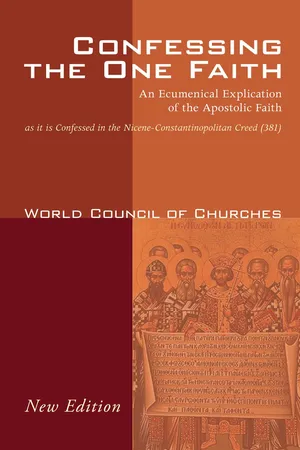
Confessing the One Faith, Revised Edition
An Ecumenical Explication of the Apostolic Faith as it is Confessed in the Nicene-Constantinopolitan Creed (381)
- 174 pages
- English
- ePUB (mobile friendly)
- Available on iOS & Android
eBook - ePub
Confessing the One Faith, Revised Edition
An Ecumenical Explication of the Apostolic Faith as it is Confessed in the Nicene-Constantinopolitan Creed (381)
About this book
Visible unity means that churches recognize in one another a witness to the fullness of the apostolic faith which they profess. Will Christians be able one day to declare together before the world, in common confession and praise, their faith in who God is and what God has done?
This text-growing out of many years of study and consultation, involving theologians from various Christian traditions and from all parts of the world-is a unique instrument for drawing the churches toward such a common confession.
As a contemporary explication of the creed that emerged from the ecumenical councils of Nicea (325) and Constantinople (381) and is used in both Eastern and Western Christian liturgies, Confessing the One Faith relates the subject matter of those ancient affirmations to the challenges of today's world-in which the language and philosophy of the fourth century sound alien to many, and the basic affirmations of the Christian faith are widely questioned.
This new edition includes an introduction written by Dame Mary Tanner, a president of the World Council of Churches.
Information
Topic
Theology & ReligionSubtopic
Christian ChurchPart I
We Believe in One God
A. The One God
6. Christians believe that “the One true God,” who made himself known to Israel, has revealed himself supremely in the “one whom he has sent,” namely Jesus Christ (John 17:3);1 that, in Christ, God has reconciled the world to himself (2 Cor. 5:19); and that, by his Holy Spirit, God brings new and eternal life to all who through Christ put their trust in him.
7. This faith in a single, universal God who is Creator, Redeemer, and Sustainer of everything is challenged by those who doubt whether there is any reality beyond the visible world, providing the source of its being and continuing life: for them a conception of God is no more than an expression and projection of human wishes and fears. Even when it is acknowledged that there are powers transcending the visible reality of the world the question is, can it be maintained that there is only one such power and should that power be conceived as purely transcendent or also as immanent in the world, and how can these aspects be reconciled?
8. Many who agree with Christians in a belief in one God find the Trinitarian affirmation of Christians difficult to understand. For Jews and Muslims particularly, the Christian concept of the Triune God has been a stumbling block because it seems to deny monotheism. There are also Christians today who consider that the Christian doctrine of the Trinity at the very least requires fresh interpretation and even linguistic revision. Moreover, there is widespread neglect and misunderstanding of the doctrine. It is sometimes explained “modalistically,” as if it meant that God is really one, but because of human limitations is understood in three different ways, or “tri-theistically,” as though worship of God the Father, God the Son, and God the Holy Spirit were three separable and different kinds of worship. Many feel that the traditional Trinitarian teaching is too speculative in comparison with the biblical language about God the Father, the Son, and the Holy Spirit. Such challenges ask for contemporary work of clarification.
I. The Creed and Its Biblical Witness
a) The Text of the Creed
9. “We believe in one God.”
(AC: “I believe in God.”)2
10. The Nicene Creed begins with confessing belief in one God. The theme of the oneness of God is in turn expanded in the three articles of the Creed in a Trinitarian way. The first article stresses belief in One God, the Father; the second, in One Lord, the Son of the Father; and the third, in the Holy Spirit, the Lord, who proceeds from the Father. Thus, the One God is understood in terms of the Father, the Son, and the Holy Spirit, the Father being the source of all divinity. Corresponding to the oneness of the Triune God, the Creed affirms that there is also only one Church and one baptism (cf. Eph. 4:4–6). Thus the Creed emphasizes oneness in all the three articles.
Commentary
From their Jewish heritage Christians have known from the beginning that “there is no God but one.” The Church of the second century affirmed against Marcion the unity of the God who creates and redeems. It took time before the Church gave a fully reasoned and well articulated account of the relation between the “one God, the Father, from whom are all things and for whom we exist” and the “one Lord, Jesus Christ, through whom are all things and through whom we exist” (1 Cor. 8:6). The decisive moment came with the Arian controversy. The Council of Nicea (325) affirmed the Son to be “from the substance of the Father” (ek tes ousias tou Patros) and “consubstantial with the Father” (homoousios to Patri). After the subsequent controversy of Pneumatomachianism, the Council of Constantinople (381) also declared the Lordship of the Holy Spirit “who proceeds from the Father and who with the Father and the Son is worshiped and glorified.” In all this the Church had no intention of putting the unity of God into question; rather, the One God was understood as Triune on the basis of his redemptive activity in history. Baptism continued to take place in the single name of the Father, the Son, and the Holy Spirit.
In subsequent centuries different interpretations were advanced concerning the ultimate principle of unity in the Trinity, namely, whether this was to be found in the divine being (ousia) or in the person (hypostasis) of the Father or in the interrelatedness and mutual indwelling of the three persons in their communion with one another. However, both East and West have always confessed in worship the unity of God and the distinction of persons with equal insistence; and it is in worship that the personal character of the Triune God is most apparent.
On the whole, Nicene theology stressed at the same time the uniqueness of each of the three persons (hypostases) in the one God revealed throughout the history of salvation, and their unity in communion (koinonia) in the one divine being. Today care needs to be taken with such words as “substance” (which now often suggests material entities, subject to instrumental measurement), “essence” (which may recall the language of a discredited metaphysics), or “person” (which could be interpreted as referring to some isolated individual center of consciousness). Contemporary Trinitarian theology continues to discuss, and even more so than in some earlier periods, how the oneness of God together with the three “persons” can be appropriately expressed. There is agreement, however, that an adequate and exhaustive rational account of the mystery of the Triune God celebrated in the liturgy of the Church remains beyond human comprehension. Trinitarian doctrine and its language can only give the reason for confessing the three persons as well as the one God.
b) Biblical Witness
11. In the course of its history Israel came to believe in the uniqueness of God. This finds its classical expression in the “Shema Israel”: “Hear, O Israel, the LORD is our God, the LORD alone. You shall love the LORD your God with all your heart, and with all your soul, and with all your might” (Deut. 6:4f.). It is most emphatically expounded in the prophecies of Second Isaiah where the LORD the Creator and Redeemer, is confessed explicitly as the only God, not only for Israel, but for all peoples. Other gods are mere idols: “And there is no other god besides me, a righteous God and a Saviour; there is none besides me. Turn to me and be saved, all the ends of the earth! For I am God, and there is no other” (Isa. 45:21–22).
12. The Old Testament emphasis on the uniqueness of God was continued in the New Testament. Jesus affirmed the faith of Israel concerning the one God. He dismissed Satan by citing the Scriptures: “You shall worship the LORD your God, and him only shall you serve” (Matt. 4:10; cf. Deut 6:13). He endorsed the “Hear, O Israel” as the first and great commandment and the way to eternal life (Mark 12:29; Matt. 22:37; Luke 10:27).
13. However, the New Testament also makes clear that this God is in a unique relationship with Jesus Christ. Jesus is called his son (Luke 1:32–33; Mark 1:11 parallels). Jesus addresses this God as “Father”, using the intimate word “Abba” (Mark 14:36). Jesus is the Father’s own beloved and only Son (John 1:18; 3:16; Rom. 8:32; Col. 1:13). Whoever has seen the Son has seen the Father (John 14:9), for the Father and the Son are “one” (John 10:30; 17:11). While remaining distinct, the Father and the Son “dwell” in each other (John 17:21).
14. At the same time the New Testament also links the Spirit—“who proceeds from the Father” (John 15–26)—with the Son (cf. para. 210). According to the prayer of Christ, the Father sends the Holy Spirit into the world, “the other Paraclete,” the Spirit who “makes alive” and guides into all the truth (John 16:7). All three, Father, Son, and Holy Spirit, are named together in the early apostolic preaching and writing (2 Cor. 13:13; Eph. 4:4–6).
II. Explication for Today
The One God: Father, Son, and Spirit
15. The particularity of Christian faith in the one God is based on the revelation of Father, Son, and Holy Spirit. Therefore, the divine economy, the history of salvation in creation, reconciliation, and eschatological fulfilment, is the basis of the Trinitarian faith. On the one hand, the One God is in all eternity the Father, the Son, and the Holy Spirit. Economic and eternal Trinity is but one reality. The two aspects are inseparable from each other. This unity of economic and eternal Trinity has not always been duly taken into consideration. But it is only on the basis of the historical revelation of God in Jesus Christ that the Trinitarian faith of the church can be accounted for. The Trinitarian doctrine is not a product of abstract speculation, but a summary of how God is revealed in Jesus Christ.
16. It is in the divine economy that the separation and alienation of the world from God as a result of sin and evil is overcome through the reconciling work of the Son and the transfiguring presence of the Spirit. In the mystery of this divine economy of salvation the one God is revealed as life and love communicating himself to his creatures. God the Father reconciles the world to himself through the incarnation, the ministry, and the suffering of his eternal Son. In the Son God shares the human condition even to death, in order to offer to humanity forgiveness of sin, resurrection, and eternal life (John 3:16). Through the Spirit God raised the crucified one to a new and imperishable life that will bring about the final transfiguration and glorification of our lives and of the whole creation in the eschatological future. By the proclamation of this good news the Spirit even now kindles faith, love, and hope in the hearts of those who receive the gospel, as even before the incarnation of the Son he encouraged the hope for the future salvation of humanity.
17. The incarnate Son reveals that in God’s eternal glory, before all time and history, his divine life is mutual self-giving and communion, that “God is love” (1 John 4:8). This eternal love and communion between Father and Son is revealed in the cross of Christ and in his resurrection through the power of the Spirit. Cross and resurrection cannot be understood apart from the Trinitarian communion of Father, Son, and Spirit, nor can the Trinity be understood apart from the cross and the resurrection. The cross is the affirmation of a love which is stronger than sin and death, and the resurrection confirms that this divine love is indeed and will be victorious.
18. The eternal source of that living Trinitarian communion of love is God the Father. But the Father was never without the Son, nor was he ever without his Spirit. The mutual indwelling of the three persons is the seal of their unity. God’s eternal life and glory is in the free giving of the persons in mutual communion to each other. The divine unity originates from the Father as its source, but is maintained in the obedience of the Son and in the testimony of the Spirit glorifying the Son in the Father and the Father in the Son.
Commentary
Often there is too little awareness of the Trinitarian character of the divine unity itself, as the Christian faith professes it. Frequently the one God is simply identified with the Father, while the Son and the Spirit are either ontologically subordinated to him or imagined as mere modes of the revelation of the Father. In distinction from this, the mutuality of inter-relations among the three persons in maintaining the “monarchy” of the Father should be understood to be the concrete form of divine unity.
19. The Church believes in this eternal communion of love, as it is revealed and actualized in the divine economy: it is at work in the creation of the world as well as in its redemption and in its sanctification and ultimate glorification. Although the work of creation is attributed specifically to the Father, the work of redemption to the Son, and the work of sanctification and glorification to the Spirit, the work of each of the Trinitarian persons implies the presence and co-operation of all three. Thus, God is one. None of the three persons of the Trinity has a life of his own apart from the ot...
Table of contents
- Title Page
- Preface to the Revised Edition
- Preface to the 1999 Edition
- Introduction
- The Texts of the Creeds
- Part I: We Believe in One God
- Part II: We Believe in One Lord Jesus Christ
- Part III: We Believe in the Holy Spirit, the Church, and the Life of the World to Come
- Appendix I: Historical Background of the Apostolic Faith Today
- Appendix II: Glossary
- Appendix III: Bibliography
- Appendix IV: Participants in Consultations On the Apostolic Faith Study
- Appendix V: For Further Reading
Trusted by 375,005 students
Access to over 1.5 million titles for a fair monthly price.
Study more efficiently using our study tools.
Frequently asked questions
Yes, you can cancel anytime from the Subscription tab in your account settings on the Perlego website. Your subscription will stay active until the end of your current billing period. Learn how to cancel your subscription
No, books cannot be downloaded as external files, such as PDFs, for use outside of Perlego. However, you can download books within the Perlego app for offline reading on mobile or tablet. Learn how to download books offline
Perlego offers two plans: Essential and Complete
- Essential is ideal for learners and professionals who enjoy exploring a wide range of subjects. Access the Essential Library with 800,000+ trusted titles and best-sellers across business, personal growth, and the humanities. Includes unlimited reading time and Standard Read Aloud voice.
- Complete: Perfect for advanced learners and researchers needing full, unrestricted access. Unlock 1.5M+ books across hundreds of subjects, including academic and specialized titles. The Complete Plan also includes advanced features like Premium Read Aloud and Research Assistant.
We are an online textbook subscription service, where you can get access to an entire online library for less than the price of a single book per month. With over 1.5 million books across 990+ topics, we’ve got you covered! Learn about our mission
Look out for the read-aloud symbol on your next book to see if you can listen to it. The read-aloud tool reads text aloud for you, highlighting the text as it is being read. You can pause it, speed it up and slow it down. Learn more about Read Aloud
Yes! You can use the Perlego app on both iOS and Android devices to read anytime, anywhere — even offline. Perfect for commutes or when you’re on the go.
Please note we cannot support devices running on iOS 13 and Android 7 or earlier. Learn more about using the app
Please note we cannot support devices running on iOS 13 and Android 7 or earlier. Learn more about using the app
Yes, you can access Confessing the One Faith, Revised Edition by Theodore Gill in PDF and/or ePUB format, as well as other popular books in Theology & Religion & Christian Church. We have over 1.5 million books available in our catalogue for you to explore.