- 186 pages
- English
- ePUB (mobile friendly)
- Available on iOS & Android
eBook - ePub
About this book
Mormon Prophet and Tenth President, Joseph Fielding Smith, once said:
Mormonism, as it is called, must stand or fall on the story of Joseph Smith. He was either a prophet of God, divinely called, properly appointed and commissioned, or he was one of the biggest frauds this world has ever seen. There is no middle ground. If Joseph Smith was a deceiver, who willfully attempted to mislead the people, then he should be exposed; his claims should be refuted, and his doctrines shown to be false . . . The doctrines of false teachers will not stand the test when tried by the accepted standards of measurement, the Scriptures.
--Doctrines of Salvation, 1:188.
Brigham Young, Prophet and Second President offered this challenge:
Well, now examine the character of the Savior, and examine the character of those who have written the Old and New Testament; and then compare them with the character of Joseph Smith, the founder of this work . . . and you will find that his character stands as fair as that of any man's mentioned in the Bible. We can find no person who presents a better character to the world . . . than Joseph Smith.
--Journal of Discourses, Vol. 14, p. 203.
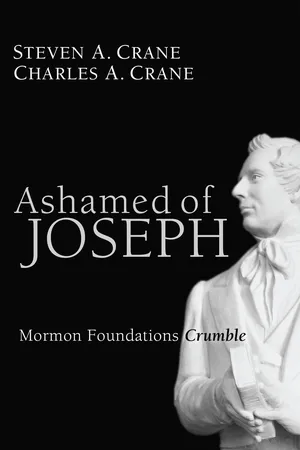
Combining their research in Mormonism to author this work, Charles A. Crane and his son, Steven A. Crane, would like to accept the challenge and show why many, even among the LDS faith, are Ashamed of Joseph.
Information
Topic
Teologia e religioneSubtopic
Chiesa cristiana1
Sort of Embarrassed
We are told to not talk about Joseph Smith . . . We are sort of embarrassed by him today.
Why Have Some Become “Ashamed of Joseph”?
Some time ago, the singing group from our college was invited to minister in Salt Lake City, Utah. It was a pleasure to travel with them and speak at the morning services of a local church. Since we were in Salt Lake City, it seemed like a good time to introduce the students to the LDS Visitors’ Center at Temple Square. We went on that Sunday afternoon. Having lived in Salt Lake City in the 1960s and 1970s, it came as a surprise to find that major changes had taken place in the Temple tour since those years.
Before this trip, our most recent visit had been in 1973. In days gone by a central theme that ran through the tour had been the life and teachings of Joseph Smith. In the Visitors’ Center were several large paintings about him and his work; in the courtyard stood two large statues of Joseph and his brother Hyrum, and the tour concluded at a large, glassed-in area with Joseph in life-size diorama receiving the first vision.
This day, however, there was not one word mentioned about Joseph Smith. We were not taken to his statue; the large paintings (we called this the “Hall of Fame”) were gone; and the diorama of Joseph receiving his first vision had vanished (it had been transformed into a meeting room). The whole impact of the tour was to leave one believing that this was a mainstream evangelical church.
This prompted me to ask several questions of the young lady who was our guide. She was gracious, lovely, and did everything she could to be helpful.
My first questions were focused primarily on the Mormon scripture and their doctrine of God. The answers were pretty standard for LDS teaching. But when I began to ask questions about Joseph Smith, she seemed reticent to answer. Finally, I pressed her to tell why nothing was said about their founding prophet during the whole length of the tour.
Her reply shocked us! “We are told to not talk about Joseph Smith.”
I thought to myself, “They are not to mention the very founder and prophet of the Mormon church!” I asked, “Why?”
She replied, “We are sort of embarrassed by him today.”
Again, I thought to myself, “They are ashamed of Joseph Smith, and well they should be.”
At a Crossroad
A U.S. News & World Report article reported that the LDS religion was an oddity only found in the Intermountain West until recently. Its teachings were considered heterodox, tinged by violence and polygamy, and could only be considered on the fringe of orthodox Christianity.1 Today, however, the church is one of the richest and fastest-growing religious movements in the world. The Mormons have shown unbelievable growth. A 1992 estimate claimed that the Mormon church had 8.3 million members worldwide. The 2010 Deseret News Church Almanac claims 13.3 million.2 Some project that the Church of Jesus Christ of Latter-day Saints will be the largest “Christian” religion, other than the Roman Catholic Church, by the year 2080.
Not only have they experienced dramatic numerical growth, but the Mormon empire is growing financially as well. According to U.S. News & World Report, the annual income of the LDS church in 1991 was estimated at 4.7 billion dollars3 and has certainly grown exponentially for nearly two decades since that time.
This growth, it seems, has produced political and doctrinal stresses that have prompted the Mormons to gloss over some of their prior history and doctrine in an attempt to appear more in line with mainstream Christianity.4
In doing this, many issues have become battlegrounds—some rather public, others behind the scenes, and some only realized by those who live in the inner circle of Utah.
Prominent issues have included the place of women in the family and church, the doctrine of dark-skinned people, the practice of polygamy, and the use of alcoholic drinks, coffee, tea, and other drinks containing caffeine. Other current issues focus on the various Mormon scriptures as to which are most authoritative and are to be counted as “standard works” of the church—are Mormons bound primarily by the teachings of the Bible, the Book of Mormon, the Doctrine and Covenants, or the Pearl of Great Price?
The Mormons have diligently worked at changing their image from “fringe” to mainstream Christianity. They realize that in order to accomplish this feat, they will have to drastically change their appearance.5
The LDS church has been one of the most successful modern religious bodies to adapt themselves to American capitalism. To accomplish their objectives, they have thrown in a big measure of business and prosperity, along with apple pie, baseball, and of course the all-important imagery of the Mormon family.
This is all served up in a modern package that is divorced from their beginning. In order to make this chameleon-like change, the Mormons have had to de-emphasize the very things that were their main persona only a few years ago.
It is safe to say that their emphasis of Joseph Smith is one of the areas in which they are making a radical shift. Much of what Joseph Smith did, said, wrote, and even who he was, is relinquished to the back corners of the closet—and understandably so.
Herein lies the proposition of this book in question form—What has caused the Mormon church to de-emphasize the role of their founder and prophet? Why are some among the Church of Jesus Christ of Latter-day Saints Ashamed of Joseph?
Rationale
The era in which we live today could be called the age of “Religious Relativism.” When dealing with the issues of religion, we have often heard views expressed that go something like this: “If people are sincere, leave them alone,” or, “They are not hurting anyone—so why should we care?”
If one believes very little, these arguments may sound logical. But for those people who believe in absolutes (such things as truth and error, right and wrong, God and the Devil, good and evil), to be silent is not only cowardice, but a gross neglect of one’s spiritual and eternal duty.
For people of principle, religious claims are vitally important—as important as clean water, healthful food, good medical care, and a high quality of education. What people believe is of vital importance because it directly affects their actions and will determine their eternal destiny.
That being said, for the logically-oriented person, the challenge of Mormonism should be accepted by all: “Seek and pray to see if what we teach is true.” The Bible tells us to prayerfully examine the evi...
Table of contents
- Title Page
- Introduction
- Section One: Ashamed of Joseph
- Chapter 1: Sort of Embarrassed
- Chapter 2: An Encounter with Joseph
- Chapter 3: An Embarrassing Dilemma
- Section Two: Ashamed of His Character
- Chapter 4: A Changing History
- Chapter 5: The Glass Looker
- Chapter 6: The Story Teller
- Chapter 7: The Mansion House
- Chapter 8: The Fighter
- Chapter 9: The Commanding Officer
- Chapter 10: King on Earth
- Section Three: Ashamed of His Role as a Prophet
- Chapter 11: The Prophet
- Chapter 12: The Golden Bible
- Chapter 13: “Doctrines”
- Section Four: Ashamed of His Other Writings
- Chapter 14: The Doctrine and Covenants
- Chapter 15: The Pearl of Great Price
- Chapter 16: The Inspired Version
- Section Five: Ashamed of His True History
- Chapter 17: A Mother’s Memoirs
- Chapter 18: A History of Superstition
- Chapter 19: The Mysterious Golden Plates
- Chapter 20: With Guns A-Blazin’
- Section Six: Conclusion
- Chapter 21: A Summary of Embarrassments
- Chapter 22: Christians Ashamed?
- Epilogue
- Bibliography
Trusted by 375,005 students
Access to over 1.5 million titles for a fair monthly price.
Study more efficiently using our study tools.
Frequently asked questions
Yes, you can cancel anytime from the Subscription tab in your account settings on the Perlego website. Your subscription will stay active until the end of your current billing period. Learn how to cancel your subscription
No, books cannot be downloaded as external files, such as PDFs, for use outside of Perlego. However, you can download books within the Perlego app for offline reading on mobile or tablet. Learn how to download books offline
Perlego offers two plans: Essential and Complete
- Essential is ideal for learners and professionals who enjoy exploring a wide range of subjects. Access the Essential Library with 800,000+ trusted titles and best-sellers across business, personal growth, and the humanities. Includes unlimited reading time and Standard Read Aloud voice.
- Complete: Perfect for advanced learners and researchers needing full, unrestricted access. Unlock 1.5M+ books across hundreds of subjects, including academic and specialized titles. The Complete Plan also includes advanced features like Premium Read Aloud and Research Assistant.
We are an online textbook subscription service, where you can get access to an entire online library for less than the price of a single book per month. With over 1.5 million books across 990+ topics, we’ve got you covered! Learn about our mission
Look out for the read-aloud symbol on your next book to see if you can listen to it. The read-aloud tool reads text aloud for you, highlighting the text as it is being read. You can pause it, speed it up and slow it down. Learn more about Read Aloud
Yes! You can use the Perlego app on both iOS and Android devices to read anytime, anywhere — even offline. Perfect for commutes or when you’re on the go.
Please note we cannot support devices running on iOS 13 and Android 7 or earlier. Learn more about using the app
Please note we cannot support devices running on iOS 13 and Android 7 or earlier. Learn more about using the app
Yes, you can access Ashamed of Joseph by Steven A. Crane,Charles A. Crane in PDF and/or ePUB format, as well as other popular books in Teologia e religione & Chiesa cristiana. We have over 1.5 million books available in our catalogue for you to explore.