eBook - ePub
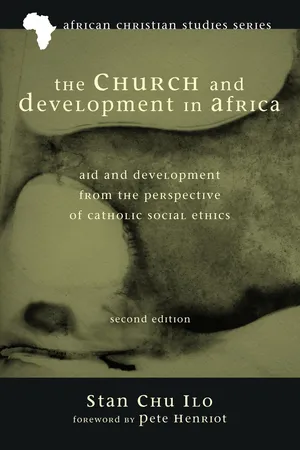
The Church and Development in Africa, Second Edition
Aid and Development from the Perspective of Catholic Social Ethics
- 348 pages
- English
- ePUB (mobile friendly)
- Available on iOS & Android
eBook - ePub
The Church and Development in Africa, Second Edition
Aid and Development from the Perspective of Catholic Social Ethics
About this book
In this book, Stan Chu Ilo offers an integral theology of development and a critical social analysis of different development theories and practices in the world, especially in Africa. Ilo offers a comprehensive biblical, anthropological, and theological foundation of the principles and praxis of Catholic social ethics from the Second Vatican Council to Pope Francis. Drawing from the social encyclical Charity in Truth, Ilo shows how Catholic social teaching responds to some of the challenging questions and concerns of our times in relation to human rights, ecology, globalization, international cooperation, development and aid, human and cultural development, business ethics, social justice, and the challenges of poverty eradication. He creatively applies these principles to the social context of Africa, and lays a groundwork for sustainable Christian humanitarian and social justice initiatives in Africa.
Information
Topic
Theology & ReligionSubtopic
Christian Theology1
Catholic Social Ethics in the Social Encyclical, Charity in Truth
The Link between Charity and Truth
Charity in Truth (CIV) is an invitation to Christians and all men and women of goodwill to apply a spiritual vision in understanding and responding to the pressing economic, ecological, social, political, and moral challenges facing humanity today. Its message is closely connected to the two previous encyclicals of Emeritus Pope Benedict XVI, forming, as Stratford Caldecott commented, a triptych on the Christian faith in both its theoretical and practical dimension, namely love, hope, and faith grounded in truth.
Thus, the primary thesis of this encyclical is that authentic development requires the establishment of the correct scale of value about what it means to be a human person and the ethical demands made on the human person by God for human and cosmic flourishing. This is especially important because in Catholic social teaching, the human person is presented as being the primary actor when it comes to development and the stewardship of creation. Catholic social teaching has constantly engaged the questions concerning the meaning of authentic human and cultural development and the goal of history. This is because of the ever changing cultural, ethical, scientific, and technological and economic factors which could lead to a narrow understanding of what constitutes human and cultural progress.
Some current theories of development in contemporary discourse are: modernization theories (which see progress as Westernization. Theorists here argue that societies evolve from simple to more complex way of life, from pre-scientific to a more scientific ways of living. It is only when this kind of progress takes place can people be freed from poverty and human suffering); anti-modernisation theories (which argue for prioritizing indigenous ways of doing things, while rejecting development-as-progress); dependency theories (the people who adopt these approaches to development argue that people suffer because of systems and structures. Therefore, changing these structures will enable the people to freely apply themselves to their own development. They propose that more than any other factor the answer to the end of aid from the West to Africa for instance lies in creating the necessary institutional frameworks for creating wealth because development depends on such internal structures); post-development theories (will argue that history is not linear and that development is much more than poverty eradication or industrialization; development is integral, involves many aspects of life and is much more complex than progress, wealth creation, etc); capability approaches (against all kinds of evolutionary approaches to development, this approach emphasizes empowerment and developing the human and cultural resources of societies, peoples and civilization: development occurs when people are free and are equipped to participate in shaping the course of their lives by being agents in their own development). There are social scientists who propose world systems theories of development as well as theories which emphasize an understanding of and an engagement with the dynamics of globalization. Proponents of these systems are concerned with identifying how the forces of globalization are driving social change worldwide and how nations, corporations, and individuals can leverage these forces in bringing about better living conditions for people and lifting many people out of poverty. Each of these theories has its own strengths and weaknesses which are beyond the scope of this work.
In Charity in Truth, development is understood at a deeper level beyond these theories. One can see an emphasis on the capability theory of development through a theological anthropology which is grounded in Christian humanism. According to Pope Benedict, development must occur within the broader goal of attuning our actions to realizing the divine purpose of creation. Development initiatives carried out solely on the bases of economics, production, profit, technical progress, and technological determinism will continue to fail to serve the person and thereby society. These initiatives must take into account the sacredness of human life, the dignity of every human person, and the dignity and importance of family life. In addition, development must respect the harmony in creation and meet the requirements of justice in our relationship with nature, and in our industrial practices. It must embody the highest ethical principles which promote and preserve the good of humans and the earth today, and which enhances the good of future generations. As a result, the promotion, preservation, and protection of the common good, therefore, requires action and solicitude by all Christians and people of goodwill at interpersonal levels, as well as in political organizations and institutions (CIV, 7).
Catholic social teaching as reflected in this encyclical admits that the human condition is essential to the Church’s mission of working towards the realization of the fruits of God’s kingdom on earth. Her mission arises from both the Lord’s mandate of reconciling all things in Christ as well as from the prophetic tradition of being immersed in and engaged with the living condition of God’s people at all times. The Church is called in the light of this understanding to accompany the poor, humanity and the entire cosmos in our pilgrimage as people of life who help in bringing about the reign of God on earth. A church which does not accompany the poor, and reflect the face of the poor man of Galilee in all her structures, priorities and practices is a church in need of renewal and conversion.
Pope Benedict begins his reflection by noting that “charity in truth, to which Jesus Christ bore witness by his earthly life and especially by his death and resurrection, is the principal driving force behind the authentic development of every person and of all humanity” (CIV, 1). The introduction to the encyclical establishes the main grounds for the Church’s teaching on the primacy of love and the origin and goal of all authentic human love. The correspondence of love and truth is found in Christ, who is the Truth and the Incarnation of divine love. Love is also the heart of God. This is because Trinitarian communion is the union of love, friendship, community, solidarity, and divinity in the three divine persons. This communion is the ground of our being and that of creation in general, “Charity is love received and given. It is ‘grace’ (charis). Its source is the wellspring of the Father’s love for the Son, in the Holy Spirit. Love comes down to us from the Son. It is creative love, through which we have our being; it is redemptive love, through which we are recreated. Love is revealed and made present by Christ (cf. John 13:1) and ‘poured into our hearts through the Holy Spirit’ (Rom 5:5). As recipients of God’s love, men and women are subjects of charity, and thus they are called to make themselves instruments of grace, so as to pour forth God’s charity and weave networks of charity” (CIV, 5) This union is the origin of all things. We can, therefore, conclude that creation and everything in it are the fruits of the creative love of God the Father, the saving love of Jesus Christ, and the sanctifying love of the Holy Spirit. Love is central to who we are because it is the very heart of the Trinity. Thus, the proper locus for Christian mission and ecclesial life ad intra and ad extra is a loving relationship with all which arises naturally from this intimate bond between the Trinity, Church and Christians. Charity is thus the basis of the Church’s social teaching (CIV, 2).
The question one may ask is: Why does Pope Benedict make a link between charity and truth? He wishes to accentuate this link because, “charity has been and continues to be misconstrued and emptied of meaning, with the consequent risk of being misinterpreted, detached from ethical living and, in any event, undervalued” (CIV, 2). This is an all too common experience from everyday living in contemporary society. We often do not see the whole picture of reality nor do we appreciate enough the diversity and extensiveness of creation. Truth grounds and directs the end proper to every human action. Truth, according to St Thomas Aquinas, is the highest of values, the indispensable source of authentic love and moral virtue which can flow only from a true knowledge of self, world, and God.1
The Incarnate Logos is the Truth: “For this I was born and for this I came into the world, to testify to the truth” (John 18:37). This meaning of truth is found in his farewell discourse in John when the Lord teaches in John chapter 14 that he is the Way, the Truth, and the Life. Here, we see that truth relates to the things about God, which have been revealed to human beings through Christ. The things about God relate not only to the divine essence or the identity of the Christian God as Trinity, but also they relate to us human persons, in our origin and ultimate destiny. The truth about God relates to creation and the goal and destiny of all things. It concerns also human action, and the ultimate goal of the moral demand which should govern our actions and their true end. This truth also tells us the authentic meaning of human, cosmic, and cultural development and the transcendent values which govern them.
Apprehending the truth, and the content and splendor of truth, guides the practical action which is proper to charity. It is not “charity and truth” but rather “charity in truth,” which means that charity inheres in the truth. It is thus directed to the end proper to the human person, which is found in the truth of things as such. Being and truth are prior to practical action and practical moral choices. Thus, the pursuit of the good must be directed primarily by the true end of both the human person and all creation. This end is apprehended by the human person through the intellect, grounded in our desire, and specified by faith in God which makes it possible for us to know, love and be with God and with creation. Steven A. Long captures this insight very well when he writes, “The speculative horizon of all ethical choice together with the order of ends implicit in any and every ethical decision provides the fragrance of genuine grandeur in moral philosophy, enabling it to rise to the contemplation of the nature of the good life. It is precisely this genuinely philosophic character that is lost to moral thought by its absorption in a praxis separated from truth. But contemplating the true of the good is not servile, and authentic freedom does not reside in liberty from the need to conform one’s mind to the order of being.”2
Humanity is often a slave to one narrative. Sometimes as humans we do not see the other side of the coin nor do we stretch our gaze beyond the human horizon or the limitations and thrills of the present moment. There are all forms of humanitarian activities in hidden alleys in many communities across the globe, and new initiatives for instance for African development which are often driven by parochial motives or some self-serving ideologies or isolated economic and political goals. Notably, these initiatives sometimes proceed from a single narrative of Africa as a poor continent without an immersion in the diverse and rich stories of the continent, which go beyond poverty and suffering. David Brooks of the New York Times for instance writes this about Africa: “Africa should not be seen as merely the basket case continent where students, mission trips and celebrities can go to do good work. It is the place where the pace of modernization is fast, and where the forces that resist modernization are mounting a daring reaction.”3 This limited narrative of African history is peculiar not only to Africa but also to many minorities. This partial reading of people’s history often leads to stereotypes, discrimination, racism, violence and all kinds of injustice.
The link between charity and truth has its foundation in a God-centered theological anthropology. Charity is not simply an act or disposition of benevolence towards another, or social welfare, or mere philanthropy. From the point of view of the Christian scripture and spiritual tradition, charity is the very essence of the Christian life and is the vocation of all Christians. It is also the vocation of God which God has given to humanity. Charity is not a mere sentiment or a feeling of good will even though these do work together to enhance the splendor of Christian charity. For Pope Benedict, charity is truth, love, and word. These are deeds which flow from the truth about who we are in God and what God is in us: love as free gift; grace without measure; and life in abundance to be received and shared with...
Table of contents
- Title Page
- Foreword
- Preface
- Acknowledgments
- Introduction
- Chapter 1: Catholic Social Ethics in the Social Encyclical, Charity in Truth
- Chapter 2: Catholic Theological Ethics Applied in Different Social Settings
- Chapter 3: Changing the Face of Africa through Aid and Development Initiatives
- Chapter 4: The Church and Christians at the Service of Charity in Truth
- Chapter 5: Transforming Africa through Charity in Truth
- Conclusion
- Appendix
- Bibliography
Trusted by 375,005 students
Access to over 1.5 million titles for a fair monthly price.
Study more efficiently using our study tools.
Frequently asked questions
Yes, you can cancel anytime from the Subscription tab in your account settings on the Perlego website. Your subscription will stay active until the end of your current billing period. Learn how to cancel your subscription
No, books cannot be downloaded as external files, such as PDFs, for use outside of Perlego. However, you can download books within the Perlego app for offline reading on mobile or tablet. Learn how to download books offline
Perlego offers two plans: Essential and Complete
- Essential is ideal for learners and professionals who enjoy exploring a wide range of subjects. Access the Essential Library with 800,000+ trusted titles and best-sellers across business, personal growth, and the humanities. Includes unlimited reading time and Standard Read Aloud voice.
- Complete: Perfect for advanced learners and researchers needing full, unrestricted access. Unlock 1.5M+ books across hundreds of subjects, including academic and specialized titles. The Complete Plan also includes advanced features like Premium Read Aloud and Research Assistant.
We are an online textbook subscription service, where you can get access to an entire online library for less than the price of a single book per month. With over 1.5 million books across 990+ topics, we’ve got you covered! Learn about our mission
Look out for the read-aloud symbol on your next book to see if you can listen to it. The read-aloud tool reads text aloud for you, highlighting the text as it is being read. You can pause it, speed it up and slow it down. Learn more about Read Aloud
Yes! You can use the Perlego app on both iOS and Android devices to read anytime, anywhere — even offline. Perfect for commutes or when you’re on the go.
Please note we cannot support devices running on iOS 13 and Android 7 or earlier. Learn more about using the app
Please note we cannot support devices running on iOS 13 and Android 7 or earlier. Learn more about using the app
Yes, you can access The Church and Development in Africa, Second Edition by Stan Chu Ilo in PDF and/or ePUB format, as well as other popular books in Theology & Religion & Christian Theology. We have over 1.5 million books available in our catalogue for you to explore.