- 68 pages
- English
- ePUB (mobile friendly)
- Available on iOS & Android
eBook - ePub
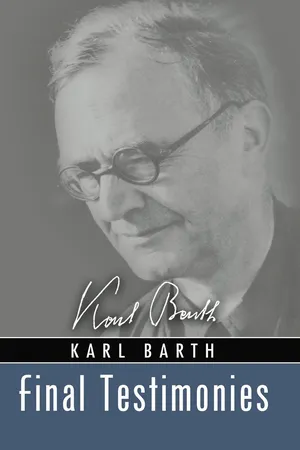
Final Testimonies
About this book
The five brief pieces collected here represent the final words prepared by Karl Barth for publication, all of them originating during the period from his serious illness in August of 1968 to his death in December of that same year. The final selection is a fragment left unfinished the night he died.
The last word that I have to say as a theologian or politician is not a concept like grace but a name: Jesus Christ. He is grace and he is the ultimate one beyond world and church and even theology. We cannot lay hold of him. But we have to do with him.... There is no salvation but in this name. In him is grace.
Karl Barth, 'Final Testimonies'
Information
Topic
Theology & ReligionSubtopic
Christian ChurchMUSIC FOR A GUEST—A RADIO BROADCAST
INTERVIEWER. IN A LETTER OF THANKS TO MOZART1 we read: “What I thank you for is simply this, that whenever I hear you I find myself set on the threshold of a good and orderly world both in rain and sunshine and by day and night, and as a twentieth-century man I find myself gifted each time with courage (not pride), with tempo (not exaggerated tempo), with purity (not tedious purity), and with peace (not indolent peace). With your musical dialectic in his ear a man can be young and grow old, can work and rest, can be content and sad, in short, can live.”
Karl Barth wrote this letter to Mozart on Mozart’s 200th birthday in 1956. It need not surprise us, then, that our guest today, Professor Karl Barth, has asked that only Mozart’s music be heard on our broadcast. To begin with we shall hear the fourth movement, the allegro, from the little G-minor symphony [K. 183], and no one will find it odd that we are beginning this broadcast with music even though Professor Barth is not a musician but a theologian.
Professor Barth, you have written an article “An Appreciation of Mozart”2 in which you refer to him somewhere as “this one and no other.” In your address on “The Freedom of Mozart”3 you even quote a saying of his father in which he calls Mozart a prodigy. Now I want to ask you what Mozart really means to you as a non-musician, as a theologian.
Barth. Before answering I want to put a question to you, Frau Schmalenbach. How is it that you are putting this particular question to me? As you have pointed out, I have written about Mozart. But that was a very little book. I have also written, as you know, a whole row of bulky volumes on what are apparently very different subjects. I have also said and done many things besides, some of them in the area of politics. How is it that you are interested in me in the specific field denoted by your question?
I. There are various reasons for this, Professor. As our guest you are one of the subjects of our broadcast but the other subject is music. And I think that if anything is known about you by people who are not theologians and not versed in theology, it is that Mozart is for you the epitome of all things musical. (Happily Mozart is the most requested composer in my program.) Again, although you have written Romans and the Barmen Declaration and the massive Church Dogmatics, and many other books that I know nothing about, you have also written the little work on Mozart. So you have something specific to say on this subject too.
B. Well, I am pleased to hear what you have just said, that I am not the only one to ask for Mozart, that it is not just a fad of mine, but, as I said in the book, there are many good folk who have found what I think I find in Mozart and who thus put in requests for him. Now what is it that we find? I might put it this way. What I hear in Mozart is a final word about life insofar as this can be spoken by man. Perhaps it is no accident that a musician spoke this word. But I hear a final word which holds up, as I stated in the extract you read, a final word which lasts, a final word to which one can always return and with which one can always begin afresh. For ultimately we must all begin afresh each day—and I make this new beginning best when I listen to Mozart. Right!
I. You also wrote, Professor, that Mozart meets the very human need for play.
B. Yes, I was very serious when I said that. But I think that in the last resort one can understand what play is only when one also knows what work is. My own life has been filled with a good deal of work. And it is only in relation to work that I have been able to see what it was in Mozart that rested on work but was in effect play.
I. You do not see Mozart, then, as a facile, outmoded, or even rococo composer?
B. Not at all. What we hear in him is play against a background of work, pleasure against a background of life—of life even in its suffering and the bearing of personal and other troubles, of which Mozart had plenty.
I. A whole heap …
B. Yes indeed. For me it works out this way. I could not understand Mozart as I do if I myself in another way did not know something about the seriousness of life. I am not speaking now of the pressures of writing the Dogmatics and preaching and so on. I am thinking of the place from which I drew and heard and received all this. From this place I have heard a harmony which Mozart obviously heard first before he composed it, and for me this has always agreed with what I have heard from a very different place than he did.
I. From a very different place, Professor?
B. From a very different place … yes, for now you are asking me as a theologian.
I. In the Bible? In the Word of God?
B. Yes.
I. We shall have to talk about theological matters too. But first another Mozart request.
B. Good. Let’s have something playful this time, for example, the third movement, the allegretto, from the Quintet in E Major.
I. That’s K. 452. We shall be hearing Vladimir Ashkenazy and the London Wind Soloists.
The question of play in serious life has led us to the allegretto. Play is pursued in a wholly dedicated way by children. My question, then, is what place music had in your childhood. What was your relation to it then? Did you yourself play any music?
B. I tried, but it didn’t turn out so well. So I became a listener. My father was musical and played the piano well. As I recall—I mention it in my little book—it is impossible for me ever to forget—I was four or five at the time—how he played “I amino mine” (“Oh, happy fate!”) from The Magic Flute. This affected me—I can’t say how—and I remarked: He’s the one!
I. So you were not even a schoolboy at the time. Where was this, Professor?
B. In Berne.
I. Did you spend all your schooldays in Berne?
B. Yes, from the first grades to the highest. Then I began my university work in Berne and from there went to Germany. A highlight in Berlin was a semester I took with Harnack.
I. Did you go on to do a doctorate with him?
B. No, I went back to Berne for a semester.
I. Did you sing student songs?
B. Yes, I could manage that—a whole semester. But I didn’t work much. I had been a real worker in Berlin but I passed my days with student cheerfulness in Berne.
I. But that is also important in the sense of play.
B. Yes, it was perhaps the one time in my life I had to enjoy life. And I did so—very radically.
I. When you became a pastor, had you already done your doctorate?
B. No, I never did a doctorate at all. I …
I. So that is why you are listed only as an honorary doctor?
B. That’s all I am.
I. “All” in inverted commas! But is this possible?
B. It’s the way it was. I was not aiming at an academic career. I wanted to be a pastor. I was this for twelve years, first in Geneva, then in Safenwil. That was all I knew.
I. And why did you not remain a pastor?
B. In my work as a pastor I gradually turned back to the Bible and began my commentary on Romans. This was not meant as a dissertation. It was written for its own sake. I thought what I had found in Romans might interest others too. Then I received a call to Gottingen and became a professor. My whole theology, you see, is fundamentally a theology for pastors. It grew out of my own situation when I had to teach and preach and counsel a little. And I found that what I had learned at the university was of little help in this. So I had to make a fresh start and I tried to do this.
I. Did you not miss as a professor the daily round of the pastor’s life?
B. No, I cannot say that. I just did the same thing on another level, the academic level, teaching, talking with students, and so on. This was not a real break for me.
I. I suspect, Professor, that you have always done ...
Table of contents
- Cover
- Title Page
- Copy Right
- Contents
- Translator’s Preface
- Foreword
- Testimony to Jesus Christ
- Music for a Guest—A Radio Broadcast
- Liberal Theology—An Interview
- Radio Sermons Catholic and Evangelical
- Starting out, Turning Round, Confessing
- Epilogue (Eberhard Busch)
Trusted by 375,005 students
Access to over 1.5 million titles for a fair monthly price.
Study more efficiently using our study tools.
Frequently asked questions
Yes, you can cancel anytime from the Subscription tab in your account settings on the Perlego website. Your subscription will stay active until the end of your current billing period. Learn how to cancel your subscription
No, books cannot be downloaded as external files, such as PDFs, for use outside of Perlego. However, you can download books within the Perlego app for offline reading on mobile or tablet. Learn how to download books offline
Perlego offers two plans: Essential and Complete
- Essential is ideal for learners and professionals who enjoy exploring a wide range of subjects. Access the Essential Library with 800,000+ trusted titles and best-sellers across business, personal growth, and the humanities. Includes unlimited reading time and Standard Read Aloud voice.
- Complete: Perfect for advanced learners and researchers needing full, unrestricted access. Unlock 1.5M+ books across hundreds of subjects, including academic and specialized titles. The Complete Plan also includes advanced features like Premium Read Aloud and Research Assistant.
We are an online textbook subscription service, where you can get access to an entire online library for less than the price of a single book per month. With over 1.5 million books across 990+ topics, we’ve got you covered! Learn about our mission
Look out for the read-aloud symbol on your next book to see if you can listen to it. The read-aloud tool reads text aloud for you, highlighting the text as it is being read. You can pause it, speed it up and slow it down. Learn more about Read Aloud
Yes! You can use the Perlego app on both iOS and Android devices to read anytime, anywhere — even offline. Perfect for commutes or when you’re on the go.
Please note we cannot support devices running on iOS 13 and Android 7 or earlier. Learn more about using the app
Please note we cannot support devices running on iOS 13 and Android 7 or earlier. Learn more about using the app
Yes, you can access Final Testimonies by Karl Barth, Eberhard Busch, Geoffrey W. Bromiley in PDF and/or ePUB format, as well as other popular books in Theology & Religion & Christian Church. We have over 1.5 million books available in our catalogue for you to explore.