eBook - ePub
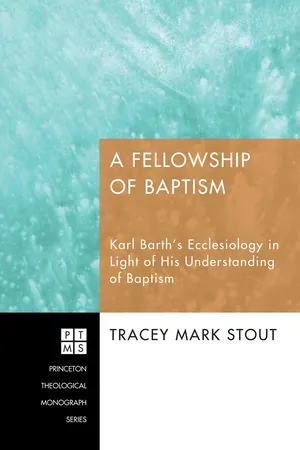
A Fellowship of Baptism
Karl Barth's Ecclesiology in Light of His Understanding of Baptism
- 208 pages
- English
- ePUB (mobile friendly)
- Available on iOS & Android
eBook - ePub
A Fellowship of Baptism
Karl Barth's Ecclesiology in Light of His Understanding of Baptism
About this book
A Fellowship of Baptism is a critical rereading of Karl Barth's ecclesiology, arguing that reading his ecclesiology through the lens of his mature view of baptism best enables one to understand Barth's view of the church. Barth's insistence on believer's baptism is connected to the free-church ecclesiology he develops in the Church Dogmatics. The church, for Barth, is a gathered, concrete community formed by the Holy Spirit. The result of believer's baptism should be a community that is free from cultural and political control so that it can serve the world and witness to it. At the same time, questions are raised about Barth's rejection of the sacramental nature of baptism and the implications this has for ecclesiology. The strengths of believer's baptism and the weakness of his non-sacramental view are both seen in his writings on the church and are brought into conversation with one another. Reading Barth's ecclesiology and doctrine of baptism together helps to show the interdependence of baptism and ecclesiology in Barth as well as in all church teaching and practice.
Information
Topic
Theology & ReligionSubtopic
Christian Theology1
Karl Barth’s Doctrine of Baptism
This chapter will address Barth’s understanding of baptism. It will examine Barth’s lecture The Teaching of the Church Regarding Baptism and then turn to the Church Dogmatics. The majority of the chapter will address the baptismal fragment published as Volume Four, Part Four of the Church Dogmatics. I will note the continuity and the change from the early 1940s to the material written at the end of Barth’s life. The purpose of this chapter is primarily descriptive. The following chapters will evaluate central ideas raised in the doctrine of baptism as they are given flesh in Barth’s ecclesiology.
The Teaching of the Church Regarding Baptism
Barth delivered a lecture to Swiss theological students in Gwatt in May of 1943. The lecture was published as a volume of the series Theologische Studien.1 This lecture caused quite a stir, primarily for its critique of the practice of infant baptism. In this lecture he asserted that “Christian baptism is in essence a representation (Abbild) of a man’s renewal through his participation by means of the power of the Holy Spirit in the death and resurrection of Jesus Christ, and therewith the representation of man’s association with Christ, with the covenant of grace which is concluded and realised in Him, and with the fellowship of His church.”2 Water baptism represents, and joins us to, the death and resurrection of Jesus. By the work of the Holy Spirit (i.e., the true baptism of the Spirit), we are united with Christ. The Holy Spirit enables our participation in the death and resurrection of Jesus Christ, which is our justification and rebirth to new life.3 Water baptism is a representation, or symbol, of “the divine-human reality which it attests.”4 Baptism testifies to the fact that God’s awakening of the person to faith through grace, and making that person a member of his covenant and the life of the church, are an objective reality and not subjective fancy. Baptism implies a threat to one’s life and a corresponding deliverance. Methods of baptism can be judged by how well they represent this death and rebirth.
According to Barth, baptism is a part of the church’s proclamation, and as such it is a human act. Yet, by the action of Christ it becomes his own word and act. Baptism is a living, expressive act because of who Christ is, the true Baptizer and chief Actor in baptism. The “potency” of baptism derives not from the faith of the baptized nor from the proper administration of the rite, not ex opera operato. The power of baptism comes solely from the reconciling work of Jesus Christ completed once for all.5
The meaning and intention of baptism is the glorification of God and the building up of the church. We cannot assert that water baptism is as such the means for the forgiveness of sins. To do so would confuse Jesus Christ with the one baptizing in his name. “Let us remember that the power of baptism lies in the free word and deed of Jesus Christ. Our baptism is no more the cause of our redemption than is our faith.”6 Baptism is not the cause, but the recognition and representation of our redemption. Barth states:
In baptism (as in Communion, as in preaching, as in all of the elements of the church’s proclamation) the word and work of Jesus Christ are recognized as a gift of salvation, a confirmation of the revelation of the covenant of grace, of the rebirth, of the forgiveness of sins, as a confirmation to believers of the complete divine-human reality which supports and surrounds him, and as a summons and obligation of believers to correspond to this reality in one’s own being and to be obedient to the Holy Spirit in accordance with his gift.7
Barth affirmed baptism as a sacrament, in the sense that it is a symbol that participates in what it points to.8 He developed a cognitive view of baptism as a sacrament which was in line with that put forth by Calvin. Baptism does not convey grace; it does however bring a person to realize the grace that he or she has been given.9 Baptism is a public act, meant to speak to the church. In baptism candidates are told that their sins are forgiven and that they are children of God. Secondly, they are told that they no longer belong to themselves; they have no further ground for disobedience. They have a Lord. All allegiance has been pledged to Jesus Christ.
Unfortunately, in actual practice the order of baptism may be sufficiently inadequate that the church really does not comprehend what baptism means. Yet, Barth rejects any re-baptism. As opposed to the repetition required for the Lord’s Supper, Barth emphasizes the once-for-all-ness of baptism.10 Re-baptizing adults was a fundamental error on the part of the Anabaptists. Baptism without the willingness of the baptized person may not be correct or given in obedience, and therefore is “clouded,” but it is still “true, effectual, and effective baptism” and is not to be repeated.11
The element of Barth’s theology of baptism which shocked and even angered those in the Reformed tradition was his insistence that the baptized be an active partner. Barth called the church to move away from infant baptism. The baptized should not be a passive instrument. We can no longer assume that everyone born to Christian parents is a part of the Christian church. The New Testament, Barth argues, does not support infant baptism.12 Barth asks: “What is baptism in itself and as such, if it has no reference to the conscious acknowledgement of regeneration and faith, to the complete divine-human reality, which is portrayed within it; if it cannot be in a really intelligible sense the confirming and binding in allegiance of the second of the chief actors, the one baptized; if it cannot be a matter of decision and confession at all?”13 In baptism a person receives the symbol of grace, but it is also a public affirmation of faith, an expression of the will. Baptism places an obligation upon the baptized; it is not meant to oblige parents or god-parents.14 Baptism is to be a responsible act; “the candidate, instead of being a passive object of baptism, must become once more the free partner of Jesus Christ, that is, freely deciding, freely confessing, declaring on his part his willingness and readiness.”15 Only if baptism is requested can it avoid “the character of an act of violence.”16 Barth thinks that the practice of infant baptism takes from the Holy Spirit the free movement and control of the calling and assembling of the church.
Barth recognizes the dangers of adult baptism, which presupposes free decision and confession: the forcing of conversions, perfectionism, false illusions of sanctity, and the rise of pharisaism. But perhaps perfectionism is not the church’s greatest concern. The dangers of infant baptism are more serious. The real danger is the existence of a Christendom which can disclaim its responsibility for Christianity.17 The greater threat is when all in a given society are baptized into the chur...
Table of contents
- Title Page
- Acknowledgments
- Introduction
- Chapter 1: Karl Barth’s Doctrine of Baptism
- Chapter 2: Baptism and the Being of the Church
- Chapter 3: Baptism as a Sacrament
- Chapter 4: Baptism and the Gathered Community
- Chapter 5: Baptism and the Free Community
- Chapter 6: Baptism and the Witnessing Community
- Conclusion
- Bibliography
Trusted by 375,005 students
Access to over 1.5 million titles for a fair monthly price.
Study more efficiently using our study tools.
Frequently asked questions
Yes, you can cancel anytime from the Subscription tab in your account settings on the Perlego website. Your subscription will stay active until the end of your current billing period. Learn how to cancel your subscription
No, books cannot be downloaded as external files, such as PDFs, for use outside of Perlego. However, you can download books within the Perlego app for offline reading on mobile or tablet. Learn how to download books offline
Perlego offers two plans: Essential and Complete
- Essential is ideal for learners and professionals who enjoy exploring a wide range of subjects. Access the Essential Library with 800,000+ trusted titles and best-sellers across business, personal growth, and the humanities. Includes unlimited reading time and Standard Read Aloud voice.
- Complete: Perfect for advanced learners and researchers needing full, unrestricted access. Unlock 1.5M+ books across hundreds of subjects, including academic and specialized titles. The Complete Plan also includes advanced features like Premium Read Aloud and Research Assistant.
We are an online textbook subscription service, where you can get access to an entire online library for less than the price of a single book per month. With over 1.5 million books across 990+ topics, we’ve got you covered! Learn about our mission
Look out for the read-aloud symbol on your next book to see if you can listen to it. The read-aloud tool reads text aloud for you, highlighting the text as it is being read. You can pause it, speed it up and slow it down. Learn more about Read Aloud
Yes! You can use the Perlego app on both iOS and Android devices to read anytime, anywhere — even offline. Perfect for commutes or when you’re on the go.
Please note we cannot support devices running on iOS 13 and Android 7 or earlier. Learn more about using the app
Please note we cannot support devices running on iOS 13 and Android 7 or earlier. Learn more about using the app
Yes, you can access A Fellowship of Baptism by Tracey Mark Stout in PDF and/or ePUB format, as well as other popular books in Theology & Religion & Christian Theology. We have over 1.5 million books available in our catalogue for you to explore.