eBook - ePub
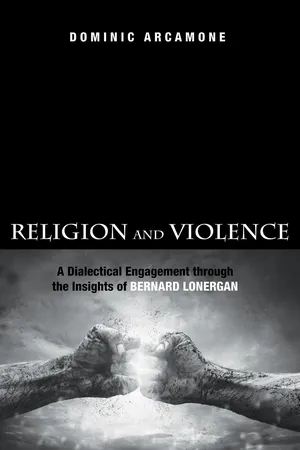
Religion and Violence
A Dialectical Engagement through the Insights of Bernard Lonergan
- 294 pages
- English
- ePUB (mobile friendly)
- Available on iOS & Android
eBook - ePub
Religion and Violence
A Dialectical Engagement through the Insights of Bernard Lonergan
About this book
The aim of Religion and Violence is to engage dialectically key symbols of religiously motivated violence through the insights of Bernard Lonergan. Sociologists and psychologists argue the link between religion and violence. Religion is viewed more as part of the problem and not part of the solution to violence. Bernard Lonergan's insights have helped the author arrive at a number of conclusions regarding the link between religion and violence. He argues that there is a difference between distorted religion and genuine religion, between authenticity and inauthenticity of the subject. Distorted religion has the capacity to shape traditions in ways that justify violence, while genuine religion heals persons, helps them make different moral decisions when confronted with situations of conflict, and aims to explore new ways of understanding themselves as shaping history toward progress.
Further, Religion and Violence, while arguing from within the Catholic Christian tradition, nevertheless seeks to provide a number of categories that will speak to people from other cultural traditions. Since many of the examples of religious violence cited by commentators come out of the Islamic tradition, the author has evidenced and explored more authentic aspects of the Islamic tradition that would help provide a solution to violence.
Information
1
Why Draw on the Insights of Bernard Lonergan?
At this point, I want to present a justification for turning to the insights of the Catholic Canadian theologian and philosopher, Bernard Lonergan. While Lonergan’s works do not specifically concern themselves with religiously motivated violence, his insights nevertheless address the problem of violence by examining the performance of the subject as subject and by providing a philosophical analysis of the self-transcending subject. Lonergan postulates a set of foundational categories for discerning how we come to have religious knowledge, an explanatory account of historical progress and breakdown in human history, and a way forward for recovery in history that is achieved through authentic religious living.
I have also chosen two other conversation partners, namely, René Girard and Charles Taylor, and I provide a selective exposition of their insights. In contrast to the other authors I have chosen in the literature review, I will not subject these writers to any extended critique. Though there are differences in their approaches from that of Lonergan, their insights nevertheless complement his. However, I will argue that Lonergan’s insights provide a much more nuanced approach for understanding religion, and for understanding violence and the means to overcoming violence through authentic religion.
A Common Ground
More than any other philosopher and theologian that I know of, Bernard Lonergan seeks “a common ground on which [people] of intelligence might meet.”1 Lonergan states that “the plain fact is that the world is in pieces before [us] and pleads to be put together again, to be put together not as it stood before on the careless foundation of assumptions that happened to be unquestioned but on the strong possibility of questioning and with full awareness of the range of possible answers.”2 Such a crisis of which Lonergan speaks is a crisis of meaning, and the common ground he proposes is the possibility of questioning in a collaborative manner. In any intellectual culture that is saturated with subjectivism, relativism, historicism, dogmatism, and skepticism, the possibility of a common ground is viewed negatively. But the common ground in Lonergan’s work, Insight, emerges not as a set philosophical worldview; rather, it is a method founded in a basic set of invariant and normative operations in human consciousness, the transcultural norms of self-transcending inquiry that constitutes all people as knowers and choosers within an explanatory account of insight.3
Lonergan’s common ground shifts the debate concerning the possibility of objectivity from the priority of language or logic to the priority of method, discovered in the concrete performance of the subject as subject. He thus proposes that a generalized empirical method is able to provide a foundation for intellectual and moral objectivity.4 The foundation of epistemology is cognitional theory, while the foundation of cognitional theory is the performance of the subject as subject. This foundation is not the same as the foundationalism spoken against by many postmodern thinkers, nor is it just one other method among many methods. Rather, it is the subject’s lifting of attention above specific principles and historical models to the methodological criteria by which we judge what is real, choose what is better or worse, and act in love. Genuine objectivity is then the consequence of authentic subjectivity.5
All knowledge, whether theological, religious, philosophical, scientific, moral, or practical is grounded in insights or acts of understanding, so that one’s normative source of meaning is insight into insight. Robert Doran, in his notes on Lonergan’s major work, Insight, gives a summary of the multiplicity of insights that we could potentially recognize in our experience.6 Lonergan states that “insight is the source not only of theoretical knowledge but also of all its practical implications, and indeed all its intelligent activity. Insight into insight will reveal what activity is intelligent, and insight into oversights will reveal what activity is unintelligent.”7
Any historical moment within a community will contain both insight and oversight intertwined. While insight can promote progress, oversight grounded in bias engenders decline. When oversight occurs, Lonergan asserts that
we reinforce our love of truth with a practicality that is equivalent to obscurantism. We correct old evils with a passion that mars the new good. We are not pure. We compromise. We hope to muddle through. But the very advance of knowledge brings a power over nature and over men too vast and terrifying to be entrusted to the good intentions of unconsciously biased minds. We have to learn to distinguish sharply between progress and decline, learn to encourage progress without putting premiums upon decline . . . learn to remove the tumor of a flight from understanding without destroying the organs of intelligence.8
The Differentiation of Consciousness
In Method in Theology Lonergan explains acts of meaning and their relation to the various differentiations of human consciousness, concluding that each realm of meaning can mix, blend, and operate in different ways within the subject.9 Lonergan’s examination of the “unfolding of a single thrust, the eros of the human spirit” from undifferentiated to differentiated realms of consciousness reveals a movement of the human mind out of a world in which reality is known directly and immediately to a world in which reality is mediated by meaning.10 I will give a full account of these realms in chapter 3.
Here, though, I particularly want to focus on an observation by Robert M. Doran, who has done much to expound Lonergan’s insights, and who argues that the concrete experience of contemporary life is taking place in a social and cultural milieu permeated by a vast increase in knowledge. Many complex theories have emerged from diverse disciplines, including theology, psychology and sociology, as well as the natural sciences, but such a milieu moves toward greater and greater specialization so that only a small dimension of any one field of study can be mastered.11 Doran therefore states that unless we find “a ground beyond theory—for it will not do just to fall back on common sense—our situation becomes one of hopeless relativism”; moreover, this “ground beyond theory (and common sense) lies in the self-appropriation of interiority.”12
Therefore I argue that discovering a better understanding of reality and enacting practical solutions toward the kind of violence justified by a distorted religious imagination will require a shift to take place in the performing subject. It will require that we move to what Lonergan calls “the third stage of meaning,” which takes its stand in interiority, and which shifts its concern from the content of meanings to acts of meaning, from products to sources of products, from objects to operations in consciousness.13 Lonergan states that we must “discover mind” and be able to distinguish “feeling from doing, knowing from deciding.”14
The Task of Self...
Table of contents
- Title Page
- Acknowledgments
- Introduction
- 1. Why Draw on the Insights of Bernard Lonergan?
- 2. A Selective Literature Review
- 3. Lonergan, Religion, and Violence
- 4. A Dialectical Engagement with Cosmic War: Cosmos
- 5. A Dialectical Engagement with Cosmic War: Warfare
- 6. A Constructive Engagement with Warfare
- 7. A Dialectical Engagement with Martyrdom
- 8. A Dialectical Engagement with Demonization
- 9. A Dialectical Engagement with Warrior Empowerment
- 10. Conclusions
- Bibliography
Trusted by 375,005 students
Access to over 1.5 million titles for a fair monthly price.
Study more efficiently using our study tools.
Frequently asked questions
Yes, you can cancel anytime from the Subscription tab in your account settings on the Perlego website. Your subscription will stay active until the end of your current billing period. Learn how to cancel your subscription
No, books cannot be downloaded as external files, such as PDFs, for use outside of Perlego. However, you can download books within the Perlego app for offline reading on mobile or tablet. Learn how to download books offline
Perlego offers two plans: Essential and Complete
- Essential is ideal for learners and professionals who enjoy exploring a wide range of subjects. Access the Essential Library with 800,000+ trusted titles and best-sellers across business, personal growth, and the humanities. Includes unlimited reading time and Standard Read Aloud voice.
- Complete: Perfect for advanced learners and researchers needing full, unrestricted access. Unlock 1.5M+ books across hundreds of subjects, including academic and specialized titles. The Complete Plan also includes advanced features like Premium Read Aloud and Research Assistant.
We are an online textbook subscription service, where you can get access to an entire online library for less than the price of a single book per month. With over 1.5 million books across 990+ topics, we’ve got you covered! Learn about our mission
Look out for the read-aloud symbol on your next book to see if you can listen to it. The read-aloud tool reads text aloud for you, highlighting the text as it is being read. You can pause it, speed it up and slow it down. Learn more about Read Aloud
Yes! You can use the Perlego app on both iOS and Android devices to read anytime, anywhere — even offline. Perfect for commutes or when you’re on the go.
Please note we cannot support devices running on iOS 13 and Android 7 or earlier. Learn more about using the app
Please note we cannot support devices running on iOS 13 and Android 7 or earlier. Learn more about using the app
Yes, you can access Religion and Violence by Dominic Arcamone in PDF and/or ePUB format, as well as other popular books in Social Sciences & Christian Theology. We have over 1.5 million books available in our catalogue for you to explore.