- 102 pages
- English
- ePUB (mobile friendly)
- Available on iOS & Android
eBook - ePub
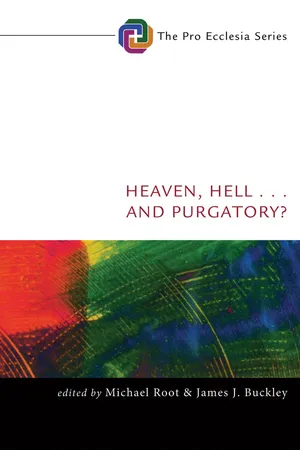
Heaven, Hell, . . . and Purgatory?
About this book
What is our destiny? The final end of humanity and the universe is a subject of perennial interest, especially for Christians. What are we promised? Will anyone finally be left out of God's intentions to bless humanity? What sort of transformation will be needed to enter the presence of God? These questions have been at the heart of Christian teachings about last things.
The 2013 Pro Ecclesia Conference of the Center for Catholic and Evangelical Theology focused such issues on the theme "Heaven, Hell . . . and Purgatory?" The six essays in this volume cover a range of topics of interest to Catholic, Evangelical, and Orthodox theology.
Information
Subtopic
Théologie chrétienne1
The Christian Faith and the Horizon of Judgment
In his dialogue on The Ascetic Life, St. Maximus the Confessor presents an exchange between an old monk and a young brother seeking instruction. The old man sets forth many classic themes of eastern monastic spirituality in light of the opening question of the dialogue: “Please, Father, tell me: What was the purpose of the Lord’s becoming man?” But somewhere around the halfway mark the tone and character of the work change. In answer to the young brother’s question, “Father, why do I have no compunction?” the old man bursts forth in a lengthy jeremiad that fills much of the rest of the work:
And the old man answered: “Because there is no fear of God before our eyes, because we have become a resting-place of all evils, and, for that reason, we scorn as a mere thought the dreadful punishment of God. For who does not feel compunction at hearing Moses speaking about sinners in God’s person: A fire is kindled in my wrath, it shall burn to the lowest hell. It shall devour the earth and her increase; it shall burn the foundations of the mountains. I will heap evils upon them, and will spend my arrows upon them (Deut 32:22f.)?”1
Similar and lengthy citations follow from Isaiah, Jeremiah, Ezekiel, Daniel, the Psalms; this first catena ends with the words of St. Paul, “For we must all stand before the judgment seat of Christ, so that every one of us may receive reward for things done through the body, whether good or evil.”2 The old man’s speech continues over many pages, turning from denunciation to prayer, at every point drawing extensively from the Scriptures, until the young brother, “having heard all this and being deeply struck with compunction,” asks in tears: “From what I see, Father, there is no hope of salvation left me. ‘For my iniquities have gone over my head’ (Ps 37:5). Yet I entreat you, tell me what I ought to do?”
Then the old man answered and said, “With men salvation is impossible; but with God all things are possible” [Matt 1:52], as the Lord Himself has said. Therefore “let us come before His presence in contrition and thanksgiving; let us adore and fall down and weep before the Lord that made us, for He is our God.”
(Ps 94:2, 6; LXX)3
(Ps 94:2, 6; LXX)3
Now, I must sadly confess that when I read this dialogue years ago, my first reaction was not to weep for my sins but rather to think, “Take that, Krister Stendahl! You can’t blame that on Augustine—it must be the introspective conscience of the East.”4 While this might lead us to sobering reflection on whether professors in particular can be saved, I want to respond a bit more appropriately this time around, and take the old man’s words as a starting point for reflection on the Christian faith and the horizon of judgment.
By the “horizon of judgment” I mean just what the old man’s speech brings so vividly before us. The Christian faith as it is attested in the Scriptures and in ecumenical tradition includes the expectation that Christ “will come again to judge the living and the dead.” Traditional Christianity is lived out in the awareness that all human creatures stand under the pressure of God’s unyielding demand for righteousness, that we are utterly exposed to his scrutiny, and that we go to meet a final judgment in which all wickedness and evil will be terminated once and for all. This is the “horizon of judgment.”
It is no secret that in the last century this horizon largely faded from the awareness of the mainline Christianity of the Global North. H. Richard Niebuhr’s gibe is worth repeating for perhaps the millionth time: “A God without wrath brought men without sin into a Kingdom without judgment through the ministrations of a Christ without a Cross.”5 In one of the most profound Lutheran essays on justification written in the last century, the Heidelberg theologian Peter Brunner wrote of the way in which the Reformation doctrine presupposed an eschatology of judgment that has become alien to modern Christianity:
We must be clear that the sharp point is broken off the message of justification from the start and its power is taken away, if it does not direct the gaze of its hearer clearly and unambiguously to the last things, to our passage through the verdict of Jesus Christ in the Last Judgment. Justification by faith has to do, decisively and in the first instance, with what will meet us from God’s side after this life, when we have died, with what will meet us after this whole earthly history, when this earth and this heaven will be no more.6
This message has largely become unintelligible, Brunner writes, in a culture marked not so much by dogmatic atheism as by a “dominant Lebensgefühl,” a “feel” for life and a “style of living” that no longer takes account of God. This culture “has, viewed as a whole, imprisoned itself in the immanence of its understanding of existence as in a prison. It no longer has any vision that reaches beyond itself. It feels itself alone in the world without God as counterpart.”7 In this situation, the life and ministry of the churches has changed dramatically.
What do the people who still belong to the church expect from the Christian faith? What are they looking for in the church? Is it not very commonly spiritual help for daily life? We want to be better equipped to cope with the difficulties of our personal life. We want to overcome these and those bad inclinations in ourselves. We would like to become better people. We would like to have something stable on which we can rely when we are threatened by trouble, sickness, misfortune, and temptations. We would like to experience something of joy and real community in this lonely and sorrowful world.8
In the same way, the diaconal engagement with human need has become the “normative function” of the existence of many churches, while the promise of eternal life in Christ has become at best an awkward heritage:
It seems likely that many church leaders, many church administrations, many church synods, many church delegations, but also many congregations of the church, would be very much surprised if one told them that the church, even this very Evangelical Lutheran territorial church of theirs, is an institute for salvation (Heilsanstalt) and that the real meaning and goal of this church consists in throwing the life-belt which God has entrusted to it into the ocean of lostness, so that human beings may be snatched from eternal death and eternal damnation by this life-belt and rescued for eternal life and eternal beatitude!9
Brunner by no means despised either spiritual help in daily life or the church’s diaconal help to those in need; his point is that these necessary ministries look and function differently when they are pursued within the horizon of eschatological judgment. I have been told recently of at least one mainline denomination whose disaster relief workers are prohibited from speaking about Jesus or engaging in prayer with those whom they are attempting to help—a fairly advanced development of the condition
Brunner described.
Brunner described.
In the body of this paper, I would like simply to reflect on the horizon of judgment within which historic Christianity operates. I hope to do so without entering into debates about universal salvation or the nature of damnation or the doctrine of purgatory, though what I say may be relevant to those discussions. I will freely confess that I am not certain whether this presentation is an academic lecture or a sermon or something in between. I shall in any case proceed by considering four theses.
I. God’s final judgment means that all things are put to rights, truth is established, and evil is terminated.
In the Old Testament, the theme of judgment is tied closely to one particular strand of usage of the word mishpat, which is often translated “judgment.” The strand of usage I have in mind speaks of mishpat as an action, as in the expression “do mishpat.” Generally speaking, the doing or executing of mishpat is the action of a ruler putting a bad situation to rights; in this broad sense it has a wide range of applications and is translated in a wide variety of ways. In its forensic usage, the execution of mishpat is not so much like pronouncing the verdict of guilty or non-guilty in a modern criminal court; it is more like the judgment in a civil suit in which a disorder or inequity is both identified and corrected. In the paradigmatic narrative of the mishpat of Solomon in 1 Kings 5, there is no mention of any punishment meted out to the woman who sought to steal the other woman’s child—but the truth is established and the situation is put to rights, so that the true mother is reunited with her child.
God’s judgment is likewise God’s action putting to rights a situation that has become intolerable. “I know that the Lord will maintain the cause of the afflicted, and will execute justice for the needy” (Ps 140:12).10 When the wealthy oppress the poor, when the nations oppress Israel, when Israel dishonors God, the divine judgment discloses the truth of the situation and sets things right.
Much of recent biblical theology has wanted to identify the righteousness which God establishes by judgment with simple covenant faithfulness, so that God’s commitment to judgment comes down to his loyalty to his people or indeed to his creatures as a whole. But covenant faithfulness is not that...
Table of contents
- Title Page
- Preface
- Chapter 1: The Christian Faith and the Horizon of Judgment
- Chapter 2: Why Hell Still Burns
- Chapter 3: Purgatory in the Writings of Augustine and Bedee
- Chapter 4: The Pains of Hell and the Surprises of Purgatory
- Chapter 5: Beatitude: What Heaven Is Like
- Chapter 6: Preaching Heaven and Hell
Trusted by 375,005 students
Access to over 1.5 million titles for a fair monthly price.
Study more efficiently using our study tools.
Frequently asked questions
Yes, you can cancel anytime from the Subscription tab in your account settings on the Perlego website. Your subscription will stay active until the end of your current billing period. Learn how to cancel your subscription
No, books cannot be downloaded as external files, such as PDFs, for use outside of Perlego. However, you can download books within the Perlego app for offline reading on mobile or tablet. Learn how to download books offline
We are an online textbook subscription service, where you can get access to an entire online library for less than the price of a single book per month. With over 1.5 million books across 990+ topics, we’ve got you covered! Learn about our mission
Look out for the read-aloud symbol on your next book to see if you can listen to it. The read-aloud tool reads text aloud for you, highlighting the text as it is being read. You can pause it, speed it up and slow it down. Learn more about Read Aloud
Yes! You can use the Perlego app on both iOS and Android devices to read anytime, anywhere — even offline. Perfect for commutes or when you’re on the go.
Please note we cannot support devices running on iOS 13 and Android 7 or earlier. Learn more about using the app
Please note we cannot support devices running on iOS 13 and Android 7 or earlier. Learn more about using the app
Yes, you can access Heaven, Hell, . . . and Purgatory? by Michael Root,James J. Buckley, Root, Buckley in PDF and/or ePUB format, as well as other popular books in Théologie et religion & Théologie chrétienne. We have over 1.5 million books available in our catalogue for you to explore.