- 166 pages
- English
- ePUB (mobile friendly)
- Available on iOS & Android
eBook - ePub
About this book
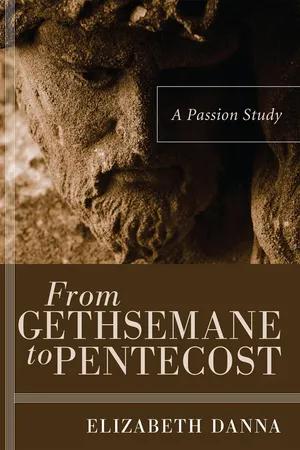
From Gethsemane to Pentecost is an eight-week Bible study for small groups or individuals. Drawing from the study of history, archaeology, literary studies, and the original languages, this in-depth look at the inspired texts of the Gospels and Acts provides a one-of-a-kind walk down the Via Dolorosa, from the Garden of Gethsemane, to Calvary and a borrowed tomb, to the wind and fire of Pentecost. On the way, you will gain both insights into the texts and practical lessons to apply to the Christian life.
Information
Week 1
Introduction
The story of Jesus’ death and resurrection formed the heart of Christian preaching from the earliest days of the church. Indeed the apostle Paul tells the Corinthians, “I decided to know nothing among you except Jesus Christ, and him crucified” (1 Cor 2:2). And again, “I handed on to you as of first importance what I in turn had received: that Christ died for your sins in accordance with the Scriptures, and that he was buried, and that he was raised on the third day in accordance with the Scriptures . . .” (1 Cor 15:3–4, emphasis added). And a saying of Jesus hints that the Passion is the reason Jesus came to earth (“For this reason I came to this hour,” John 12:27). It is probable, then, that this part of the story of Jesus was the first to be formed into a coherent narrative. Indeed one scholar has described the Gospels as Passion narratives with extended introductions. By the way, the events of Jesus’ suffering and death are called the “Passion” from the Latin passio, “suffering” (the story was given this name when Latin was the only language of the church. Indeed the Roman Catholic Church to this day lays much emphasis on the physical suffering of Jesus during his trials and crucifixion).
It was not long before Christians wanted to know more about what Jesus had said and done during his lifetime, before his crucifixion. They also found themselves faced with questions from opponents: what had Jesus done that the authorities wanted him dead? If he truly was the Messiah of God, why had God allowed him to die? To answer these questions, they did two things. First, as they told the story of Jesus they showed that he was innocent of the charges brought against him, and also that he knew ahead of time what was going to happen, and accepted it. Second, they searched the Scriptures to show that the prophets had foretold the events of Jesus’ life. This was the only way they could persuade Jews to believe in Jesus, for, the Jews reasoned, God would not do anything as important as this without telling Israel beforehand (see Amos 3:7, “Surely the Lord GOD does nothing, without revealing his secret to his servants the prophets”). Mark shows in the first half of his Gospel that Jesus was able to teach, preach, cast out demons and do miracles because he was sent from God and had God’s approval. When reading about Jesus’ suffering and death, the reader is to understand that his dying in this way did not mean that God had rejected him (compare Acts 2:22–24, “Jesus of Nazareth, a man attested to you by God with mighty works and signs and wonders which God did through him in your midst, as you yourselves know—this Jesus, delivered up according to the definite plan and foreknowledge of God, you crucified and killed by the hands of lawless men. But God raised him up”).

So why should we study the Passion story today? What value does it have for us? The first thing we may say is that the story concerns the death of Jesus, and the death of Jesus is still the only way to salvation. Jesus said, “I am the way, and the truth, and the life; no one comes to the Father, but by me” (John 14:6). “There is salvation in no one else, for there is no other name under heaven given among men by which we must be saved” (Acts 4:12). This is still true today. This alone would make this story worthy of our attention. But there is also much to be learned from these passages, and many lessons that we can apply to our own lives. Paul, writing about some tragic incidents in Israel’s past, says, “These things were written down for our instruction” (1 Cor 10:11). Paul is referring to the Old Testament Scriptures, but the same thing also applies to the New Testament for us. So there are good reasons for studying these passages.
Most Bible scholars today agree on the following timeline: Jesus was crucified in about AD 30. Paul wrote his letters between about AD 50 and 67. The Gospel of Mark was written about AD 65, the Gospels of Matthew and Luke, and the book of Acts, in the 70s, and the Gospel of John in the 80s. This means that the New Testament records of Jesus’ life, death, and resurrection were written within fifty years of the events themselves. This means that there would still be people alive when the Gospels were written who had been alive in Jesus’ lifetime, and could confirm or refute what the church said (by way of comparison, less time elapsed between the death of Jesus and the writing of the Gospels than has elapsed between World War Two and the writing of this study. There are those who have tried to deny that the Holocaust occurred, but they have had little success, because there are still witnesses alive to refute them). This speaks in favor of the accuracy of the Gospel records.
Let us turn now to the Gospel of Mark. I have chosen to focus on Mark’s Passion narrative because Mark is the shortest and earliest of the Gospels (though we will be bringing in the other Passion narratives, as well as other Scripture, as needed). Mark’s Gospel was probably written around AD 65, probably at Rome. In the summer of 64 there was a terrible fire at Rome, a fire in which three of the city’s fourteen wards were completely destroyed and seven more were badly damaged. Roman historians said that the fire was ordered by the emperor Nero; today’s historians are more inclined to think that it started by accident. However that may be, blame for the disaster soon fell upon the Christians; the fact that at this time they were an underground Jewish sect about which the general public knew little made this all the easier. Severe persecution of Christians ensued, but was limited to the area of the city. According to church tradition, the apostles Peter and Paul were among the victims of this persecution. It was in these circumstances that Mark, Peter’s assistant, was led by God to write down what he remembered Peter saying about Jesus’ life, ministry and death. Mark tells his story in a way that encourages his readers to face trials with the same resolute and courageous submission to the will of God that Jesus showed when he was falsely accused by the authorities, and abandoned by his disciples and (apparently) by God. The disciples fail (at least in the short term), the reader may fail too but there is hope of restoration, and if he or she endures, God will vindicate him or her just as he vindicated Jesus. (The other Gospel writers, writing over the following two decades, in different locations and circumstances, have slightly different emphases. Luke, for example, stresses that Jesus was at peace throughout his trials because he knew that God was in charge and was with him. And John stresses Jesus’ control over events and his triumphant completion of his mission. But they are all telling the same story.)
One thing that we will discuss in this study is literary and characterization issues. These concern how the Gospel writers tell their stories. I should make it clear that in discussing these things I am not suggesting that the Gospels are fiction—some stories are true stories. But God led the Gospel writers to tell their stories in such a way as to bring out certain points, according to what the church, in the time and place in which a particular Gospel was written, needed to hear.
One literary device that we will see Mark use in his storytelling is irony, an irony rooted in the fact that Jesus is not the kind of Messiah that people expected. He is not a glorious conquering military Messiah, but a Suffering Servant. No one can understand Jesus until they understand that he must suffer. John uses a similar form of irony, in which characters say more than they know. Caiaphas, for example, says more than he knows in John 11:50, “it is expedient for you that one man should die for the people, and that the whole nation should not perish.” He means that it is politically expedient for one man to die, if that will avoid a Roman crackdown which would cost many lives. But as John explains in verses 51–52, the meaning of the high priest’s words is that Jesus will die for the Jewish nation and the world. This kind of irony encourages the reader to come alongside the writer (often against the characters) because the reader is expected to “get it,” even when the characters do not.
We will also see in these next weeks that Scripture is fulfilled. Now, “Scripture is fulfilled” is an expression that Christians use frequently—but what exactly does it mean? Perhaps the simplest thing that we may say is that certain Old Testament Scriptures, whatever meaning they had in the situation in which they were first given, also described events in the life of Jesus. An example of this is in Matt 2:15, where Matthew quotes Hos 11:1, “Out of Egypt I have called my son.” In the original context, Hosea is referring to Israel’s exodus from Egypt (Israel is also called God’s son in Exod 4:22; compare Deut 32:18; Jer 3:19) But Matthew sees Hosea’s statement as referring also to Jesus, Son of God, and his return from Egypt after the death of Herod the Great. A more famous example of this is in Isa 61:1–4. In one sense Isaiah is talking about God’s call on his own life. But in another sense he is talking about Jesus, as Jesus himself makes clear (Luke 4:18–21). We saw above that showing how Jesus fulfils prophecy was an important element in the early church’s witnessing to Jews.
Another thing that we will see in these next weeks is the “divine passive.” Simply put, this is a way of phrasing that, instead of saying, “God did this,” says, “This was done.” For example, in Mark 4:24–25 Jesus warns, “the measure you give will be the measure you get, and still more will be given you. For to him who has will more be given; and from him who has not, even what he has will be taken away.” By using passive verbs (“be given; be taken”), Jesus hints that it is God who will be doing the measuring, giving, and taking. This was a Jewish custom, which arose shortly before Jesus’ time, to avoid unintentional irreverent use of God’s name.
God led each of the Evangelists—the Gospel writers—to draw lessons from the events of Jesus’ death and resurrection that God wanted Christians of the first century to apply to their lives. Let us, as part of the modern-day church, look into these things and see what we can learn from them, and how we can apply these lessons to our own lives. And let us be doers of the Word, not hearers only who deceive ourselves.
Week 2
Second Garden, Second Adam
Day One
Tempted, Just As We Are Today’s key verses: Mark 14:32–52;Luke 22:50–52; Matt 27:52–53
This week we begin our study at the beginning of the Passion narrative, in the Garden of Gethsemane. The garden was a grove of olive trees, probably on the lower slopes of the Mount of Olives, on the Kidron side, probably adjacent to an olive press (the word Gethsemane means “oil press”). The Mount of Olives is a significant location in Scripture. It is the setting for Jesus’ last-days discourse of Mark 13. The Mount of Olives also figures in the story of 2 Sam 15:13–31, where David flees from Absalom across the Kidron valley, up the Mount of Olives, where he weeps and prays. In the Passion narrative Jesus, Son of David, comes to the Mount of Olives to pray; he is connected not with David the triumphant king, but with David in his suffering and weakness.
Please read Mark 14:32–52, the passage that we will be studying all this week. This is the story of Jesus’ struggle in Gethsemane. It is unlikely that the church would invent this story, in which Jesus could seem weak, and the disciples fail. Jesus now comes face-to-face with the fact that the trial that he has known was coming is about to begin. The words for Jesus’ emotions at verses 33–34 are strong; his distress shows his full humanity. The Greek word translated “greatly distressed” is ekthambeo. This word refers to being struck with astonishment, amazement, and terror. The word translated “troubled” is ademoneo; it means “to be in distress of mind.” The word translated “very sorrowful” is perilupos. It comes from peri, meaning “around,” and lupe, meaning “grief; physical or mental distress.”1 The combination suggests being surrounded by grief and distress, as if by enemies. These are strong words, and the effect produced by their being together, one after the other like an unbearably heavy chain, is even greater. When the force of these words is considered, Mark 14:33–34 could be read like this: “And he [Jesus] took with him Peter, James, and John, and began to be amazed and terror-stricken, and to be in distress of mind. And he said to them, ‘My soul is surrounded by grief and distress, to the point that it is likely to kill me. Remain here and stay awake.’”
Jesus’ falling to the ground (verse 35) indicates intense emotions and an urgent need for help (compare, e.g., Mark 5:22; Matt 17:6; 18:26, 29; Luke 5:12). He prepares for his ordeal by staying awake and praying. He cries out to the Father here at the beginning of the Passion narrative, just as he will cry out to him at its end (Mark 15:35, 37). Jesus begins his prayer by addressing God as Father, with all the confidence and trust of a son talking to his father, and affirming that for God all things are possible. Jesus asks that, if possible, he might avoid suffering. But he puts God’s will above his own will, and above his own comfort. If doing God’s will means suffering, Jesus is willing to suffer.
Jesus prays that the cup be taken away from him...
Table of contents
- Title Page
- Acknowledgments
- How to Use This Book
- Week 1: Introduction
- Week 2: Second Garden, Second Adam
- Week 3: Jesus (and Peter) on Trial
- Week 4: A Roman Tragedy
- Week 5: Via Dolorosa
- Week 6: Sealed in a Stone-Cold Tomb
- Week 7: A Happy Beginning
- Week 8: Wind and Fire
- Bibliogaphy
Trusted by 375,005 students
Access to over 1.5 million titles for a fair monthly price.
Study more efficiently using our study tools.
Frequently asked questions
Yes, you can cancel anytime from the Subscription tab in your account settings on the Perlego website. Your subscription will stay active until the end of your current billing period. Learn how to cancel your subscription
No, books cannot be downloaded as external files, such as PDFs, for use outside of Perlego. However, you can download books within the Perlego app for offline reading on mobile or tablet. Learn how to download books offline
Perlego offers two plans: Essential and Complete
- Essential is ideal for learners and professionals who enjoy exploring a wide range of subjects. Access the Essential Library with 800,000+ trusted titles and best-sellers across business, personal growth, and the humanities. Includes unlimited reading time and Standard Read Aloud voice.
- Complete: Perfect for advanced learners and researchers needing full, unrestricted access. Unlock 1.5M+ books across hundreds of subjects, including academic and specialized titles. The Complete Plan also includes advanced features like Premium Read Aloud and Research Assistant.
We are an online textbook subscription service, where you can get access to an entire online library for less than the price of a single book per month. With over 1.5 million books across 990+ topics, we’ve got you covered! Learn about our mission
Look out for the read-aloud symbol on your next book to see if you can listen to it. The read-aloud tool reads text aloud for you, highlighting the text as it is being read. You can pause it, speed it up and slow it down. Learn more about Read Aloud
Yes! You can use the Perlego app on both iOS and Android devices to read anytime, anywhere — even offline. Perfect for commutes or when you’re on the go.
Please note we cannot support devices running on iOS 13 and Android 7 or earlier. Learn more about using the app
Please note we cannot support devices running on iOS 13 and Android 7 or earlier. Learn more about using the app
Yes, you can access From Gethsemane to Pentecost by Elizabeth Danna in PDF and/or ePUB format, as well as other popular books in Théologie et religion & Critique et interprétation bibliques. We have over 1.5 million books available in our catalogue for you to explore.