eBook - ePub
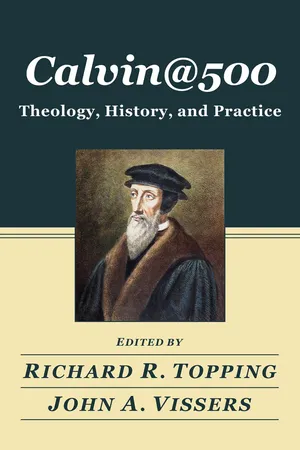
CALVIN@500
Theology, History, and Practice
- 198 pages
- English
- ePUB (mobile friendly)
- Available on iOS & Android
eBook - ePub
About this book
Calvin@500 is an exercise in appreciative criticism and appropriation of the Reformer's work for church and society. The collection serves as an introduction to the life and thought of this sixteenth-century Reformer in his context. The book also traces Calvin's continuing legacy for political, economic, theological, spiritual, and inter-religious practices of our own time. The essays reflect the depth and breadth of Calvin scholarship from the sixteenth century to the present. They also reflect Calvin's own wide-ranging ministry: the authors are pastors, teachers, social justice workers, and theologians. Calvin@500 arose from two Canadian conferences on the occasion of the 500th anniversary of Calvin's birth.
Information
Topic
Theology & ReligionSubtopic
Christian Theology1
“The First-Born in God’s Family”
Calvin and the Jews
The condition of Jewish people in Europe, on the eve of the Reformation, can be accurately described by the word “miserable.”1 For centuries Jewish communities and individual Jews had been persecuted by Christians. Jews were regarded as rejected by God for crucifying Jesus and were blamed for plagues, natural disasters and various misfortunes. They were accused of the ritual murder of Christian children, charged with desecrating the Eucharistic host and were generally resented for their money lending practices.
A new chapter in the persecution of the Jews began with the preaching of the First Crusade by Pope Urban II in 1095. This crusade ignited a series of murderous attacks against Jews, first in France and then along the Rhine in Germany, in what has been called “the first holocaust.” The German church opposed this torrent of racial and religious hatred and violence since canon law did not condone the victimization of the Jews and prohibited forced conversions. Yet for the most part the Pope and the bishops reacted as in earlier times and would later. They simply looked on and did little.2
Bernard of Clairvaux promoted the Second Crusade in 1146. To guard against any anti-Jewish fervor, he warned: “Whoever touches a Jew to take his life is like one who harms Jesus himself . . . for in the book of Psalms it is written of them, ‘Slay them not, lest my people forget.’” Bernard was, of course, simply repeating, as Paula Fredriksen has pointed out,3 Augustine’s justly famous “witness doctrine” found in his The City of God and elsewhere in his writings.4 I will enlarge upon this doctrine later, but in brief, Augustine stated that through their possession and preservation of the ancient Scriptures, and as a result of their dispersion among all nations, the Jews, in spite of themselves, were witnesses that the Christian church had not fabricated the prophecies about Christ. The effect of this preaching was that there were no similar murderous attacks on the Jews during the Second Crusade. The teaching of these two theologians—John Calvin’s favorite and the two he quoted most—definitely curbed but, of course, did not put an end to persecution of the Jews. Jews were expelled from England in 1290; from France in 1306; from Spain in 1492 and from Portugal in 1497. Many found asylum in the Low Countries and Turkish lands.
Luther and the Jews
Jewish hopes were aroused and then dashed by Martin Luther’s initial break with the medieval church and its anti-Jewish legacy. As a biblical scholar Luther placed a high value on the Old Testament Scriptures and in his lectures on the Psalms (1513–15) he laid the exegetical foundations for a christological interpretation of the Old Testament. In 1523, he published his tract, That Jesus Christ was born a Jew, in which he argued that the Jews are blood-relatives of Christ. “We are aliens and in-laws,” Luther wrote, [they] “are actually nearer to Christ than we are.” They ought therefore, to be treated in a kindly manner.5 This was a rare exhibition of philo-Semitism in an age in which there were few friends of the Jews,6 but alas, it did not last. When Jews failed to convert to Christianity, which was always Luther’s main motive for Christian friendship, he turned against them in his virulent tract, On the Jews and Their Lies (1543).7 In it he called for the destruction of their homes, synagogues, and books, as well as the abrogation of any civil rights they still had. In his later years, Luther was feverishly focused on the apocalyptic struggle with the Anti-Christ—and Jews, along with the Pope, the Turks, and false Christians, represented what we would call today the four Axes of evil. It has been said in his defense that his animus toward the Jews was theological and not racist. Yet Luther cannot be exonerated so easily. His anti-Judaism became in fact anti-Semitism by virtue of the harsh measures he demanded the state to enact. It was a pre-figurement for Hitler’s “final solution”—the Holocaust and the Nazis did not hesitate to use Luther’s hateful tracts8 for their evil purposes. Rabbi Josel of Rosheim, his friend Philip Melanchthon and his Nuremberg disciple, Andreas Osiander, expressed their deep shock but Luther ignored them. He continued his venomous tirade against the Jews to the end of his life in 1546.
John Calvin and the Jews
John Calvin was twenty-six years younger than Luther and twenty-five younger than Zwingli and belonged to the second generation of reformers. What was his stance toward Jews and Judaism? Unquestionably, Calvin was a faithful follower of Martin Luther’s theology. Did he share Luther’s attitude to the Jews? Whether or not he was familiar with Luther’s essay That Jesus Christ was born a Jew, like the early Luther, Calvin emphasized that Christ proceeded from the Jewish race. According to Calvin, this gave Jews a pre-eminence in the divine economy. Thus, commenting on Rom 9:5, Calvin stated, “for it was not a thing to be lightly esteemed, to have been united by a natural relationship with the Redeemer of the world; for if he had honored the whole human race, in joining himself to us by a community of nature, much more did he honor them, with whom he had a closer bond of union.” But Calvin added that this favor, if not connected with godliness, far from being an advantage leads to a greater condemnation.9
The crucial question, however, is; did Calvin share Luther’s later views expressed in his infamous tract of 1543, On the Jews and their Lies? It is very likely that Calvin did not know Luther’s later views, although he must have known Martin Bucer’s negative views. In May, 1561, Ambrosius Blaurer, pastor at Biel and Winterthur, wrote to Calvin to ask him his opinion on the toleration of the Jews. In his letter he stated, “I know you are not unfamiliar with what Luther wrote in 1543 in a thoroughly sharp way against the Jews” and then added in the margin of the letter that perhaps Calvin had not read it since it was written only in German without a Latin translation.10 Calvin’s answer to this letter is unfortunately no longer extant. But we can surmise that Calvin gave a nuanced answer to Blaurer’s question since in a subsequent letter Blaurer thanked Calvin for his “opinion on the toleration or non-toleration of the Jews.”11
In the same year that Blaurer asked Calvin for his views, Calvin had written in his Daniel commentary: “I have often spoken with many Jews. I never saw the least speck of godliness, never a crumb of truth or honesty, not even discerned any common sense in any Jews whatsoever.”12 This is the only direct statement that we have from Calvin about meeting Jews. Certainly, he did not meet them in Noyon, Paris, or Geneva. When, where, and with whom did Calvin come into contact? These questions are difficult to answer. While most scholars assume that Calvin had no direct contact with Jews, Achim Detmers has argued persuasively that we can learn indirectly that Calvin met a number of Jews during his sojourn in Strasbourg from 1538–41. It was also during this period that he traveled to Frankfurt-am-Main, Hagenau, Worms, and Regensburg. Calvin spent six weeks in Frankfurt where there was a large Jewish ghetto of around 400 Jews. It is also probable that he was familiar with the question of the toleration of Jews since this issue was debated at the Frankfurt princes’ assembly. At a public disputation at which Calvin may have been present, Rabbi Josel of Rosheim countered the anti-Jewish views of Luther and Bucer. Detmers thinks it is likely that Calvin met Rabbi Josel of Rosheim either in ...
Table of contents
- Title Page
- Contributors
- Introduction and Acknowledgements
- Chapter 1: “The First-Born in God’s Family”
- Chapter 2: Scripture Funded
- Chapter 3: The Holy Spirit in the Thoughts of John Calvin
- Chapter 4: A Reformed Culture of Persuasion
- Chapter 5: Calvin as Apologist
- Chapter 6: John Calvin and the “Still-born” Third Option in the French Reformation
- Chapter 7: Pilgrimage
- Chapter 8: Calvin and the Preaching of the Lively Word
- Chapter 9: John Calvin, Refugee
- Chapter 10: A Comment on Calvin’s The Necessity of Reforming the Church (1543)
- Chapter 11: “Everyone’s a Part of the Line of Production”
- Bibliography
Trusted by 375,005 students
Access to over 1.5 million titles for a fair monthly price.
Study more efficiently using our study tools.
Frequently asked questions
Yes, you can cancel anytime from the Subscription tab in your account settings on the Perlego website. Your subscription will stay active until the end of your current billing period. Learn how to cancel your subscription
No, books cannot be downloaded as external files, such as PDFs, for use outside of Perlego. However, you can download books within the Perlego app for offline reading on mobile or tablet. Learn how to download books offline
Perlego offers two plans: Essential and Complete
- Essential is ideal for learners and professionals who enjoy exploring a wide range of subjects. Access the Essential Library with 800,000+ trusted titles and best-sellers across business, personal growth, and the humanities. Includes unlimited reading time and Standard Read Aloud voice.
- Complete: Perfect for advanced learners and researchers needing full, unrestricted access. Unlock 1.5M+ books across hundreds of subjects, including academic and specialized titles. The Complete Plan also includes advanced features like Premium Read Aloud and Research Assistant.
We are an online textbook subscription service, where you can get access to an entire online library for less than the price of a single book per month. With over 1.5 million books across 990+ topics, we’ve got you covered! Learn about our mission
Look out for the read-aloud symbol on your next book to see if you can listen to it. The read-aloud tool reads text aloud for you, highlighting the text as it is being read. You can pause it, speed it up and slow it down. Learn more about Read Aloud
Yes! You can use the Perlego app on both iOS and Android devices to read anytime, anywhere — even offline. Perfect for commutes or when you’re on the go.
Please note we cannot support devices running on iOS 13 and Android 7 or earlier. Learn more about using the app
Please note we cannot support devices running on iOS 13 and Android 7 or earlier. Learn more about using the app
Yes, you can access CALVIN@500 by Richard R. Topping,John A. Vissers, Topping, Vissers in PDF and/or ePUB format, as well as other popular books in Theology & Religion & Christian Theology. We have over 1.5 million books available in our catalogue for you to explore.