- 432 pages
- English
- ePUB (mobile friendly)
- Available on iOS & Android
eBook - ePub
About this book
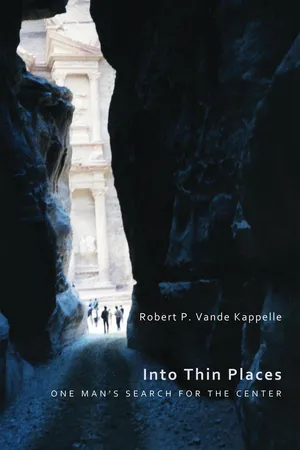
In this third volume of his "Adventures in Spirituality" trilogy, Dr. Robert Vande Kappelle travels from Amsterdam to Cairo in search of his cultural and spiritual roots, inviting readers to join him in exploring fabled places across the Mediterranean World. Despite the grave problems centered in this region, it is the birthplace of Western civilization and the source of the world's three guiding religions. Readers unfamiliar with the emergence and development of Western civilization will find Into Thin Places a compelling introduction; others will discover here a new perspective.
Affirming the human quest for adventure, meaning, and wholeness, Professor Vande Kappelle beckons adventurers to enjoy the wonderful experiences described in the book's "travel entries." Those seeking historical and cultural perspective will want to examine the numerous "explanatory entries" scattered throughout the narrative. These vignettes expand and deepen the storyline, piquing curiosity about seminal events, persons, and places that helped shape Western sensibility.
As Dr. Vande Kappelle points out in his closing chapter, our world is in a state of crisis, precipitated by numerous factors but primarily by the loss of the sacred. "Whether the current crisis is curable is debatable, but it will clearly require massive cultural reorientation. More importantly, it will require a transformation of the human spirit and a commitment of will." Into Thin Places encourages readers to find "thin places"--places transparent to the divine--in their own transformative journeys of discovery.
Information
Topic
Theology & ReligionSubtopic
Christian Church1
The Sacred Journey
Mythology is the penultimate truth—penultimate because the ultimate cannot be put into words.
—Joseph Campbell
Humans search for adventure, meaning, and wholeness. And the greatest and most meaningful adventures are those that bring spiritual satisfaction, if it is true, as the biblical religions affirm, that we are made “in the image of God” and that our ultimate destination is a realm we call Heaven.
The Quest for Adventure
In The Hero with a Thousand Faces, Joseph Campbell dwells on a particular type of myth from all time periods and found across the globe: the myth of the human quest. This classical endeavor, titled “The Hero’s Adventure,” symbolically addresses the stages of human realization, the trials of the transition from childhood to maturity, and the meaning of maturity. The various mythologies, whether they depict the hero as going in quest of a boon or in quest of a vision, present the same essential undertaking: individuals leave their everyday lives and travel a distance, sometimes into a depth, and sometimes up to a height. The hero leaves the ordinary world, sometimes by choice and other times by force, and undertakes a journey to the center, into a region of supernatural wonder, where he encounters fabulous forces and wins a decisive victory. Then comes a greater challenge: should the protagonist remain in his enchanted setting, thereby forsaking his former world, or should he return with a boon to benefit others? The hero does come back from this mysterious adventure, returning with the power to bestow blessings on fellow humans.
The hero’s adventure, we are told, is about one’s character and its potential for transformation. The path of the mythological adventure, and of all successful quests, involves a twofold venture: an inward journey to a spiritual center—a place of healing, vision, and transformation—and an outward journey toward others.
The messages of the world’s great teachers—Moses, the Buddha, Christ, Muhammad—differ greatly. But their visionary journeys are much the same. All are heroes, for they leave the predictable in search of the unknown, resisting temptation to find a liberating truth. Moses is such a hero, for he ascends the mountain, meets with Yahweh on the summit of the mountain, and he comes back with Torah, a constitution for the formation of a new society. That’s a typical hero act—departure, illumination (fulfillment), and return.
One might also declare that the founding of a life—your life or mine, if we live our lives authentically, instead of imitating the lives of those around us—comes from a quest as well. At birth, a lifetime of adventure beckons. A hero lies dormant within each person, awaiting a spiritual awakening, a call to departure. In order to affirm something new, one must leave the old and go in quest of the germinal idea, a seed that contains the potentiality of bringing forth that new thing.
Opportunities for transformation are present all around us. When they arise at critical moments in our lives, they are called rites of passage, conversions, revivals, or moments of awakening. What we call them is not important, but how we envision them. Not all transformational opportunities arise dramatically. Some are manifested subtly, through solitary endeavors such as meditation, fasting, confession, prayer, and Bible reading; others emerge publicly and corporately, through disciplines like worship, receiving a sacrament, or through sacrificial service to the poor and needy. The deepest opportunities arise unexpectedly, however, through the twists and turns of everyday life, including suffering, loss, and events that we think of as accidents and tragedies. Such experiences can rob us of our vitality or they can fuel the growth of our spirit and provide a powerful transformative impetus for our character.
The Quest for Meaning
Humans quest for meaning. Meaning, understood as vitality of purpose, leads to fulfillment, and the prospect of fulfillment makes life worth living. When Abraham Maslow outlined his hierarchy of needs, represented as a pyramid consisting of five levels, he placed “self-actualization” (by which he meant working toward fulfilling one’s fullest potential) at the top. In Maslow’s scheme, the final stage of psychological development comes when the individual feels assured that lower levels of needs—both physiological and emotional—have been satisfied. Once these are met, self-actualization drives the personality.1
Mythology and ritual traditionally supplied the symbols that carry the human spirit forward, energizing individuals to navigate successfully the necessary passages of their adulthood. Think of the rites of passage, those rituals associated with the vital transitions of human life, especially birth, puberty, marriage, and death. Each of these passage points frames the individual within the context of the community, serving to transform the person into the new stage of life and to integrate her or him into the community at that new spiritual level. Because passages of life are liminal—that is, they involve crossing a threshold from one state of existence to another—they are critical to the full human development of the person and also to the welfare of the community.
In the past, people quested for meaning through rites of passage; their quest was intentional, predictable, and patterned. Society demanded it, clans promoted it, and families made it happen. Although similar rites are enacted today, particularly in traditional families, modern (and postmodern) people tend to quest spontaneously, often doing so unintentionally.
To find meaning, or to connect with something deeper, some people quest through adventure, visiting exotic locations or engaging in enterprising ventures. Others quest through careers of service and devotion to others. Some apply for the Peace Corps; others participate in humanitarian efforts or campaigns to eradicate poverty or disease. Some quest through lifestyle choices such as fasting, celibacy, or vegetarianism. Others quest hedonistically, seeking meaning through pleasure, drugs, power, wealth, and materialism. Some seek meaning through disciplined acts of devotion such as prayer, Bible study, and inspirational reading. All such quests reenact aspects of some ancient rite of passage. When human beings stop questing, they abdicate their identity.
The Quest for Wholeness
Humans—indeed most living creatures—desire good health, safety, and security; taken together, these vital qualities contribute to the wholeness and wellbeing that make life supremely special. In traditional societies, the ability to apprehend the sacred was regarded as of crucial importance to health, wholeness, and wellbeing. Indeed, without this sense of the divine, people often felt that life was not worth living. Like other aesthetic experiences, the sense of the sacred needs to be cultivated. In our modern secular society, the sacred has diminished in value and in priority; left unused, it has tended to wither away.
In the past, when people tried to speak about the sacred or about their inner life, they did not express their experience in logical, discursive terms. Rather they had recourse to symbols and myths. Freud and Jung, who were the first to chart the so-called scientific quest for the soul, turned to the myths of the classical world or of religion when they tried to describe interior events. Mythology, they realized, was never designed to describe historically verifiable events. Mythology was an attempt to express inner significance or to draw attention to realities that were too elusive to be discussed in logically coherent ways. Mythology, religion scholar Karen Armstrong indicates, was an ancient form of psychology; the myths of sacred geography express truths about the interior life.2
One of the earliest and most ubiquitous symbols of the divine has been the concept of place. Since prehistoric times, certain places have exerted a mysterious attraction to billions of people around the world. Many cultures of antiquity recognized the existence of these sites, called “sacred,” and marked their geographic locations in a variety of ways. The names of such places—Stonehenge, Machu Picchu, the Pyramids of Giza, Rome, Delphi, Mecca, Benares, Mount Sinai, Jerusalem—are familiar to us all. Such places are found across the planet in the form of sacred mountains, healing springs, oracular caverns, enchanted forest glens, ceremonial sites, monasteries, places of divine revelation, places where sages attained enlightenment, and certain cities.
Over time, through countless cultural expressions, people have made pilgrimages to particular sites, drawn by the magnetism of such places and by their reputation for healing and wholeness. Ancient legends, the scriptures of the world’s religions, and modern-day reports tell of extraordinary experiences by people while visiting sacred sites. While contemporary science cannot explain, and therefore tends to disregard, the unusual insight and the seemingly miraculous phenomena that occur at such sites, they continue to be the most venerated and visited locations on the planet. Let’s briefly examine one such site, the ancient Mayan ceremonial center at Chichén Itzá.
Kukulkan’s Pyramid at Chichén Itzá
Every year, on the first day of spring and fall, hundreds of people from all over the globe gather at Chichén Itzá to witness a mysterious ritual. On the late afternoon of the vernal and the autumnal equinoxes (March 20 and September 21), sunlight bathes the western staircase of El Castillo (known as Kukulkan’s Pyramid). This causes seven isosceles triangles to form the image of a serpent’s body that creeps in a combination of shadow and light down the great pyramid’s ninety-one steps until it joins the huge serpent’s head carved in stone at the bottom of the stairway. The symbolic descent of Kukulkan, the feathered serpent god known as Quetzalcoatl by the Aztecs and Viracocha by the Incas, signaled the most auspicious time to plant corn, the revered food staple of the Maya.
Chichén Itzá, in the Peninsula of Yucatan in Mexico, is considered one of the most magnificent archeological sites in the world, giving us a glimpse of the splendor and sophistication of an ancient Mayan metropolis ruled by the heavens. The Maya were extraordinarily good astronomers, making observations and recording the motion of the sun, the moon, and the stars. They related astronomy to many areas of everyday life. For the Maya, like most primal peoples, common chores and daily concerns, including agricultural decisions, had a religious association.
El Castillo was constructed by the Mayans around 1000 to 1200 CE, directly upon the foundations of previous temples. Built for religious and astronomical purposes, the impressive stepped pyramid has 91 steps on each side (totaling 364 steps) plus one for the platform at the top, making 365 steps, one for each day of the year. The stone edifice, which combines earthly and heavenly symbolism, was built in homage to King Kukulkan, a real person but also a mythological figure. Half god and half man, he is considered the founder of all empires in ancient America. He came from heaven to earth, and therefore is represented as a feathered serpent in all of Mexico’s archaeological sites. The feathers (a symbol of the quetzal bird) represent heaven; the serpent represents earth. Kukulkan was endowed with mystical qualities: he received visitors from distant places and possessed the power to heal and to bring the dead back to life. Surprisingly, he was described by the natives as being Caucasian, with white skin, a beard, and beautiful emerald eyes. When he departed for the east, traveling the ocean on a raft of serpents, he promised his followers to return in the year that Hernán Cortés and his expedition disembar...
Table of contents
- Title Page
- Preface
- Acknowledgments
- Introduction: Searching for the Center
- Chapter 1: The Sacred Journey
- Part One: Departure
- Part Two: Illumination
- Part Three: Return
- Selected Readings
Trusted by 375,005 students
Access to over 1.5 million titles for a fair monthly price.
Study more efficiently using our study tools.
Frequently asked questions
Yes, you can cancel anytime from the Subscription tab in your account settings on the Perlego website. Your subscription will stay active until the end of your current billing period. Learn how to cancel your subscription
No, books cannot be downloaded as external files, such as PDFs, for use outside of Perlego. However, you can download books within the Perlego app for offline reading on mobile or tablet. Learn how to download books offline
Perlego offers two plans: Essential and Complete
- Essential is ideal for learners and professionals who enjoy exploring a wide range of subjects. Access the Essential Library with 800,000+ trusted titles and best-sellers across business, personal growth, and the humanities. Includes unlimited reading time and Standard Read Aloud voice.
- Complete: Perfect for advanced learners and researchers needing full, unrestricted access. Unlock 1.5M+ books across hundreds of subjects, including academic and specialized titles. The Complete Plan also includes advanced features like Premium Read Aloud and Research Assistant.
We are an online textbook subscription service, where you can get access to an entire online library for less than the price of a single book per month. With over 1.5 million books across 990+ topics, we’ve got you covered! Learn about our mission
Look out for the read-aloud symbol on your next book to see if you can listen to it. The read-aloud tool reads text aloud for you, highlighting the text as it is being read. You can pause it, speed it up and slow it down. Learn more about Read Aloud
Yes! You can use the Perlego app on both iOS and Android devices to read anytime, anywhere — even offline. Perfect for commutes or when you’re on the go.
Please note we cannot support devices running on iOS 13 and Android 7 or earlier. Learn more about using the app
Please note we cannot support devices running on iOS 13 and Android 7 or earlier. Learn more about using the app
Yes, you can access Into Thin Places by Robert P. Vande Kappelle in PDF and/or ePUB format, as well as other popular books in Theology & Religion & Christian Church. We have over 1.5 million books available in our catalogue for you to explore.