- 220 pages
- English
- ePUB (mobile friendly)
- Available on iOS & Android
eBook - ePub
About this book
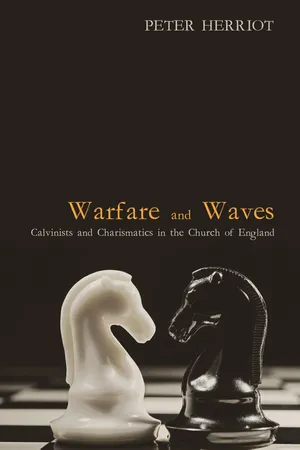
Why is the Church of England perceived by many as homophobic, misogynist, or just plain weird? Because two movements within it, the Calvinists and the Charismatics, have recently achieved a degree of influence disproportionate to their numerical strength. And how has this come about? Both movements are well organized and wealthy. The Calvinists have played the media and ecclesiastical politics games with skill and determination, while sternly identifying themselves as guardians of the one true Reformed doctrine, having no truck with "the world." The Charismatics, on the other hand, have embraced many elements of late-modern culture but retain a premodern worldview.
Peter Herriot argues that to recover from the opportunity costs and reputational damage that it has suffered at their hands, the Church of England must seize back the agenda from the Calvinists and face outwards rather than inwards. In its efforts to come to terms with globalization, the elephant in the Anglican crypt, the church's leadership will need to sideline the Calvinists and encourage the Charismatics with their recent increased social involvement.
Written by a social psychologist, this book is full of detailed case studies that give a vivid insight into the organizational structures and subcultures of these two very different evangelical movements.
Information
Topic
Theology & ReligionSubtopic
Christian TheologyChapter 1
Institutions and Movements
A national institution
The Church of England is a national institution. It is an institution in the everyday sense that it is a part of our national cultural furniture with which most of us are familiar. We may refer to it, with a mixture of affection and exasperation, as the dear old C of E,1 or we may merely make use of it as a convenience when asked to state our religion for bureaucratic purposes. But it is also an institution in a more formal sense, since institutions can be understood from a social scientific perspective as a category of social system with some unmistakable differentiating features.
Institutions tend to have bureaucratic structures and a long history, but to have survived through many vicissitudes because they have managed to adapt themselves to changing times. The C of E has, over the last half-millennium, survived murderous internal feuds and looming external threats. It has, albeit slowly, adapted to industrialization and post-industrialization, modernity and late-modernity.
Its culture—its beliefs, values, norms, and artefacts—has generally remained sufficiently aligned to the national culture to constitute part of it, but sufficiently distinctive to be able to offer a critique. Consider, for example, the plight of the poor during the Industrial Revolution. Associated with the hierarchical society of traditional rural England to the extent that it was almost synonymous with the Tory party at prayer, the C of E was left standing in the blocks by the urgent response to the new industrial society by the Methodists and elements of its own Evangelical wing. However, new parishes were soon set up in the urban slums, the Christian Socialist movement was born, and both the High Church Oxford Movement and the Evangelicals established missions in the cities.
A century and a half later, the Church’s same concern for social justice bucked the liberal free market political orthodoxy by producing the powerful report “Faith in the City.” Or consider the action of Archbishop Runcie, himself a war veteran, who, in the service at St. Paul’s Cathedral in commemoration of the Falklands War, prayed for the Argentinian as well as the British dead. This prayer directly critiqued the dominant nationalistic triumphalism led by Prime Minister Thatcher. In both these cases, the C of E was sufficiently in tune with contemporary English society to be able to give powerful expression to its own values without alienating the majority.
Institutions also have relations with other institutions, acquiring thereby precious social capital in terms of legitimacy and authority. As the established church, the C of E has ties with other established national institutions: the monarchy, parliament, and the legal system, for example. It also derives indirect status from these ties. It is worth emphasizing the continuing extent of the legal involvement of the C of E with the state. For example, the monarch has to be in communion with the Church of England. He or she appoints all of the bishops, and the government appoints the vicars of almost 700 parishes. Prisons and the Armed Services have to have C of E chaplains. And, for the nostalgic, there are still twenty-six bishops in the House of Lords, just as there is honey still for tea at Grantchester. Moreover, while the majority of the English population do not now get christened, married, or buried in their national church, let alone attend it regularly, there is little doubt that it will continue to officiate with great sense of occasion and dignity when, for example, the royal family experiences these life events.
Institutions are supported by their own hierarchical structures of authority and systems of control: rules and regulations, disciplinary procedures, policy-making processes, and so on. These enable them to plan, organize, and coordinate actions across the institution and use human and financial resources effectively. The C of E is no exception. Its hierarchy is based on the episcopal system, with archbishops overseeing the provinces of Canterbury and York, bishops overseeing dioceses such as Chelmsford or Southwark, clergy overseeing parishes, and uniform governance structures down to and including the level of individual congregations.2
Historically it would be true to say that the bishops have exercised a great deal of power both individually and in concert, although the advent of Synod in 1970 curtailed their influence.3 Synod is, in effect, the C of E’s parliament, and consists of bishops, clergy, and laity. Recent reorganization has seen the introduction of the Archbishop’s Council in an attempt to centralize decision-making processes and improve the effectiveness of Synod.
So the C of E has all the advantages of being an institution: history, legitimacy, authority, culture, structure, and resources. It also has some of the disadvantages. It can be very slow to change. It has frequently adopted the traditional method of kicking difficult issues into touch by establishing a commission to investigate them. One historic case was the Commission on Doctrine. This was designed to address contentious theological issues between the Catholic and Reformed wings of the Church, which were particularly evident after the First World War. It was established in 1922 and reported in its own good time in 1938. At this point the nation and the Church had certain more urgent concerns.
The C of E, like other institutions, also finds it difficult to innovate, partly because its structure and processes are hierarchical, formal, and established, and discourage radical thought. In the 1960s, for example, when radical social and cultural change was abroad, the Church as a whole discouraged such innovators as Bishops Mervyn Stockwood and John A. T. Robinson (of Honest to God fame) and the Reverend Nick Stacey. The very idea that the Church should train its priests, conduct its liturgies, and formulate its stances on ethical issues with a view to engaging with a modern urban post-industrial workforce was at that point a bridge too far for both the Church hierarchy and the laity in general.
And finally, the Church has difficulty in securing a high level of commitment from many of its adherents in terms of time, effort, and money. For, as part of everyone’s cultural furniture, it tends to get taken for granted. It has recently, for example, put additional financial responsibility onto individual congregations, instead of relying so much on its income from its investments, but the response has been decidedly mixed. Congregations that are both committed and wealthy support both themselves and the institution generously (although some have used their financial power as a political lever to influence diocesan policy). The poorer parishes, and also those individual adherents who perceive the Church as a public institution that provides various services that they need at different points in their lives, are less able, or less inclined, to demonstrate their commitment in financial terms.
So given these pros and cons of its status as an institution, how does the C of E measure up at present? A general conclusion based on two excellent recent reviews of the evidence4 might run as follows: like most other contemporary institutions, its number of committed adherents is in decline; but it is currently achieving greater public prominence. If we consider membership and regular attendance figures as criteria, then the picture is indeed a grim one.5 Numbers have been declining over a long period, but especially since the 1960s, with an apparent acceleration of decline in the 1980s and 1990s. Some, however, have detected a recent slowing in the rate of decline, particularly within the theologically Evangelical wing of the church. According to the English Church Census of 2005, in 1998 980,000 Anglicans worshipped regularly, whereas in 2005 the figure had decreased to 871,000. During this same period, mainstream or orthodox Evangelical Anglicans increased from 73,000 to 77,000; Charismatic Evangelicals remained constant at 115,000; and broad church Evangelicals decreased from 121,000 to 105,000. Of the 160 largest churches in the C of E with a membership of over 350, 83 percent are Evangelical. Also, attendance at cathedral services has increased markedly.
On the other hand, at least half of English people still say that they believe in God.6 This has led Grace Davie7to describe the nation as “believing but not belonging.” Perhaps, she speculates, English believers (but not belongers) want the minority belongers to act vicariously on their behalf and maintain the institution, to which they are emotionally attached, and upon which they depend in time of personal or national need.8
However, the more fundamental question is: by what criteria should a national institution be evaluated? Clearly, at the congregational level of analysis, membership and attendance figures are part, but part only, of an appropriate set of criteria. But at the institutional level, success criteria should surely relate to the effectiveness of the C of E within national, and, I will argue, global society.
This response begs some questions, of course: for example, what is it that the C of E has to contribute that is distinctive, and how does it need to relate to other societal institutions? A response to the first question might be that it directs the nation towards a transcendent perspective and its implied ethical imperatives, or, in theological terms, that it presents and represents God within society. In particular, it has consistently spoken for those without a voice, the poor and marginalized. Such a function clearly reflects the differentiation of religion from other social systems and its unique purpose and role. Differentiation of this nature is a central feature of modernity and secularization.9
However, the attribution of these functions specifically to religion also implies, as Durkheim and others have argued,10 that it can be seen as an element of civil society, integrated within it to a degree. Hence the C of E is likely to engage in relationships with a far wider range of social institutions than just the monarchy and parliament, cited above. For example, it is closely concerned with the institution of marriage and the family; the economic system and the distribution of wealth and resources; the provision of medical and social services; the education system; other Christian denominations and other religions and faith groups; and with music and the visual and performing arts.
The fundamental feature of all social systems is that they position themselves somewhere on a continuum between, at the one unsustainable extreme, total differentiation from other systems, and at the other, total integration with them (and therefore non-existence as a separate entity). By their very nature, institutions are normally likely to be located towards the integration end of the continuum. However, if they are to fulfill a unique role, they will also have to maintain a considerable degree of differentiation. For example, to contribute a prophetic element to the promotion of distributive and procedural justice, the C of E needs to different...
Table of contents
- Title Page
- Preface
- Chapter 1: Institutions and Movements
- Chapter 2: Geneva, Lambeth, Los Angeles, and Toronto
- Chapter 3: The Production Line
- Chapter 4: Trouble and Strife
- Chapter 5: The Power House
- Chapter 6: Big and Bigger
- Chapter 7: The Charismatic Self
- Chapter 8: Change
- Chapter 9: The Days of Miracles and Wonders
- Chapter 10: A Global Institution
- Bibliography
Trusted by 375,005 students
Access to over 1.5 million titles for a fair monthly price.
Study more efficiently using our study tools.
Frequently asked questions
Yes, you can cancel anytime from the Subscription tab in your account settings on the Perlego website. Your subscription will stay active until the end of your current billing period. Learn how to cancel your subscription
No, books cannot be downloaded as external files, such as PDFs, for use outside of Perlego. However, you can download books within the Perlego app for offline reading on mobile or tablet. Learn how to download books offline
We are an online textbook subscription service, where you can get access to an entire online library for less than the price of a single book per month. With over 1.5 million books across 990+ topics, we’ve got you covered! Learn about our mission
Look out for the read-aloud symbol on your next book to see if you can listen to it. The read-aloud tool reads text aloud for you, highlighting the text as it is being read. You can pause it, speed it up and slow it down. Learn more about Read Aloud
Yes! You can use the Perlego app on both iOS and Android devices to read anytime, anywhere — even offline. Perfect for commutes or when you’re on the go.
Please note we cannot support devices running on iOS 13 and Android 7 or earlier. Learn more about using the app
Please note we cannot support devices running on iOS 13 and Android 7 or earlier. Learn more about using the app
Yes, you can access Warfare and Waves by Peter Herriot in PDF and/or ePUB format, as well as other popular books in Theology & Religion & Christian Theology. We have over 1.5 million books available in our catalogue for you to explore.