- 180 pages
- English
- ePUB (mobile friendly)
- Available on iOS & Android
eBook - ePub
About this book
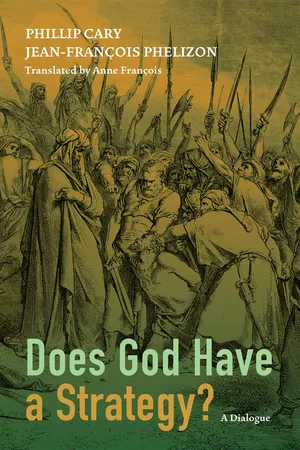
A philosopher and a business leader have a friendly debate about whether it makes sense to speak of God having a strategy for the human race. What might a divine strategy look like, in light of the biblical portrait of God and the historical record of religions that claim to carry out God's strategy? With so much violence in our religious history, can there be a divine strategy of peace rather than war--where our religions do not strategize to defeat their enemies but to bless them? In other words, could God have a strategy that overcomes rather than continues the legacy of Cain and Abel? If so, to what future might it point us?
Information
Topic
Theology & ReligionSubtopic
Christianity1
A Strategy of Blessing?
Phillip Cary—Does God have a strategy? That is an interesting question, for a number of reasons. To begin with, the very idea that God could have a strategy might seem odd. In the monotheist conception, God is omnipotent, the creator of all things. Shouldn’t God simply be in control of everything, always getting his way? “For who can resist his will?” as the apostle says (Rom 9:19). Who can say no to God?
And yet it is evident—also from a monotheist conception—that we do say no to God all the time. What God creates can talk back to him, resist him, flee him, disbelieve in him, even curse him. The possibility of this “no” opens up the possibility of divine strategy. We can say no to God, and he has to deal with that. Or I should say, he chooses to deal with that. He chooses to be the kind of creator whose creatures can say no to him, and therefore one who has to adopt a strategy for dealing with beings who resist him, with recalcitrant wills that oppose his purposes in the world. You might say, he chooses to create an interesting world—one that would be interesting also to him.
At least so it is in the narrative of the Bible, from which I propose to derive my thoughts about divine strategy. The later theological traditions of Judaism and Christianity have a great deal to add to this, of course, and at a further remove so also does the theological tradition of Islam. Nearly all of us in Europe and America stand, as it were, downstream from the Bible, within the influence of its derivative religious traditions—even the many of us who are no longer believers in them. Whenever we think about God we drink, as it were, from what these traditions carry to us, across the centuries, from this primal source. But by the same token, it is always possible to go back to the source—the religious traditions themselves frequently urge us to do so. When we do that, we bring our traditions with us—we should not be naïve and unaware of this. Even ex-Christians still read the Bible like Christians, and ex-Jews like Jews. But we inevitably do read, fascinated by this source which is the beginning of so much of our thinking down to this day. So I am a Christian reading like a Christian, but trying to go back to this source which pre-dates Christianity—which is a very Christian thing to do.
The source is a story about God and these human creatures of his who keep saying no to him in various ways. And yes, he has to develop a strategy to deal with this.
Jean-François Phelizon—It seems to me we should begin by defining what strategy is.
1. In the broadest sense, strategy (or rather, conceptual strategy, which I will contrast in a moment with operational strategy) is the art of moving a social group: a nation, an army, a business, for example. Its aim is to obtain real or supposed advantages that the group could not obtain otherwise, except by chance. It implies a direction, from which there necessarily follows a common rule of action. Why a direction? There is in Chinese an interesting character, dào (sometimes transliterated tao), which means road, way, teaching, and by extension, to lead, to educate. It is composed of two radicals, one meaning to go and the other forward. I think dào is close to the concept of strategy, precisely because the strategy of a group is nothing other than a road traveled in common, which presupposes a common direction and a common rule. Hence, a strategy is a guideline. It is a guideline to which everyone is held—and to which everyone is expected to hold themselves.
When different social groups, in the name of what they call their interests, lay claim to the same resources, they come into conflict and their strategies are usually in competition with one another. Sports teams, businesses, armies, and to a certain extent religious institutions constitute communities that I describe as agonistic, and their conceptual strategy is thus the rule of action for an agonistic group.
For entities that are agonistic and competing with each other (that is to say, antagonistic), conflict is at once legitimate, inevitable, and sustained. It is legitimate, because each entity is certain that it is in the right and that the behavior and claims of the other are utterly unacceptable. It is inevitable, because the opponent does not want to “listen to reason” and one can’t back down without losing something essential: interests, identity, honor. And it is sustained, because while one ascribes to the other the responsibility of surrendering when beaten, one anticipates that hostilities will arise whenever one shows weakness.
As a rule of action, conceptual strategy is related to constraint, an obligation to behave in a certain way. It is inspired by what is relevant, and is connected to politics. It is contrasted with operational strategy, which certainly pursues objectives compatible with the rule of action but takes more account of risks and opportunities. Operational strategy then opens out onto tactics, whose degree of freedom and choice of means stem entirely from contingent circumstances.
In fact, although every strategic concept imposes a direction on a social group as well as on the strategist who leads it, the conduct of the strategy should be constrained as little as possible. The Chinese author Sun Tzu is right in saying that the conduct of military operations is like the flow of water. Water is by nature shapeless; it always flows around the heights in order to pour into the depths. Likewise in battle, the thing to do is to avoid the enemy’s strong points and attack his weak spots instead. More broadly, it is a matter of making tactics depend on how the situation develops, adapting to what could be called the infinite variety of circumstances.
2. Conceptual strategy is analyzed in terms of necessities, operational strategy in terms of objectives, and tactics in terms of opportunities.
At the operational level, the strategist establishes objectives. He must find a solution to the problem that he sets for himself or that has been set for him, which means he must work out a combination of basic effects—offensive or defensive—corresponding to the maneuver he envisions to arrive at the desired result. He must put in place means that, once activated, become forces that can be opposed to those of his adversary. But it is not enough to dispose of means. The good strategist is the one who manages to find the time and space he needs. He is thus the one who, to varying degrees, knows how to make time and terrain his allies.
For the tactician, by contrast, nothing is ever set. It is only by accepting situations as they are—and through them the principle of reality—that he can triumph over them. To humble oneself before experience remains the first and supreme commandment of the mind. So when it’s time to act, the first task of the strategist is to determine his degrees of freedom. If he’s lacking in that area, then it’s absolutely imperative for him to “break the game wide open.” In this way conceptual vision is relentlessly refined by the facts. In other words, the dogmatism of the strategic concept must be answered by the pragmatism with which it is put into effect.
Strategy may be reducible to a simple idea, but because in the end it comes down to contingent circumstances the conduct of strategy turns out to be infinitely complex. As Napoleon famously said, the art of war is simple but it’s all in the execution. Which means, in the view of Marshall Foch, that facts must take precedence over ideas, deeds over words, and execution over theory. Also, that means the strategist’s responsibility to be vigilant extends beyond refining his vision. It also includes seizing opportunities within the framework of a “necessity”: conducting the strategy of the group over which he has assumed leadership.
3. Rereading the Bible now, it is easy to find lots of references to objectives that are to be achieved, but harder to spot traces of a conceptual strategy. Is there an overall direction to the history of the people of Israel or to the early history of Christianity? Do these histories have a meaning? Do they follow a guideline? Do they give expression to a dynamic leading to a definite result in a given direction? This deserves analysis and discussion.
It really is necessary to make a distinction between what Christians call the Old and New Testaments. The Old Testament tells the story of the Jewish people by way of various remarkable episodes. Especially in the Torah, the divine teaching that according to tradition was handed down by Moses in the Pentateuch, and at each stage of their existence, one has the impression of the Jewish people being “led” by God; whereas the New Testament looks more like a message of justice and peace addressed by Christ to all human beings. Perhaps one must conclude that the Old Testament is subordinated to a strategy (more operational than conceptual) and that the New Testament is situated at an entirely conceptual level.
Phillip Cary—Using your definition and terminology, and combining it with the way Christian theology reads the Bible, I would describe divine strategy as follows. At the highest level, God’s conceptual strategy is to bless the human race with life, despite our opposition. We human creatures are all antagonists of God’s strategy insofar as we are heirs of Cain and Abel (Gen 4:1–16), for we have become antagonists of one another, preferring that other humans die so that we might live. Like Cain, we want God’s favor and blessing for ourselves, not for others, and so we kill them. Our antagonism to God’s strategy is our murderousness. The direction of God’s strategy, his way or dào, is opposite to our direction toward death for others. It is blessing and life for others, even at great cost to oneself. This strategy is carried out most fully on the cross of Christ. The rule of action of divine strategy is, in a word, love. By this I mean the kind of work that grows from the desire that others might live and be blessed rather than die and get out of our way. Or one could say: love is the enacted hope that I might find in the other a friend rather than an enemy or a slave.
At the next level, in God’s operational strategy, his primary objective is to reverse the kind of relationship we see between Cain and Abel by using one part of the human race to bring life and blessing to others. This strategy is founded on what theology calls “the doctrine of election,” which is to say, the doctrine of what God chooses or elects. In the biblical doctrine of election, God chooses some to bless others, as for example Abraham is chosen to be a blessing for “all the families of the earth” (Gen 12:3). In the Old Testament this means that Israel in particular, the chosen people descended from Abraham, Isaac and Jacob, is to be a blessing for the Gentiles. To each of these three ancestors God makes a version of the same promise: “in your offspring shall all the nations of the earth be blessed” (Gen 22:18, 26:4, and 28:14). The word for “nations” here is goyim, often translated “Gentiles”—a word that covers all non-Jews. The idea is that it is a good thing for the Gentiles that the Jews are the chosen people.
Of course the Gentiles often do not see it that way, so in this respect also God’s strategy encounters antagonists. The opposition can be quite literal, as the nations often aim to destroy Israel. Then it becomes an objective of God’s strategy to defend his people against their enemies. We see much of this in the Old Testament. It needs to be emphasized that this is not the primary objective of divine strategy, but a secondary objective that serves the primary objective: God cannot bless all nations through Israel if Israel does not exist, so God defends Israel from the murderousness of her neighbors. The Bible connects these two objectives by joining curse to blessing in God’s words to Abraham, which I take to define God’s operational strategy: “I will bless those who bless you, and him who dishonors you I will curse, and in you all the families of the earth shall be blessed” (Gen 12:3). There is both curse and blessing, but the curse is for the sake of the blessing, as God defends his people in order to bless others.
And the biblical story gets yet more complicated than that. For there are many episodes in the Old Testament in which God takes sides against the people of Israel when they rebel against him. He brings armies against them, hands them over to their enemies, and sends them into exile. Here we see a third objective of divine strategy: God disciplines his people s...
Table of contents
- Title Page
- Preface
- Chapter 1: A Strategy of Blessing?
- Chapter 2: Three Jealous Brothers
- Chapter 3: Religions and Revolutions
- Chapter 4: Truth, Tolerance, and Utopia
- Chapter 5: Paradigms of God
- Chapter 6: The God of Redemption
- Chapter 7: Jesus and the Church in History
- Bibliography
Trusted by 375,005 students
Access to over 1.5 million titles for a fair monthly price.
Study more efficiently using our study tools.
Frequently asked questions
Yes, you can cancel anytime from the Subscription tab in your account settings on the Perlego website. Your subscription will stay active until the end of your current billing period. Learn how to cancel your subscription
No, books cannot be downloaded as external files, such as PDFs, for use outside of Perlego. However, you can download books within the Perlego app for offline reading on mobile or tablet. Learn how to download books offline
Perlego offers two plans: Essential and Complete
- Essential is ideal for learners and professionals who enjoy exploring a wide range of subjects. Access the Essential Library with 800,000+ trusted titles and best-sellers across business, personal growth, and the humanities. Includes unlimited reading time and Standard Read Aloud voice.
- Complete: Perfect for advanced learners and researchers needing full, unrestricted access. Unlock 1.5M+ books across hundreds of subjects, including academic and specialized titles. The Complete Plan also includes advanced features like Premium Read Aloud and Research Assistant.
We are an online textbook subscription service, where you can get access to an entire online library for less than the price of a single book per month. With over 1.5 million books across 990+ topics, we’ve got you covered! Learn about our mission
Look out for the read-aloud symbol on your next book to see if you can listen to it. The read-aloud tool reads text aloud for you, highlighting the text as it is being read. You can pause it, speed it up and slow it down. Learn more about Read Aloud
Yes! You can use the Perlego app on both iOS and Android devices to read anytime, anywhere — even offline. Perfect for commutes or when you’re on the go.
Please note we cannot support devices running on iOS 13 and Android 7 or earlier. Learn more about using the app
Please note we cannot support devices running on iOS 13 and Android 7 or earlier. Learn more about using the app
Yes, you can access Does God Have a Strategy? by Phillip Cary,Jean-Francois Phelizon, Anne Francois in PDF and/or ePUB format, as well as other popular books in Theology & Religion & Christianity. We have over 1.5 million books available in our catalogue for you to explore.