- 426 pages
- English
- ePUB (mobile friendly)
- Available on iOS & Android
eBook - ePub
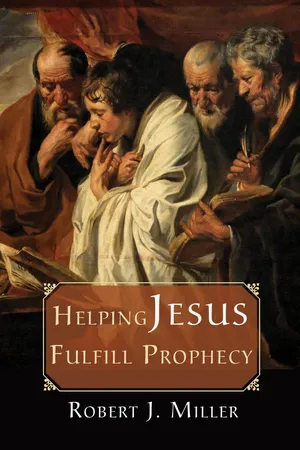
Helping Jesus Fulfill Prophecy
About this book
It's obvious that Jesus fulfilled prophecies about the promised Messiah--or so the gospels make it seem. But the real story is more complex, and more compelling. In hindsight we can see that Jesus had help fulfilling prophecy. The gospel writers skillfully manipulated prophecies--carefully lifting them out of context, creatively reinterpreting them, even rewriting them--to match what Jesus would do in fulfilling them. The evangelists also used the prophecies themselves to shape the very stories that show their fulfillment.
This book describes in detail how Christian authors "helped" Jesus fulfill prophecy. Studies of Greek oracles, the Dead Sea Scrolls, translations of the Hebrew Scriptures into Greek and Aramaic, and the writings of Josephus explore the interpretive techniques that paved the way for the New Testament's manipulation of prophecy.
This book analyzes how the belief that Jesus fulfilled prophecy became an argument to justify a new notion: the view that Christians had replaced Jews as God's chosen people. An aggressive anti-Judaism is analyzed in chapters on patristic theologians such as Justin Martyr and Augustine, who embedded it into the argument from prophecy.
The book concludes with an ethical argument for why Christians should retire the argument from prophecy.
Information
Topic
Theology & ReligionSubtopic
Biblical Studiespart 1
Prophecy, Prediction, and Fulfillment in Israel
1
Prophecy and Prediction in Ancient Israel
In the modern world a prophet is a future teller, someone with supernatural knowledge of future events. But in ancient Israel that was not the essence of prophecy. The most basic description of a prophet in Israel was as an intermediary between God and the people. A prophet therefore had two roles: delivering God’s words to the people and interceding with God on the people’s behalf. The second role is less emphasized in the Bible, and so I will discuss it only briefly by citing a few examples. Moses, the prophet par excellence, several times pleads with God on behalf of the Israelites, most famously after the incident of the golden calf, when Moses dissuades Yahweh from obliterating his people (Exod 32:1–14). Similarly, the prophet Amos twice intercedes with Yahweh to call off devastating punishments (Amos 7:1–6). The clearest example of this prophetic role has to do with Abraham, who is not usually thought of as a prophet. In Genesis 20, Abraham’s wife Sarah, whom he represents as his sister, is taken by a Canaanite king. God appears in a dream to the king and threatens him with death because he has taken a married woman. When the king rightly pleads his innocence, God tells him, “Send back the man’s wife now; he is a prophet and he will intercede on your behalf, and you shall live” (Gen 20:7). Notice that Abraham’s status as a prophet has nothing whatsoever to do with predicting the future.
Spokesmen for God
The central role of biblical prophets was to be spokesmen for God by delivering his words. That understanding of the prophet’s role can perhaps best be seen in two short scenes from the Book of Exodus. In the first scene, God commands Moses to carry his words to Pharaoh. Moses complains that he is unfit for the task because he is a poor speaker (Exod 4:10). God tells Moses that he will empower Aaron, his brother, to speak on his behalf. Note how concretely this is put:
You [Moses] shall speak to him [Aaron] and put the words in his mouth . . . He indeed shall speak for you to the people; he shall serve as a mouth for you, and you shall serve as God for him. (Exod 4:15–16)
What Yahweh means by Moses serving “as God” to Aaron becomes clear in our second scene when Moses and Aaron are about to confront Pharaoh for the first time.
Yahweh said to Moses, “See, I have made you like God to Pharaoh, and your brother Aaron shall be your prophet. You shall speak all that I command you, and your brother Aaron shall tell Pharaoh to let the Israelites go out of his land.” (Exod 7:1–2)
Aaron’s being a prophet has nothing to do with his predicting the future. He is Moses’ prophet because he is Moses’ spokesman. Aaron will speak to the Pharaoh, but the words he speaks will be Moses’, not Aaron’s. That is the essence of biblical prophecy: to speak on God’s behalf.
This concept of prophecy is also evident in how the prophets delivered their divinely given messages. The prophets frequently preface their declarations with “Thus says Yahweh.”8 This “thus says X” was a common formatting device in the ancient world, which scholars call the messenger formula. It was used when a messenger needed to make it clear that the words he was about to speak were those of the one who had sent the message, not the personal words of the messenger himself. The messenger formula thus functioned as oral quotation marks. Here is an example, from a highly dramatic scene during the Assyrian invasion of Israel. The king of Assyria had sent a royal official to persuade the defenders of Jerusalem to surrender. As that official stood outside the city wall, he shouted up to the soldiers looking down from the walls:
Thus says the king of Assyria: “Make your peace with me and come out to me; then every one of you will eat from your own vine and your own fig tree and drink water from your own cistern, until I come and take you away to a land like your own, a land of grain and wine, a land of bread and vineyards, a land of olive oil and honey, that you may live and not die.” (2 Kgs 18:31–32)
Note that “me” and “I” refer to the king, not the official delivering the message. By opening his declaration with the messenger formula, the official signaled to the soldiers that the terms of surrender came straight from the king himself. The prophets’ constant use of “thus says Yahweh” underlines their sense of being his messengers.
The prophets were speakers, not writers. When Jeremiah dictated his words to his assistant Baruch to be written down on a scroll, it was an exception that proved the rule. Jeremiah could not enter the temple to deliver his divine message, so he had Baruch write it down, which enabled Baruch literally to carry Jeremiah’s words into the temple and read them to the people (Jer 36:5–8). Except in extraordinary situations like Jeremiah’s, the prophets’ words and speeches were written down later in order to preserve them. Even in written form, it is clear that their speeches were meant to be spoken and heard in public, not read in private. Scholars know that because the prophets’ speeches are full of the techniques of effective public speaking, techniques aimed at engaging and challenging listeners.9 This is important because it reinforces what common sense tells us: that the prophets wanted their words to have an impact on their audiences, to influence them to believe certain things, experience certain feelings, or act in certain ways.
The prophet’s mission was to tell listeners how their present situation fit or, more often, did not fit, into God’s plans, and to challenge the people to act according to God’s will, usually as expressed in the covenant. The characteristic task of the great prophets who preached before the Babylonian Exile was to indict the kings, the wealthy aristocrats, often the priests, and sometimes the entire nation for serious violations of the covenant. The prophets often pleaded with their audiences to repent, and threatened them with terrible consequences (usually invasion and exile) if they refused. Sometimes these prophets urged rulers to avoid alliances with other nations, and they backed up their messages with analyses of the diplomatic and military situation.10 Occasionally the prophets foretold the blessings that God would send if Israel would repent and live in faithfulness...
Table of contents
- Title Page
- Preface
- Acknowledgments
- Abbreviations and Short Titles
- Introduction
- Part One: Prophecy, Prediction, and Fulfillment in Israel
- Part Two: The Fulfillment of Prophecy in the New Testament
- Part Three: The Argument from Prophecy in Patristic Thought
- Part Four: Modern Reckoning with the Argument from Prophecy
- Appendix 1: Muhammad in the Bible?
- Appendix 2: Adam and Edom
- Translations of Ancient Sources
- Bibliography
Trusted by 375,005 students
Access to over 1.5 million titles for a fair monthly price.
Study more efficiently using our study tools.
Frequently asked questions
Yes, you can cancel anytime from the Subscription tab in your account settings on the Perlego website. Your subscription will stay active until the end of your current billing period. Learn how to cancel your subscription
No, books cannot be downloaded as external files, such as PDFs, for use outside of Perlego. However, you can download books within the Perlego app for offline reading on mobile or tablet. Learn how to download books offline
Perlego offers two plans: Essential and Complete
- Essential is ideal for learners and professionals who enjoy exploring a wide range of subjects. Access the Essential Library with 800,000+ trusted titles and best-sellers across business, personal growth, and the humanities. Includes unlimited reading time and Standard Read Aloud voice.
- Complete: Perfect for advanced learners and researchers needing full, unrestricted access. Unlock 1.5M+ books across hundreds of subjects, including academic and specialized titles. The Complete Plan also includes advanced features like Premium Read Aloud and Research Assistant.
We are an online textbook subscription service, where you can get access to an entire online library for less than the price of a single book per month. With over 1.5 million books across 990+ topics, we’ve got you covered! Learn about our mission
Look out for the read-aloud symbol on your next book to see if you can listen to it. The read-aloud tool reads text aloud for you, highlighting the text as it is being read. You can pause it, speed it up and slow it down. Learn more about Read Aloud
Yes! You can use the Perlego app on both iOS and Android devices to read anytime, anywhere — even offline. Perfect for commutes or when you’re on the go.
Please note we cannot support devices running on iOS 13 and Android 7 or earlier. Learn more about using the app
Please note we cannot support devices running on iOS 13 and Android 7 or earlier. Learn more about using the app
Yes, you can access Helping Jesus Fulfill Prophecy by Robert J. Miller in PDF and/or ePUB format, as well as other popular books in Theology & Religion & Biblical Studies. We have over 1.5 million books available in our catalogue for you to explore.