eBook - ePub
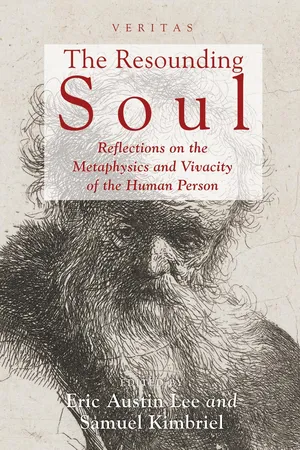
The Resounding Soul
Reflections on the Metaphysics and Vivacity of the Human Person
- 424 pages
- English
- ePUB (mobile friendly)
- Available on iOS & Android
eBook - ePub
The Resounding Soul
Reflections on the Metaphysics and Vivacity of the Human Person
About this book
It is surely not coincidental that the term "soul" should mean not only the center of a creature's life and consciousness, but also a thing or action characterized by intense vivacity ("that bike's got soul!"). It also seems far from coincidental that the same contemporary academic discussions that have largely cast aside the language of "soul" in their quest to define the character of human mental life should themselves be so--how to say it?--bloodless, so lacking in soul. This volume arises from the opposite premise, namely that the task of understanding human nature is bound up with and in important respects dependent upon the more critical task of learning to be fully human, of learning to have soul. The papers collected here are derived from a conference in Oxford sponsored by the Centre of Theology and Philosophy and together explore the often surprising landscape that emerges when human consciousness is approached from this angle. Drawing upon literary, philosophical, theological, historical, and musical modes of analysis, the essays of this volume vividly remind the reader of the power of the ancient language of soul over against contemporary impulses to reduce, fragment, and overly determine human selfhood.
Information
Topic
Teologia e religioneSubtopic
Storia e teoria della filosofiaSection V
Vivacity
16
The Soul and “All Things”
Contribution to a Postmodern Account of the Soul
Anima quodammodo omnia est.
To modern ears, “soul” sounds more poetic than scientific, or at least vaguely religious.839
Introduction: The Concept of the Soul and Its Three-fold Necessity
The soul is a necessary concept for Christian theology, for an account of Christian religious experience and for the philosophy that cannot help finding itself thinking from within this domain—and perhaps, further, for any thinking that wants to do full justice to our human experience of ourselves and others as bearing permanent identities and inestimable value. This necessity is doubled when we recognize that the soul, like its perennial corollary concepts God and the world, is a concept that bears within itself a critique of the fundamental mythos of conceptual rationality: it asserts the primacy of personality and freedom over abstraction in the metaphysical domain (i.e., the domain of basic intelligibility) and it therefore bears within itself an appropriate, permanent element of deconstruction for every systematization, every conceptualization, every account of reality that considers ultimate reality coincident with that which one can think, with instrumental reasoning.
In a fundamental and paradoxical way, the concept of the soul (again, like “God” and the “world”) conceptually exceeds its conceptuality, thereby performing the essential critical (we could even say, before and beyond Kant, “meta-critical”) function basic to religious rationality—i.e., a thinking that is more rational precisely because it is “religious,” because, that is, it senses that ultimate reality fundamentally exceeds its own grasp and it arrives to itself in its own activity as devoted to reality.
This fundamental and permanent critical value of the concept is furthermore (and here do we find its necessity tripled) tied to the fact that, like its corollary concepts that pertain to the ultimately and irreducibly real, the concept of the soul is unavoidably given to be thought (as its privileged place in the classic modern three-fold division of metaphysics, metaphysica specialis, surely indicated). For believers who reflect rationally, for meta-critical thinkers especially, the “immortality of the soul” attains to the level of “dogma”: unconditionally given to be thought.840 Dogma gives rise to thought, and furthermore, a specific kind of thought, thinking that thinks beyond the boundaries of its own conditions, since dogma fundamentally exceeds these conditions that reason would attempt to give itself. Dogma can therefore become, and in fact must become, the condition for the most properly “critical” approach of a thinking truly come of age.
The soul is therefore a permanent feature of religious or “theological” thinking.841 The validity of this thinking can be challenged, but the necessity of the concept for this thinking is not in doubt. This three-fold necessity, as I have sketched it above, is today only a promise, however, as if the necessity itself has become wholly un-compelling, and in fact wholly invisible to our thinking. How do we understand, and in fact revive this necessity today, after the era, if we can speak this way—and I am compelled to—of the death of the soul, strictly concomitant with the “death of God”?842 The following reflections attempt to gather together some crucial dimensions of the soul’s history in Christian thinking in order then to give the first indications of a proposal regarding the resurrection of the soul for contemporary thought, after its death in modernity. The remarkably wealthy and fruitful “background,” culminating in Thomas Aquinas’ conception of the “immortality of the soul” as necessary condition for the activity of theology itself, is not only a perennial source for the renewal of the concept, but would also serve as a sort of measure of richness by which any renewal of the concept must be ultimately judged.
I will first elucidate some critical dimensions of the concept of the soul (§§ 1–2) before “foregrounding” the most suggestive moments of its erasure in modernity (§ 3), in order, finally, to propose a first sketch for a renewal of the intelligibility of the concept by means of a synthesis of phenomenology and the spiritual senses (§ 4).
§ 1 Background: Some Aspects of the Soul in Scripture and Tradition
Not only is the immortality of the soul a dogma (with a relatively clear biblical proof text in the Wisdom of Solomon 3:1–4), but the term itself (psuchē) is used throughout the Old and New Testaments: for example, in the second creation account itself, where Adam receives the breath of life in his nostrils in order to become “a living soul” (Gen 2:7),843 and much later, in the reflections on the living beings of the “new creation,” the baptized and especially the martyred dead are considered essentially as “souls” (see Heb 6:19; 1 Pet 1–2; Rev 6:9, 20:4). The creation account reveals that to be human is to be alive and to be a living human is to be a “soul”: the essence of the humanity of man, its defining feature, is to be alive, which means, unique among the creatures of the earth, to be intrinsically and even a priori (the word is not misplaced here) open to the divine presence, to breathe with the breath of life, imparted by the creative spirit of God in a way unlike every other “living creature” (nefesh): the f...
Table of contents
- Title Page
- Preface
- Acknowledgments
- List of Contributors
- Introduction
- Section One: The Soul and the Saeculum
- Section Two: Fracture and Unity
- Section Three: Moving to Wholeness
- Section Four: The Soul’s Regard
- Section Five: Vivacity
Trusted by 375,005 students
Access to over 1.5 million titles for a fair monthly price.
Study more efficiently using our study tools.
Frequently asked questions
Yes, you can cancel anytime from the Subscription tab in your account settings on the Perlego website. Your subscription will stay active until the end of your current billing period. Learn how to cancel your subscription
No, books cannot be downloaded as external files, such as PDFs, for use outside of Perlego. However, you can download books within the Perlego app for offline reading on mobile or tablet. Learn how to download books offline
We are an online textbook subscription service, where you can get access to an entire online library for less than the price of a single book per month. With over 1.5 million books across 990+ topics, we’ve got you covered! Learn about our mission
Look out for the read-aloud symbol on your next book to see if you can listen to it. The read-aloud tool reads text aloud for you, highlighting the text as it is being read. You can pause it, speed it up and slow it down. Learn more about Read Aloud
Yes! You can use the Perlego app on both iOS and Android devices to read anytime, anywhere — even offline. Perfect for commutes or when you’re on the go.
Please note we cannot support devices running on iOS 13 and Android 7 or earlier. Learn more about using the app
Please note we cannot support devices running on iOS 13 and Android 7 or earlier. Learn more about using the app
Yes, you can access The Resounding Soul by Eric Austin Lee,Samuel Kimbriel, Lee, Kimbriel in PDF and/or ePUB format, as well as other popular books in Teologia e religione & Storia e teoria della filosofia. We have over 1.5 million books available in our catalogue for you to explore.