eBook - ePub
Making Good the Claim
Holiness and Visible Unity in the Church of God Reformation Movement
- 312 pages
- English
- ePUB (mobile friendly)
- Available on iOS & Android
eBook - ePub
Making Good the Claim
Holiness and Visible Unity in the Church of God Reformation Movement
About this book
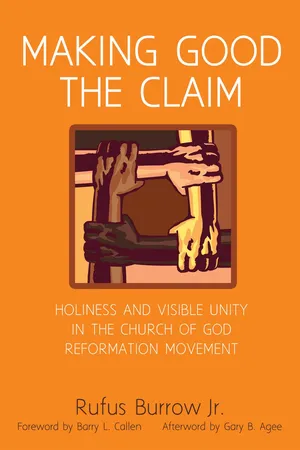
The Church of God Reformation Movement (founded in 1881) has the distinction of having been founded on the two core principles of holiness and visible unity. Standard histories of the group proudly argue that the founder and pioneers exhibited a zeal for interracial unity that began to wane only in the early years of the twentieth century. This book rejects that claim and argues instead that little to no extant hard evidence supports that view. Moreover, Making Good the Claim argues that while blacks eagerly joined the group, they did so not because whites expended much energy evangelizing among them but because they heard something deeper in the message of holiness and visible unity than God's expectation that members achieve spiritual and church unity. Unlike most whites, blacks interpreted the message to call for unity along racial lines as well. This book challenges members of the Church of God to begin forthwith to make good their historic claim about holiness and visible unity, particularly as it applies to interracial unity.
Information
1
The Church of God in Sociological Transformation
Religious groups generally pass through at least three distinct stages before ultimately reaching a more settled phase and becoming stabilized in relation to other religious groups and the broader society. Indeed, by the time stabilization occurs, some religious groups will have entered a fourth stage. This is the stage in which church members might begin to intentionally look back to their roots, for by this time they are at least three generations removed from the time the group was founded. By now, members may have a strong desire to rediscover the teachings of the founder(s); to re-examine and ponder the founding core beliefs of the group—what they meant to the founder and pioneers and what they should mean today, both in theory and most especially, in practice. My sense is that the Church of God Reformation Movement has entered just such a stage in its lifecycle. This might well be the time when Movement members will consciously and determinedly consider committing themselves “to make good the claim” of their founder—Daniel Sydney Warner—the claim about uniting holiness and visible unity in the church.
The sociology of religion teaches us that when members of religious groups are on the social, economic, political, or religious fringes of society there is a strong likelihood that they will form a sect (i.e., a protest group) that comprises members of their group or community. The group bonds in protest against real or imagined injustices against them; or they bond in protest against various ideas and practices of the parent group. The emergence of the new group is a result of complex multiple causes. These include, but are not limited to: migration and transplantation of members, social disorganization, social change, conflict over doctrinal issues, socioeconomic differentiation, and charismatic leadership.1 Once the group emerges as a sect the sociological tendency is for it to be transformed multiple times before reaching the level of stabilization. These transformations are affected by occurrences both within and outside the group. The implication is that if a new religious group survives it will go through a series of stages over the course of several generations. A new religious group can go through its entire natural history in one generation or, what is more commonly the case, over the course of several generations. What does this process generally entail?
The Basics: Sect and Church
Following H. Richard Niebuhr’s discussion in his classic text, The Social Sources of Denominationalism (1929), sociologist of religion David O. Moberg provides an instructive portrait of the life cycle of new religious bodies.
According to [the process of a religious group’s life cycle], children born into the families of first generation sect members begin to change the sect into a church even before they reach adulthood. With their coming the sect must become an educational and disciplinary institution in order to make the new generation conform to its ideas and customs. The second generation holds its convictions less fervently than pioneers of the sect, whose convictions were formed in the heat of conflict and sometimes at the threat of martyrdom. With each succeeding generation isolation from the world becomes more difficult. Wealth may also increase, giving sect members vested interests in the economic order. Compromise is an inevitable result; the ethics of the sect, increasingly become like those of church-type bodies.2
In time the sect’s administration also tends to become church-like. An official clergy replaces lay leadership; easily taught creeds replace the unwritten, enthusiastically held doctrines of the emergent sect. Infant baptism or dedication becomes a means of grace as children’s salvation is sought . . . Sectarian organization theoretically can endure in pure form for only one generation.
Even the sect or cult that originates as a protest against ritualism, ceremonialism, and formalism is soon likely to have its own ritual. Regular religious services make emergence of repetitive patterns inevitable. Although the group may insist that it has no liturgy or ritual, any deviation from the customary pattern may produce insecurity or a feeling that something important is left out.3
Without question, members become alarmed if and when someone ignores or forgets the functions of the rituals or does not perform them as they have always been performed. However, the formalizing and establishment of ritualism and other practices only contributes to the group’s movement from sect toward church; from less to more stability; from charismatic to bureaucratic leadership. These are all ideas to be developed in this book.
At any rate, my contention is that once a group reaches the third stage (i.e., the denominational stage) and becomes stabilized, it is from this point that other religious movements may arise, or, it might be that other significant dynamics may occur instead. I emphasize “may” because it is not necessarily the case that another group will arise from the more stabilized one. Sociologists of religion such as Max Weber, Elizabeth Nottingham, Barbara Hargrove, J. Milton Yinger, C. Eric Lincoln, Ronald Johnstone, Meredith McGuire, Keith Roberts, and Grace Davie have advocated that from this stabilized position new religious movements may emerge. That is, internal dissension may arise that could lead to division or schism and possibly the development of a new religious group. My contention, however, is that what could happen, instead, is that the stabilized group may enter a fourth stage in which it begins to focus in serious and creative ways on internal renewal and regeneration, which may also entail a looking back, remembering, and re-examining the meaning and implications of the founding principles. I believe that the Church of God Reformation Movement has entered or is on the verge of entering such a stage, or is at least poised to do so if enough of the members have the will, courage, and moral resolve to press ahead in this regard. How the members and leaders respond and behave at this point in their history will likely have important implications for their success or failure to actualize the meaning and requirements of their founding core beliefs.
Sociologists of religion have long held that sectarian elements (which are potentially explosive, creative, and even divisive) are always present in the church, although in varying degrees. This is a different way of saying that generally we find both church and sect type tendencies (which may be viewed as end points on a continuum) in religious groups. In an early work, sociologist J. Milton Yinger described these two basic types of tendencies or religious groups (sect and church). According to Yinger the sect type organizations tend to,
refuse to compromise their ideal in any thoroughgoing fashion and are forced by this decision to withdraw from normal participation in the dominant structure. They prefer to maintain their ideal, to the extent of human ability, in a small, intimate community, rather than have it sharply reduced in the competition with secular powers that it would face to a much larger degree if they tried to control the whole society. Being outside, in a sense, the dominant social structure, the sects . . . are in a position to make a radical challenge, either directly (as in the case of sixteenth-century Anabaptists) or implicitly (as in the case of medieval monastics), to those aspects of society which contradict their ideal.4
The tendency of the sect to refuse to compromise its ideals and view of what is the true gospel and church implies an attitude of rigidity and exclusivism. This frequently points to not wanting to fellowship with other denominations, or to acknowledge that they are legitimate chur...
Table of contents
- Title Page
- Foreword
- Introduction
- Chapter 1: The Church of God in Sociological Transformation
- Chapter 2: John Winebrenner and the Churches of God (General Eldership)
- Chapter 3: Daniel Sidney Warner
- Chapter 4: The Next Generation
- Chapter 5: Continued Expansion and Diversification
- Chapter 6: Making Good the Claim
- Chapter 7: Conditions for Making Good the Claim about Holiness and Visible Unity
- Afterword
- Appendix A: Letter from James Earl Massey
- Appendix B: Validity of Oral and Written History
- Acknowledgments
- Bibliography
Trusted by 375,005 students
Access to over 1.5 million titles for a fair monthly price.
Study more efficiently using our study tools.
Frequently asked questions
Yes, you can cancel anytime from the Subscription tab in your account settings on the Perlego website. Your subscription will stay active until the end of your current billing period. Learn how to cancel your subscription
No, books cannot be downloaded as external files, such as PDFs, for use outside of Perlego. However, you can download books within the Perlego app for offline reading on mobile or tablet. Learn how to download books offline
Perlego offers two plans: Essential and Complete
- Essential is ideal for learners and professionals who enjoy exploring a wide range of subjects. Access the Essential Library with 800,000+ trusted titles and best-sellers across business, personal growth, and the humanities. Includes unlimited reading time and Standard Read Aloud voice.
- Complete: Perfect for advanced learners and researchers needing full, unrestricted access. Unlock 1.5M+ books across hundreds of subjects, including academic and specialized titles. The Complete Plan also includes advanced features like Premium Read Aloud and Research Assistant.
We are an online textbook subscription service, where you can get access to an entire online library for less than the price of a single book per month. With over 1.5 million books across 990+ topics, we’ve got you covered! Learn about our mission
Look out for the read-aloud symbol on your next book to see if you can listen to it. The read-aloud tool reads text aloud for you, highlighting the text as it is being read. You can pause it, speed it up and slow it down. Learn more about Read Aloud
Yes! You can use the Perlego app on both iOS and Android devices to read anytime, anywhere — even offline. Perfect for commutes or when you’re on the go.
Please note we cannot support devices running on iOS 13 and Android 7 or earlier. Learn more about using the app
Please note we cannot support devices running on iOS 13 and Android 7 or earlier. Learn more about using the app
Yes, you can access Making Good the Claim by Rufus Burrow Jr. in PDF and/or ePUB format, as well as other popular books in Social Sciences & Christian Theology. We have over 1.5 million books available in our catalogue for you to explore.