- 216 pages
- English
- ePUB (mobile friendly)
- Available on iOS & Android
eBook - ePub
About this book
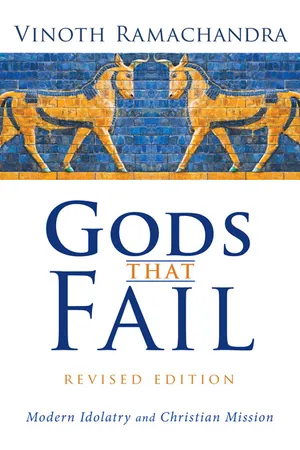
The globalizing world of late modernity is heavily awash with pseudo-gods. Gods That Fail provocatively deploys the theological concept of idolatry to explore the ways in which these gods blind their devotees and wreak suffering and dehumanization. Many of these pseudo-gods have infiltrated the life of the Church and compromised its witness. Combining lively social critique with fresh expositions of familiar biblical stories, this book engages with a variety of secular discourses as well as the sub-Christian practices that accompany and undermine Christian involvement in the public square.
Information
Topic
Theology & ReligionSubtopic
Christian MinistryPREFACE TO REVISED EDITION
This book first saw the light of day in 1996, having been published by Paternoster Press in the UK and, a year later, by InterVarsity Press in the US. It arose out of talks given to university student audiences, both Christian and non-Christian, in various countries, and has been widely used in churches, colleges and seminaries to promote critical reflection on modernity and postmodernity from within the biblical Christian tradition.
In this revised edition, I have tried to find a balance between keeping the original text and its contextual setting (always important) and bringing some of the egregiously outdated examples and statistics up to date. Most quotations have been retained, and while my thinking about certain areas has deepened since I first wrote, I have refrained from turning this into a different book altogether. The reader can judge how successfully this has been achieved. The main structural revision has been to interchange chapters 2 and 4 in the original, as I believe this makes for a more logical progression.
In the Introduction I state that my aim throughout has been to provide my fellow-pilgrims, who are attracted, repelled or confused by cultural developments, with a few historical and biblical compasses that may help them in their journey beyond modernity to the counterculture of the kingdom of God. Also, in keeping with the introductory and essentially “bridge-building” character of the book, I have chosen to dispense with detailed footnotes (apart from, of course, references to sources) and the endless qualifications that must necessarily attend a more academic presentation.
Gods That Fail was my first full-length book; and I would consider it my most successful in that it captivated a Danish woman working in India who invited me to teach parts of it in a college program she was leading, and who eventually became my wife.
I am grateful to Wipf and Stock for their enthusiastic support in restoring this work to circulation.
Vinoth Ramachandra
Colombo, Sri Lanka
January 2016
1. INTRODUCTION: MODERNITY & IDOLS
“Constant revolutionizing of production, uninterrupted disturbances of all social conditions, everlasting uncertainty and agitation distinguish the bourgeois epoch from all earlier ones. All fixed, fast-frozen relations, with their train of ancient and venerable prejudices and opinions, are swept away, all new-formed ones become antiquated before they can ossify. All that is solid melts into air all that is holy is profaned . . . ”
—K. Marx & F. Engels, The Communist Manifesto (1848)1
These famous words, written a century and a half ago, are still an apt description of social changes taking place all over the world. Modernity has come to encircle the globe, its effects felt in the most remote rural villages and not only in university campuses, urban shopping malls and government bureaucracies. It is not simply one civilization among others, but the first truly global civilization to emerge in human history.
For Karl Marx, “modern” conditions were those created by technological progress and the ever-expanding commerce of nations. Capitalist production was the nerve-centre of the monster of modernity. Ancient communities were uprooted and people thrust into competition with each other in the new jungle of a capitalist social order. But, for Marx, the horrors of modernity also contained a potent promise. The collapse of “all fixed, fast-frozen relations” liberated modern human beings from the “ancient and venerable prejudices and opinions” of traditional peasant life. It created a historic opportunity for humankind, represented initially by the new industrial working class, to seize control over its existence through collective revolution and thus put an end to all irrational and arbitrary authority. The monster of modernity could not only be tamed (since it was, after all, a human creation) but would become a necessary means to human liberation.
Another well-known image of what it feels like to live under modern conditions was given by Max Weber (1864–1920), one of the founders of modern sociology. For Weber capitalism was part of a broader phenomenon of increasing rationalization, appearing for the first time in the West in the late-sixteenth and seventeenth centuries. Like Marx, Weber believed that capitalism was a historically specific economic form, not a universal human drive. Unlike the pursuit of gain or ruthless expropriation common to most human cultures, the modern epoch of capitalism was a system of rational rule-governed behaviour, organized around a central motivation—the continuous accumulation of profit as an end in itself. Modernity was like an “iron cage” that drew an ever-tightening noose of impersonal, abstract, instrumental rationality around its victims, leading to the suppression of spontaneity, diversity, and mystery, and the widespread “disenchantment” of the world.2 This is an image that came to dominate much of the fictional and sociological literature of the twentieth century. It bred a widespread mood of pessimism and near-fatalism.
Marx and Weber were notorious for their Eurocentric readings of history. A number of recent historians have argued that modernity should be seen as a multi-centred enterprise, involving the active participation of many societies around the globe.3 The East was more advanced, technologically and economically, than the West between 500 and 1800 and played a crucial role in enabling the rise of modern Western civilization. None of the major players in the world economy at any time before 1800 was European. Ironically, European colonial expansion was made possible by the assimilation of Arab, Chinese and Indian scientific ideas and nautical technologies. In order to solve the massive challenges posed by ocean sailing, the Portuguese and the Spanish turned to the East for help in ship design and navigation.
Islamic science found its way to the Portuguese court via the many Jewish scholars who had fled there from Spain in the fourteenth century. Many of the technologies that proved crucial to the agricultural, military and political revolutions in Europe from medieval times to 1800 diffused from the East—for example, the stirrup, the horse-collar harness, the watermill and windmill, the iron ploughs and horseshoes, guns and gunpowder, cannon, compasses, square ship hulls and multiple mast-systems, paper-making and movable metal-type printing presses. It was only in as late as the mid-nineteenth century that Europe caught up with Asia and the Ottoman empire. A hundred years before the first European conquistadors set sail for the Americas and the East Indies, China controlled half the world’s oceans. India and China were industrial powers long before the industrial revolution gathered momentum in Europe; and their de-industrialization accompanied nineteenth-century British colonialism.
Consequently, the neat polarisations of “Eastern” and “Western”, “national” and “foreign”, are as misleading as the popular distinction between the “secular” and “religious”. The origins of modernity lie not exclusively in Western economic, political and intellectual developments but in the complex, historical interplay of European and non-European civilizations that intensified from the eighteenth century onwards. The origins of change in world history have always been multi-centred. Modernity thus has a global history.
However, half a century after the end of European colonialism, many are still held captive by Eurocentric narratives. We talk of China’s “emergence” from “centuries of backwardness” to be a global economic power today. Even the most ardent nationalist is fired by models of “development” and “progress” that have been defined by European nations, economists and institutions. India’s popular “call-centres” replay the familiar colonial pattern: young English-speaking Indians toiling at night to enlarge the profits of Western corporations. The mega-malls of Asian cities, into which teenagers slavishly imitating the latest European and American fashions flock in droves, display luxury goods bearing mostly Western brand names but manufactured in Asian sweatshops. The recent rapid economic growth in China that frightens European and American workers has itself been fuelled by Western corporations, and China’s insatiable appetite for oil means that it will follow the same path of European colonialism in Africa.
So, we should speak of modernities (plural) rather than modernity (singular). But, given the dominance since the nineteenth century, at least among political and academic elites around the world, of a secularizing, Western “Enlightenment” understanding of modernity, it will be the latter sense of the term that will be deployed throughout the present book, unless we qualify it.
An alternative image to both Marx and Weber is offered in the writings of the British sociologist Anthony Giddens. He likened life in the modern world to being aboard a “careering juggernaut . . . rather than being in a carefully controlled and well-driven motor car.”4 The English word “juggernaut” comes from the Hindi Jagannath, one of the titles for the god Krishna. A huge chariot was used to take an idol of the deity out of its temple in Orissa once a year, and as it trundled through the streets devotees would throw themselves under its wheels and be crushed to death. The modern juggernaut is an engine of enormous power which “collectively, as human beings, we can drive to some extent but which also threatens to rush out of our control and which could rend itself asunder.”5 The ride is by no means unpleasant. Riding on the juggernaut of modernity is often exhilarating and rewarding, but there are times it veers a...
Table of contents
- PREFACE TO REVISED EDITION
Trusted by 375,005 students
Access to over 1.5 million titles for a fair monthly price.
Study more efficiently using our study tools.
Frequently asked questions
Yes, you can cancel anytime from the Subscription tab in your account settings on the Perlego website. Your subscription will stay active until the end of your current billing period. Learn how to cancel your subscription
No, books cannot be downloaded as external files, such as PDFs, for use outside of Perlego. However, you can download books within the Perlego app for offline reading on mobile or tablet. Learn how to download books offline
Perlego offers two plans: Essential and Complete
- Essential is ideal for learners and professionals who enjoy exploring a wide range of subjects. Access the Essential Library with 800,000+ trusted titles and best-sellers across business, personal growth, and the humanities. Includes unlimited reading time and Standard Read Aloud voice.
- Complete: Perfect for advanced learners and researchers needing full, unrestricted access. Unlock 1.5M+ books across hundreds of subjects, including academic and specialized titles. The Complete Plan also includes advanced features like Premium Read Aloud and Research Assistant.
We are an online textbook subscription service, where you can get access to an entire online library for less than the price of a single book per month. With over 1.5 million books across 990+ topics, we’ve got you covered! Learn about our mission
Look out for the read-aloud symbol on your next book to see if you can listen to it. The read-aloud tool reads text aloud for you, highlighting the text as it is being read. You can pause it, speed it up and slow it down. Learn more about Read Aloud
Yes! You can use the Perlego app on both iOS and Android devices to read anytime, anywhere — even offline. Perfect for commutes or when you’re on the go.
Please note we cannot support devices running on iOS 13 and Android 7 or earlier. Learn more about using the app
Please note we cannot support devices running on iOS 13 and Android 7 or earlier. Learn more about using the app
Yes, you can access Gods That Fail, Revised Edition by Vinoth Ramachandra in PDF and/or ePUB format, as well as other popular books in Theology & Religion & Christian Ministry. We have over 1.5 million books available in our catalogue for you to explore.