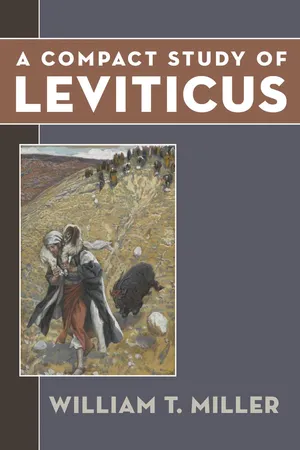
- 224 pages
- English
- ePUB (mobile friendly)
- Available on iOS & Android
eBook - ePub
A Compact Study of Leviticus
About this book
Beginners scanning Leviticus will find much detail about rituals and sinful situations, but little enlightening context or rationale. This study explores how scholars imagine that these rituals and moral laws made sense to those living back then, even though many of these early rituals and customs have been discontinued or replaced by consensus with alternative forms of worship.
The authors seem to be unquestioningly devout, and quite realistic about life at the same time. Everyone shared in rituals of faith at home, at shrines, or in Jerusalem; everyone honored the proper food and eligibility regulations, and everyone was called to the common code of justice.
Likewise, most everyone knew at least the temptation to shirk religious duties; they understood the lure of trying to contact other gods, ones more lenient or at least easier to understand; and they could be inclined to look the other way at improper romances, or quick but dishonest chances to get a bigger slice of the pie.
The Covenant was not a deal made by saints. It was a cry for help from sinners, a cry for help for which they had not earned the right. The same is true for us believers even now.
Information
Topic
Theology & ReligionSubtopic
Biblical CommentarySection One
Leviticus 1:1—17
The first verse of the book shows God speaking to Moses from the tent of meeting. Moses is outside the tent, listening to the instructions. There are several ways to depict the dialogs between God and Moses. In some cases Moses is within the fore room of the tent while God is within the inner room, the holy of holies (see Exod 25:22; 30:6, 36; Num 7:89). When Moses is with the people, God’s glory can fill the fore room also (see Exod 29:42–43; Lev 9:4–5, 23–24; Num 14:10; 16:19, 43; 20:6).
The intimate contact between God and Moses in Exod 24:15—25:1 can be contrasted with the more restricted communications in Exod 40:34–38 and Lev 1:1. The conferences about plans for the tabernacle are unique, but the instructions in Leviticus are of a lesser magnitude.
The Priestly writers usually avoid phrases that have Moses seeing God directly. The dramatic phrases in Exod 33:11; Deut 34:10; and Num 12:8 about seeing God face to face (in Num 12:8 mouth to mouth) are not from the Priestly traditions. Milgrom suggests we take them simply as ways of speaking of God’s presence, rather than literal descriptions of what Moses himself experienced. Perhaps the Priestly editors were wary of leaving the impression that Moses had or should become an immortal or semi-divine figure.
Many scholars take the description of the cloud of glory that leads the people when they journey (Exod 40:36–38) as an interpolated text, which points toward the culmination of the ordination of Aaron and his sons in Lev 9:15–24. These two passages then serve to bracket all of Lev 1:1—9:14.
The reference to any of you (adm) in Lev 1:2 seems to refer to the people of Israel. Milgrom suggests that the instructions may have originally included resident aliens. They are mentioned in 22:18–25 in connection with other ceremonies, and in 24:17–21 in connection with blasphemy and other crimes.
In Hebrew the verb for offer or sacrifice (qrb) means to bring something near (forward), and the sacrifice itself is called qorban, that which is brought near. The word for burnt offering (ola) may come from a verb meaning to rise or ascend, perhaps referring to the extensive smoke from the total incineration. In the Pentateuch burnt offerings are usually mentioned first when discussing several ceremonies. Male animals were the most expendable, given that in herd management only a certain percentage of males were kept for breeding. The entrance of the tent of meeting includes what we would call the outer courtyard of the entire tabernacle. Lay people were not simply spectators; they brought the animals, laid their hands on the heads of the animals, slaughtered, flayed and quartered them, and presented the sacrifice to the priests. Those bringing the offerings were responsible to be sure they were unblemished; the priests also inspected the animals for the same reason.
Milgrom argues that when the donor puts a hand on the head of the animal it is simply a gesture of ownership. The donor of birds or offerings of flour or bread or monies does not perform the same gesture, because he or she is already carrying those offerings by hand—the normal gesture for someone who owns such goods. When indicating ownership by the placing of the hand, the donor would also tell the priest what type of sacrifice was intended. Some of the same animals could be used for offerings of well-being, as we will see in Lev 3.
In 1:5 the one who actually slaughters the animal is not identified; the Hebrew simply says that one will kill it. At times in English translations such phrases are put in a passive form (the bull shall be slaughtered), which also does not identify the subject. Context indicates that the person bringing the animal does the slaughtering, and the flaying, quartering, and cleaning mentioned in 1:6–9.
Ancient rabbinical commentary indicates that the custom was to point the animal’s face toward the sanctuary at the moment of slaughter. Pagan custom often called for pointing the animal’s head down at the ground; this is consistent with animism or ancestor worship. Other cultures had the head pointed up to the sky, the realm of the gods. In 1 Sam 14:32 Saul’s soldiers slaughtered some cattle and sheep on the ground (arzah). The Hebrew could well mean toward the ground, i.e., having the animals’ heads pointed down. At that point Saul had them use a stone altar, and gave stricter instructions about disposing of the blood of the animals before eating them. The mention that the soldiers sinned by eating meat with blood in it (1 Sam 14:33–34) might also have included the improper pointing of the animals’ heads as well.
In Lev 1:5 the priests put the blood against the sides of the altar; blood was not put on top of the altar or incinerated in quantity with the sacrifices. Later, in the temple, there were special drains encircling the base of the altar, leading to an area for evaporation and proper disposition.
The donor then skinned the animal after severing the head and lower shins, quartered it as directed, and washed the entrails and leg areas to remove dung. The priests put new firewood on the glowing coals on the altar and then completely burnt the quartered pieces, head, and sections of suet, following the customary practice.
From other sources (Neh 10:35; 13:31 and rabbinical traditions) we learn that at the temple firewood was donated in quantity by leading families or tribes. The individual offerer would have been hard put to bring firewood at the time of the ceremony.
Milgrom modifies the traditional translation of offering by fire (ishh) in 1:9, 13, 17 to food gift. He derives this from non-Hebrew semitic root words for gift, and theorizes that it was an obsolete term even in pre-exilic times. Milgrom also notes that speaking of the pleasing odor (reah nihoah) of the sacrifices is another ancient phrase that became so standard as to lose much of its meaning. He cautions against using more melodramatic English words such as appeasing, placating, or soothing, since they can introduce many misimpressions about God.
Apparently bulls could be slaughtered anywhere near the altar (most likely on the east side, closer to the entrance into the outer courtyard) but sheep were to be slain at the north sid...
Table of contents
- General Introduction to Leviticus
- Instructions for Study Groups
- Section 1: Leviticus 1:1—17
- Section 2: Leviticus 2:1–16
- Section 3: Leviticus 3:1–17
- Section 4: Leviticus 4:1–35
- Section 5: Leviticus 5:1–13
- Section 6: Leviticus 5:14—6:7
- Section 7: Leviticus 6:8—7:38
- Section 8: Leviticus 8:1–36
- Section 9: Leviticus 9:1–24
- Section 10: Leviticus 10:1–20
- Section 11: Leviticus 11:1—15:33
- Section 12: Leviticus 16:1–34
- Section 13: Leviticus 17:1–16
- Section 14: Leviticus 18:1–30
- Section 15: Leviticus 19:1–37
- Section 16: Leviticus 20:1–27
- Section 17: Leviticus 21:1—22:33
- Section 18: Leviticus 23:1–44
- Section 19: Leviticus 24:1–23
- Section 20: Leviticus 25:1–55
- Section 21: Leviticus 26:1–46
- Section 22: Leviticus 27:1–34
- Final Overview
- Answers
- Bibliography
Trusted by 375,005 students
Access to over 1.5 million titles for a fair monthly price.
Study more efficiently using our study tools.
Frequently asked questions
Yes, you can cancel anytime from the Subscription tab in your account settings on the Perlego website. Your subscription will stay active until the end of your current billing period. Learn how to cancel your subscription
No, books cannot be downloaded as external files, such as PDFs, for use outside of Perlego. However, you can download books within the Perlego app for offline reading on mobile or tablet. Learn how to download books offline
Perlego offers two plans: Essential and Complete
- Essential is ideal for learners and professionals who enjoy exploring a wide range of subjects. Access the Essential Library with 800,000+ trusted titles and best-sellers across business, personal growth, and the humanities. Includes unlimited reading time and Standard Read Aloud voice.
- Complete: Perfect for advanced learners and researchers needing full, unrestricted access. Unlock 1.5M+ books across hundreds of subjects, including academic and specialized titles. The Complete Plan also includes advanced features like Premium Read Aloud and Research Assistant.
We are an online textbook subscription service, where you can get access to an entire online library for less than the price of a single book per month. With over 1.5 million books across 990+ topics, we’ve got you covered! Learn about our mission
Look out for the read-aloud symbol on your next book to see if you can listen to it. The read-aloud tool reads text aloud for you, highlighting the text as it is being read. You can pause it, speed it up and slow it down. Learn more about Read Aloud
Yes! You can use the Perlego app on both iOS and Android devices to read anytime, anywhere — even offline. Perfect for commutes or when you’re on the go.
Please note we cannot support devices running on iOS 13 and Android 7 or earlier. Learn more about using the app
Please note we cannot support devices running on iOS 13 and Android 7 or earlier. Learn more about using the app
Yes, you can access A Compact Study of Leviticus by William Thomas Miller in PDF and/or ePUB format, as well as other popular books in Theology & Religion & Biblical Commentary. We have over 1.5 million books available in our catalogue for you to explore.