- 278 pages
- English
- ePUB (mobile friendly)
- Available on iOS & Android
eBook - ePub
About this book
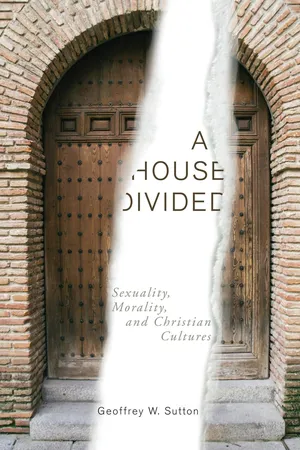
A House Divided helps answer the question, how do Christians form moral judgments about sex-linked issues? After analyzing key differences between conservative and progressive Christians on such divisive issues as abortion, sex education, and same-sex marriage, readers will learn how a combination of four factors can lead to principled Christian morality.
First, a review of diverse interpretive comments on relevant Scriptures can help identify a foundation for agreement as well as sharpen differences. Second, a review of psychological factors can help identify prejudices, personality traits, and powerful emotions that intensify and color public debate. Third, new research on moral psychology will add six dimensions of analysis to appreciating the reasons conservatives and progressives draw upon when forming moral judgments. And finally, knowledge about sexual attraction, sexual orientation, conception, and sexual health is vital to thinking ethically about the specific issues addressed in this book.
Information
Part I
Pathways to Understanding Christianity, Morality, and Sexuality
1
Biblical Texts and Christian Perspectives
Christianity had a rough start. Jesus of Nazareth, born a Jew in the ancient lands of Roman-occupied Israel, taught a new way of faith in a loving and forgiving God who, like a loving father, was intent on having a large family of children who loved one another. When he taught, he quoted the Hebrew Scriptures. He also associated with people considered unclean and unwelcome in Jewish society. He challenged the interpretations of contemporary religious leaders on points of law and tradition. He was beaten and crucified. His followers hid in fear that they too might suffer the same fate, but he appeared to them and encouraged them to share the good news of this new way of living before he left the earth. Then his followers spread the good news of freedom from spiritual bondage and a new way of faith based on a loving relationship with God. He offered forgiveness and hope to people weighed down by onerous laws and traditions.
In this chapter I plan to answer two main questions important to anyone striving to understand diverse Christian views on morality. First, a two-part question: what are the sacred texts of Christianity, and how did they become the book widely known as the Holy Bible, which governs how Christians frame morality? And second, how can we identify a Christian perspective on morality?
How Was the Bible Formed?
The sacred text of Christianity known as the Bible, or Holy Bible, is a collection of ancient writings called books that were written over a period of centuries by many persons. The collections vary from the sixty-six books in the Protestant Bible to several more in Catholic and Orthodox Church Bibles. Early on, Christians accepted the Hebrew Scriptures as part of their canon. Religious scholars use the term canon to mean a religious group’s official collection of sacred texts.1 Because Christians accept Jesus’ teaching as a new covenant between God and people, the term old covenant referred to the agreement between God and the descendants of Abraham while new covenant referred to the new message presented by Jesus and written about by his followers. The different sets of texts became known among Christians as Old and New Testaments, indicating that the documents bear witness to the two different covenants.
The Hebrew Bible
The Hebrew Bible includes twenty-four sets of documents referred to as books in three sections: The Torah (five books of the law, or teaching, traditionally attributed to Moses), Nevi’im (prophets), and Ketuvim (writings). The variety of documents is broadly identified as law, poetry, and prose.2 In contemporary Western Christian versions of the Bible, the Hebrew Bible is presented as thirty-nine Old Testament books. Traditionally, the Jewish canon was considered firm since about 100 CE (Common Era), but Toorn suggests that what came to be the official collection of scrolls had more to do with the end of the canonical era sometime after the Hebrew prophet Ezra.3
There are different theories as to how the ancient writings were eventually organized into a collection. References in 2 Kings 22 and 1 Samuel 10:25 indicate the presence of scrolls in the Hebrew temple. Also 2 Maccabees 1:20—2:18 refers to a temple library. Outside of Scripture, there are references by Flavius Josephus to a collection of twenty-two books that, depending on how books are counted, could refer to the collection in use by Jews. The Hebrew language collection of books is the official version of the Hebrew Bible in contrast to a Greek translation, The Septuagint, which had wide use sometime before the Christian era among Greek-speaking Jews and later, among Christians.4
Other Jewish writings appear in the Bibles of the Catholic Church and the Eastern Christian churches, but not in the Protestant Bible. These additional books are referred to as the Apocrypha, which means hidden. The Apocrypha are not part of the Bibles of either Judaism or Protestant Christianity. There are other collections of ancient writings such as the Pseudepigrapha and the New Testament Apocrypha, but these are not commonly found in official canons.5
The Christian Bible
Because the early Christians were Jews who followed Jesus, they, like Jesus, accepted the Hebrew Bible as their sacred text. Early followers of Jesus and his teachings created a number of documents, which were circulated among the newly formed congregations. Two major collections were used in the early years of the church. One collection consists of writings by Jews close to the time of Jesus and, as previously mentioned, this collection is known as the Apocrypha. Another collection, which eventually became the New Testament, consisted of the four Gospels, the Acts of the Apostles (history), twenty-one Epistles (letters), and the book of Revelation. This latter collection of New Testament books was a work in progress for many years because different groups maintained different lists of sacred texts.
The four Gospels explain the importance of Jesus’ life and teaching to different audiences. There is some overlap of content among the four Gospels as well as some differences in what the writers include. One writer, Luke, produced a two-volume work known as Luke-Acts. The book titled Luke is one of the four Gospels. In the Acts of the Apostles, Luke explains that the name Christian was used to refer to a follower of Jesus. The term Christian refers to a particular role that is key in separating traditional Jews from the Jews in the new group that followed Jesus. In the Hebrew Bible, Jews looked forward to a man sent from God as a savior of their status as a people under foreign rule. This savior is also known as the Messiah, meaning the anointed one. The followers of Jesus accepted Jesus as God’s Messiah. In the Greek language, the Hebrew word for messiah is christos, which is the origin of the name translated into English as Christ and the term Christian. What looks like a two-part contemporary name—Jesus Christ—is actually a name (Jesus) and a title (Christ, the anointed one). However, many Christians use the phrase, Jesus Christ, as if his name were similar to the two names common in contemporary Western cultures. Eventually the Jews who followed Jesus’ way became known as Christians. In addition to their acceptance of Jesus as the Christ, they created new documents and welcomed non-Jewish converts into their congregations. As this group of Jews expanded, another event happened to change the course of Judaism. The Romans put down a Jewish rebellion and destroyed the Jewish temple at Jerusalem in the year 70. The destruction put an end to a focal point of Jewish faith and the important rite of sacrifice.6
One early Jewish convert, Saul of Tarsus, persecuted the first-century Jewish followers of Jesus for their heretical teachings, but following a dramatic conversion, he—now using the name Paul—embarked on a series of missionary journeys throughout the Roman Empire. He communicated with towns where early Christians formed groups by sending letters known as Epistles. These letters of Paul form a large part of the New Testament. But scholars like Victor Furnish disagree over who actually wrote some of the letters attributed to Paul based on analyses of dates and the characteristics of the writings themselves.7 Other letters are traditionally attributed to the apostle Peter and Jesus’ brothers, Jude and John.
As the Gospels and letters began to circulate among the early congregations, a collection began to form. There were disputes over some books, such as Hebrews and Revelation, that ultimately made it into the official canon. Other writings were rejected despite strong support from some leaders. Examples of rejected documents include The Gospel of Thomas and The Letter of Barnabas.8
As noted above, the official canon varies with the Christian traditions. The Hebrew Torah and Prophets were in use by Jews before Jesus, but the addition of the other Jewish writings appears to have taken place within a few decades after Jesus. Roman Catholics fixed their canon at the Council of Trent (1545–63). They included forty-six books from the Old Testament and twenty-seven for the New Testament. The books in the Apocrypha were reviewed and included as part of the official Catholic Bible. These books have since been known as Deuterocanonical (of the second canon). In current versions of the Catholic list, these apocryphal books are part of the Old Testament booklist. As already noted, most Protestants do not accept these additional Old Testament texts, so Protestant Bibles have only thirty-nine Old Testament books. Variations in what books were included appear in Greek, Russian, Georgian, and Eastern Orthodox Bibles. The Anglican Church uses some apocryphal books in their...
Table of contents
- Acknowledgements
- Introduction
- Part I
- Chapter 1: Biblical Texts and Christian Perspectives
- Chapter 2: The Influence of Spirituality and Thinking on Morality
- Chapter 3: The Influence of Personality, Physiology, Emotions, and Social Context on Morality
- Chapter 4: Moral Psychology
- Chapter 5: Psychology and Sexuality
- Chapter 6: Sexuality and Healthy Relationships
- Part II
- Chapter 7: Beginnings: From Pregnancy to Adolescence
- Chapter 8: Marriage, Divorce, and Sexual Relationships
- Chapter 9: Sexual Orientation and Same-Sex Relationships
- Chapte 10: Sex and Gender Roles
- Chapter 11: Sexual Violence and Christianity
- Part III
- Chapte 12: Sexuality, Morality, and Redemption
- Chapter 13: Reflections: Sexuality, Morality, and Christian Cultures
- Bibliography
Trusted by 375,005 students
Access to over 1.5 million titles for a fair monthly price.
Study more efficiently using our study tools.
Frequently asked questions
Yes, you can cancel anytime from the Subscription tab in your account settings on the Perlego website. Your subscription will stay active until the end of your current billing period. Learn how to cancel your subscription
No, books cannot be downloaded as external files, such as PDFs, for use outside of Perlego. However, you can download books within the Perlego app for offline reading on mobile or tablet. Learn how to download books offline
Perlego offers two plans: Essential and Complete
- Essential is ideal for learners and professionals who enjoy exploring a wide range of subjects. Access the Essential Library with 800,000+ trusted titles and best-sellers across business, personal growth, and the humanities. Includes unlimited reading time and Standard Read Aloud voice.
- Complete: Perfect for advanced learners and researchers needing full, unrestricted access. Unlock 1.5M+ books across hundreds of subjects, including academic and specialized titles. The Complete Plan also includes advanced features like Premium Read Aloud and Research Assistant.
We are an online textbook subscription service, where you can get access to an entire online library for less than the price of a single book per month. With over 1.5 million books across 990+ topics, we’ve got you covered! Learn about our mission
Look out for the read-aloud symbol on your next book to see if you can listen to it. The read-aloud tool reads text aloud for you, highlighting the text as it is being read. You can pause it, speed it up and slow it down. Learn more about Read Aloud
Yes! You can use the Perlego app on both iOS and Android devices to read anytime, anywhere — even offline. Perfect for commutes or when you’re on the go.
Please note we cannot support devices running on iOS 13 and Android 7 or earlier. Learn more about using the app
Please note we cannot support devices running on iOS 13 and Android 7 or earlier. Learn more about using the app
Yes, you can access A House Divided by Geoffrey W. Sutton in PDF and/or ePUB format, as well as other popular books in Social Sciences & Christian Theology. We have over 1.5 million books available in our catalogue for you to explore.