- 240 pages
- English
- ePUB (mobile friendly)
- Available on iOS & Android
eBook - ePub
About this book
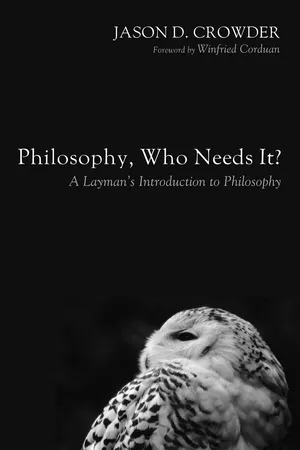
Too often skeptics charge Christians with having a blind faith. Unfortunately, believers have added fuel to the charges of skeptics by speaking of their faith illogically. But the Christian faith is not a blind faith. In fact, biblical faith is never a blind, irrational faith. Christianity rests firmly on the stone that was rejected by the builders, which has become the cornerstone--Jesus Christ (Acts 4:11). Living biblically requires thinking biblically, just as "to think biblically entails to live biblically," as Winfried Corduan notes in the Foreword.
As followers of Christ, believers cannot separate biblical thinking and biblical living. These two behaviors are eternally connected not only in the person of Jesus Christ, but they stem from the eternal being of God the Father and his eternal truth. Christ mandates that his followers love God with their entire being--heart, soul, mind, and strength (Mark 12:30). How are believers to go about living out this biblical mandate? Christian faith is a warranted belief. This is why it is so essential that Christians recognize the value and importance of philosophy and its proper place in Christendom and in the Christian's walk.
Information
Topic
FilosofiaSubtopic
Filosofia etica e moralePart One
Prelude to Philosophy and Its Value for the Christian
1
What is Philosophy?
An Examination into Its Nature
“‘Behold, the fear of the Lord that is wisdom,and to turn away from evil is understanding.’”
—Job 28:28
“Nothing is more highly esteemed among men than philosophy,” according to Philip Mauro.1 When beginning a study into a new or unfamiliar subject, having a basic understanding of its content is helpful. A definition is the best place to begin any discussion. Many philosophers have problems defining philosophy with a specific, straightforward definition. But as we move towards a better grasp of the word, a description reveals itself in the term’s etymology, which is the study of the history and origins of words.
History ascribes Pythagoras of Samos with introducing the terms philosophy and philosophers to the ancient Greek world.2 Pythagoras combines two Greek words, phileo and sophos, to form a single concept—philosophy. Phileo means to love, and sophos denotes wisdom. Hence, most philosophers can agree upon the love of wisdom as a conventional definition.
On some level this elementary definition suffices. But the explanation lacks a full scope of what philosophy is. From here, trying to arrive at an agreeable definition gets more muddled.
Moving Towards a More Concrete Definition for Philosophy
A consensus exists among philosophers that there is no airtight definition for philosophy beyond the traditional one, which expresses everything the subject covers. The problem of obtaining an all-encompassing definition is, in some manner, due to philosophy touching upon nearly every aspect of human life and all topics of study. A survey of ancient Greek philosophical writings reveals biology, botany, law, mathematics, physics, psychology, and rhetoric are just a few of the subjects originating from philosophical discourse. Philosophy does not have any specific material of its own, which bewilders the situation further. As a result, we cannot distinguish the term with regards to a particular area of investigation. Additional problems arise in deriving a more concrete description; for example, the content and character of philosophy changes throughout history.3 At one point in time, God was an acceptable given in philosophical thought, and today the existence of God is questioned rather than assumed. Still further, a problem rests in whether philosophy is simply the evaluation of concepts and presuppositions or if more than this exists.4
Look closer at the traditional definition for philosophy—the love of wisdom. Defining wisdom presents a challenging task since one may not know what constitutes wisdom. Merriam-Webster Dictionary defines wisdom as:
• knowledge that is gained by having many experiences in life
• the natural ability to understand things that most other people cannot understand
• knowledge of what is proper or reasonable: good sense or judgment
In other words, wisdom is the proper understanding and right application of knowledge about the nature of reality. A wise person, therefore, lives accordingly by applying what the individual learns to real-life situations. Do not simply equate wisdom to having knowledge. Having wisdom is much more than mere knowledge of facts and various other bits of information. I am confident you can think of someone who you consider to be book smart but who does not have a bit of common sense.
Remember a wise person applies what is learned to everyday life. Solomon personifies wisdom throughout the book of Proverbs to illustrate this point. For example, let us look at Proverbs 4 to see why we must apply knowledge to life:
Hear, O sons, a father’s instruction, and be attentive, that you may gain insight, for I give you good precepts; do not forsake my teaching. When I was a son with my father, tender, the only one in the sight of my mother, he taught me and said to me, “Let your heart hold fast my words; keep my commandments, and live. Get wisdom; get insight; do not forget, and do not turn away from the words of my mouth. Do not forsake her, and she will keep you; love her, and she will guard you. The beginning of wisdom is this: Get wisdom, and whatever you get, get insight. Prize her highly, and she will exalt you; she will honor you if you embrace her. She will place on your head a graceful garland; she will bestow on you a beautiful crown.”
Hear, my son, and accept my words, that the years of your life may be many. I have taught you the way of wisdom; I have led you in the paths of uprightness. When you walk, your step will not be hampered, and if you run, you will not stumble. Keep hold of instruction; do not let go; guard her, for she is your life. Do not enter the path of the wicked, and do not walk in the way of the evil. Avoid it; do not go on it; turn away from it and pass on. For they cannot sleep unless they have done wrong; they ar...
Table of contents
- Title Page
- Foreword
- Preface
- Acknowledgements
- Abbreviations
- Introduction
- Part One: Prelude to Philosophy and Its Value for the Christian
- Part Two: How We Come to Know Things
- Part Three: Philosophy and the Gospel
- Part Four: So What Now
- Bibliography
Trusted by 375,005 students
Access to over 1.5 million titles for a fair monthly price.
Study more efficiently using our study tools.
Frequently asked questions
Yes, you can cancel anytime from the Subscription tab in your account settings on the Perlego website. Your subscription will stay active until the end of your current billing period. Learn how to cancel your subscription
No, books cannot be downloaded as external files, such as PDFs, for use outside of Perlego. However, you can download books within the Perlego app for offline reading on mobile or tablet. Learn how to download books offline
Perlego offers two plans: Essential and Complete
- Essential is ideal for learners and professionals who enjoy exploring a wide range of subjects. Access the Essential Library with 800,000+ trusted titles and best-sellers across business, personal growth, and the humanities. Includes unlimited reading time and Standard Read Aloud voice.
- Complete: Perfect for advanced learners and researchers needing full, unrestricted access. Unlock 1.5M+ books across hundreds of subjects, including academic and specialized titles. The Complete Plan also includes advanced features like Premium Read Aloud and Research Assistant.
We are an online textbook subscription service, where you can get access to an entire online library for less than the price of a single book per month. With over 1.5 million books across 990+ topics, we’ve got you covered! Learn about our mission
Look out for the read-aloud symbol on your next book to see if you can listen to it. The read-aloud tool reads text aloud for you, highlighting the text as it is being read. You can pause it, speed it up and slow it down. Learn more about Read Aloud
Yes! You can use the Perlego app on both iOS and Android devices to read anytime, anywhere — even offline. Perfect for commutes or when you’re on the go.
Please note we cannot support devices running on iOS 13 and Android 7 or earlier. Learn more about using the app
Please note we cannot support devices running on iOS 13 and Android 7 or earlier. Learn more about using the app
Yes, you can access Philosophy, Who Needs It? by Jason D. Crowder in PDF and/or ePUB format, as well as other popular books in Filosofia & Filosofia etica e morale. We have over 1.5 million books available in our catalogue for you to explore.