- 256 pages
- English
- ePUB (mobile friendly)
- Available on iOS & Android
eBook - ePub
About this book
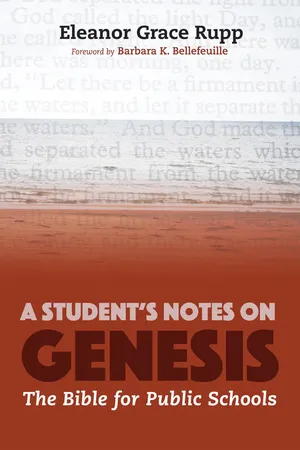
Curious about ancient stories, once a part of our culture, that schools fail to teach today? Our Supreme Court gave guidelines so classes could read them, so why don't they? Are schools fearful that teachers will present the stories for religious purposes? Shouldn't students know of Eve and her fatal choice of pride's poison, a poison that took her life, sent one son to the grave, and condemned her firstborn to wander the earth? Shouldn't they know of Lamech, drunk on that same poison, singing self-exalting songs of brutality and leading the world into a violence that could be cleansed only by raging floods? Also, for their great comfort, shouldn't students know of Jacob's sons, so much like Cain yet united by a brother who laid aside pride's call for revenge--even pride's call for personal justice? This book leads public school students through the first part of the world's hidden-away bestseller, marking out a path through the legal thickets and pits of the Bible into the hearts of the ancients--people who had the same joys, sorrows, failures, and hopes that all of us have, even today.
A Student's Notes on Genesis is for curious-minded students and for public school teachers who know that education should include the world's bestseller.
Information
Topic
Theology & ReligionSubtopic
Literary Criticismlesson 1
My Notes for the Genesis Bible Class
I am a high school student who loves movies, books, sports (especially basketball), and hiking with friends. Near the end of our summer break, about the time when I start to get bored, I realized I hadn’t escaped into a single book this summer. That escape, I knew, was what I needed now. I wished I had a really good book waiting.
In that state of mind I bounced my basketball along the sidewalk, unaware that the ball was about to do me a favor. It bounced right out of my hand, rolled down the street, and wedged itself into the bottom step of a store. After freeing the ball, I noticed a sign on the window: Jewish Books. The sign jogged a thought. “Jewish books. Didn’t the Jews have something to do with writing the Bible?”
I had often told myself I should read it. The Bible pops up everywhere I turn: English classes, history classes, discussions, debates, music, movies, and more. I have always had to drop out of those conversations. I know almost nothing about the Bible. Maybe it’s time to get a copy and read one, so I entered the bookstore.
“Yes,” the owner said, “we have Bibles, and yes, we Jews do have something to do with it. We wrote it. Do you want the Hebrew Bible or the Christian Bible?” I told him I couldn’t read Hebrew and I was not a Christian; I just wanted an English Bible. He patiently explained that he didn’t mean the Hebrew language. Realizing I was essentially ignorant of the book, he explained that what Christians call the Bible comes in two parts. Christians call the first and larger part the Old Testament, but Jewish people call the first part the Hebrew Bible. He said that Christians call the second part of the Bible the New Testament which is about a Jewish man named Jesus. The two parts together are what Christians mean by the Bible.
I knew that Jesus has something to do with Christmas, so wanting to learn all I could, I decided to get both parts. I was proud of my decision, but as I glanced through the pages, I realized it would take a lot of study. A short time later I heard that my school was offering a world literature elective that would include a unit on the book of Genesis—the first book in the Bible. I decided I would take the class.
The first day of the Genesis class
The first day of school the teacher took away any fears we might have. She explained that the Supreme Court’s guidelines for studying the Bible in the public schools give protection to all beliefs and non beliefs—not endorsement, but protection. The guidelines free all students from fear of their beliefs being censored. She also made sure we knew that this would not be a comparative religions class and that our goal would be to know Genesis, a unit in itself and the gateway to the rest of the Bible.
To get some idea of how familiar we were with the Bible, the teacher asked us to write down as many Bible characters as we could remember in two minutes. Then she set the timer. I was sure (almost sure) of five people—Adam, Eve, Noah, Moses, and Jesus. A girl in front of me wrote and wrote and said she needed a lot more than two minutes. Fortunately, that’s all the time the teacher gave.
She then asked us to give our ideas of what the Bible is about. Some said it was like an anthology, a collection of old miracle stories or maybe a mystical anthology. A few thought it was a book of old laws. Several said that every day they would read something in it. One girl said she usually opened her Bible up anywhere, put a finger on the page, and read a few sentences. She found it hard to understand, but thought it might do her good. It sounded like a rabbit’s foot to me. All agreed that if they knew more about the Bible, it should help them in literature classes. I didn’t say anything. I just knew the Bible had been too influential in the history of the world for me to be ignorant of it.
The teacher’s next words surprised me: she said that since some interpret the Bible as myths and legend and some as true historical events, if in class she took a stand on one side or the other, she would be stepping outside of the Supreme Court’s guidelines for public schools. The religion of both Jews and Christians comes out of the Bible. Since the public school teacher may neither affirm nor deny any student’s religious beliefs, the teacher said she would not take a stand on their differing religious viewpoints. Rather, she would teach its storyline—a storyline that lays a foundation for all that happens in the rest of the Bible.
As the class ended, the teacher explained that for several days we would study the formation of the Bible, the history of Bible translations, and the battles and bloodshed that brought it to us in our modern English. Although I was eager to start studying Genesis immediately, I could see by her introduction that those topics would answer some of my other questions—questions about where the Bible came from, who wrote it, when it was written, whether the original documents still exist, and how its story has survived to this day.
In order to make our study meaningful, at the end of each study, she will give us questions to discuss, checking our understanding and guiding us in analyzing those ancient characters and events. She said those characters were just like us, like every person—like all who sit around us in class.
I look forward to reading this book. I think I’ll keep my notes as a journal—not just the information, but my expectations and reflections on each study. I don’t want to forget my first impressions.
lesson 2
Overview of the Bible’s Composition
My first thoughts
On the board the teacher had written the objective for the next few days: “Analysis of the Composition of the Bible.” Realizing these lessons might be heavy, I took detailed notes. The following notes (brushed up some) were what I recorded from the teacher’s lesson, as well as the comments from the class.
My notes on the teacher’s lesson
This study is to cover the dates of the Bible writings, the different divisions of the Bible, and its languages, names, and writers.
The dates and age of the Bible writings
How years are dated
Before we can grasp the dates of the Bible writings, we must understand the changes in history’s calendar. Thousands of years ago people dated their lives by important events such as a natural catastrophe, the rule of a great king, or the beginning of an important treaty. As the centuries passed, Christians who saw the work of Jesus (called Christ) as the great turning point in history began dating events according to his birth. From that estimated year, we have the dates we use today. The letters bc are the initials of Before Christ, meaning “before his birth.” The letters ad are the initials, not of English words but of the Latin words, Anno Domini, meaning “in the year of our Lord.” They refer to the years following his birth.
Events that happened one year before Jesus was born were dated as 1 bc. Events that happened one year after his birth were dated as ad 1. Notice that the letters bc follow the number of the year, and the letters ad precede the number of the year.
Making calendars with Christ as the center of history did not begin until over 500 years after his birth, gradually becoming a general world-standard. The best efforts of the calendar-makers in trying to line up his birth with the records of history, however, apparently missed the date by a number of years. The true date of Jesus’ birth was probably about four or five years before the calendar date of 1 bc! Perhaps the only great problem created by that error was for those who were sure something cataclysmic would occur in ad 2,000. When the world celebrated the calendar year 2000 (at least four years too late), few knew that the probable two thousandth year had quietly come and gone about forty-eight months earlier with no cataclysm showing up for those parties.
The Bible’s dates and age on a timeline
The teacher used a timeline to help us grasp the great age of the Bible. It surprised us all. The traditional view—the view held for hundreds of years—claims the writing, or the organizing of the writings, began about 1450 bc and was completed about ad 100. Some recent views place the beginning of the Bible writings about 1200 bc and the completion about ad 150.
Averaging the dates, Genesis was written over 3,300 years ago. Hearing that figure, a student interjected the words, “In fourteen hundred ninety-two, Columbus sailed the ocean blue.” He then went on to say that Columbus’s journey began a little over 500 years ago, a length of time that can seem endless to us; yet the writing of Genesis began over six times further back in history than Columbus, and the end of the Bible over three times further back. He remarked that compared to when the Bible writings began, Columbus’s discovery of America was like last week! A student who is a history buff added that when Columbus dis...
Table of contents
- Foreword
- Preface
- Acknowledgments
- Introduction for Students
- 1. My Notes for the Genesis Bible Class
- 2. Overview of the Bible’s Composition
- 3. The “Original” Bible
- 4. Ancient and Recent Changes that Assist Readers
- 5. History of English Bible versions, Part I
- 6. History of English Bible Versions, Part II
- 7. Genesis Background
- 8. The Beginnings
- 9. The Garden of Eden
- 10. Death in Eden: Part I
- 11. Death in Eden: Part II
- 12. Cain and Abel
- 13. Where Did Cain Get His Wife?
- 14. Civilization Outside of Eden
- 15. Noah and the Flood
- 16. New Restraints on Evil
- 17. A New Direction: Abram (Abraham) and His Family
- 18. Abram Scandalizes His Own Name
- 19. Nephew Lot’s Choices
- 20. Great Rewards and Great Failures
- 21. Visitors, Promises, Beliefs, and Fears
- 22. Lot’s Rewards in Sodom
- 23. Challenges to Sarah’s Son in Gerar
- 24. Challenges to Isaac from Within the Family
- 25. Abraham’s Worst Test
- 26. The Standards for Isaac’s Wife
- 27. The Sons of Isaac Compete
- 28. Development of Jacob’s Family
- 29. Jacob Faces Enemies
- 30. From Haran to Canaan: Told from the Viewpoint of Jacob’s Young Son, Joseph.
- 31. Jacob Crushed by His Sons
- 32. Judah’s Sowing and Reaping
- 33. Joseph’s Further Humiliation
- 34. Joseph and Timing
- 35. The Brothers Face Joseph
- 36. Final Tests of Joseph’s Brothers
- 37. Forgiveness and Comfort
- 38. Jacob’s Years in Egypt
- 39. Jacob Blesses His Sons
- 40. Two Deaths
- Epilogue
- Bibliography
- Maps
Trusted by 375,005 students
Access to over 1.5 million titles for a fair monthly price.
Study more efficiently using our study tools.
Frequently asked questions
Yes, you can cancel anytime from the Subscription tab in your account settings on the Perlego website. Your subscription will stay active until the end of your current billing period. Learn how to cancel your subscription
No, books cannot be downloaded as external files, such as PDFs, for use outside of Perlego. However, you can download books within the Perlego app for offline reading on mobile or tablet. Learn how to download books offline
Perlego offers two plans: Essential and Complete
- Essential is ideal for learners and professionals who enjoy exploring a wide range of subjects. Access the Essential Library with 800,000+ trusted titles and best-sellers across business, personal growth, and the humanities. Includes unlimited reading time and Standard Read Aloud voice.
- Complete: Perfect for advanced learners and researchers needing full, unrestricted access. Unlock 1.5M+ books across hundreds of subjects, including academic and specialized titles. The Complete Plan also includes advanced features like Premium Read Aloud and Research Assistant.
We are an online textbook subscription service, where you can get access to an entire online library for less than the price of a single book per month. With over 1.5 million books across 990+ topics, we’ve got you covered! Learn about our mission
Look out for the read-aloud symbol on your next book to see if you can listen to it. The read-aloud tool reads text aloud for you, highlighting the text as it is being read. You can pause it, speed it up and slow it down. Learn more about Read Aloud
Yes! You can use the Perlego app on both iOS and Android devices to read anytime, anywhere — even offline. Perfect for commutes or when you’re on the go.
Please note we cannot support devices running on iOS 13 and Android 7 or earlier. Learn more about using the app
Please note we cannot support devices running on iOS 13 and Android 7 or earlier. Learn more about using the app
Yes, you can access A Student’s Notes on Genesis by Eleanor Rupp in PDF and/or ePUB format, as well as other popular books in Theology & Religion & Literary Criticism. We have over 1.5 million books available in our catalogue for you to explore.