- 228 pages
- English
- ePUB (mobile friendly)
- Available on iOS & Android
eBook - ePub
About this book
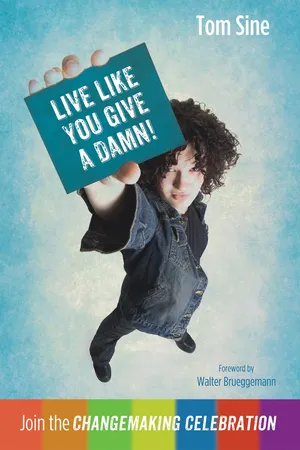
Live Like You Give a Damn! declares the very good news that God is raising up a new generation, largely outside the church, to bring impressive change to the lives of our neighbors locally and globally by creating innovative forms of social enterprise and community empowerment.
The even better news is that those of us within the church can join this changemaking celebration and discover creative new ways God can use our mustard seeds to make a more remarkable difference than we ever imagined possible.
In this book Tom Sine offers practical ways you can join those who are creating their best communities, their best world, and in the process their best lives. Sine shows that in a world changing at warp speed, following Jesus is a "design opportunity."
It is not only an opportunity to design innovative ways to make a difference but also an opportunity to create lives with a difference, in the way of Jesus, that are simpler and more sustainable--and to throw better parties along the way. Why would anyone want to settle for less and miss the best?
Information
Topic
Theology & ReligionSubtopic
Religion1
Touring, Sampling, and Savoring the Changemaking Celebration
First Stop: San Francisco
Our plane touched down at San Francisco International Airport on a stunningly beautiful blue-sky September morning in 2013. I was there to attend the SOCAP15 Conference because I wanted to learn about new forms of social innovation that are reportedly making a lasting difference in people’s lives all over the planet. However, I got much more than I bargained for. I invite you to join me as we not only get a little taste of SOCAP but as we savor tasty examples of the global changemaking celebration.
My first taste of this celebration came as I ate an early morning breakfast of granola and yogurt with my friends at the Sojourner Community16 in the Mission District. My attention was caught by a rich array of murals in this predominantly Latino neighborhood as I was headed to catch my bus. Suddenly, I was confronted by an arresting portrait of Archbishop Óscar Romero. He seemed to be looking directly at me. This imposing mural is painted on one wall of St. Peter’s Catholic Church. It captured for me a sense Archbishop Romero’s hope for a future that transcends our present world of violence and injustice. This turned out to be a great image to start what would turn out to be a day of remarkable discovery.
I boarded a bus crowded with students, which headed down Van Ness Boulevard and past Redding Elementary School, where I attended my first four years of school. I got off the bus at the end of Van Ness, at the edge of the San Francisco Bay, and walked past the Muni Pier, where I fished on a number of Saturdays as a kid. Then I hiked up over the hill. As I reached the crest I could see the iconic Golden Gate Bridge against the brilliant blue sky.
Directly below me, I spotted Fort Warden, an old military base left over from World War II that has been repurposed as a conference site. I headed down the hill and toward the loud music blaring from a huge inflated tent where SOCAP 13 was beginning. I found myself with nearly two thousand mainly younger social innovators as well as a host of investors and representatives from foundations like the Rockefeller and Bill Gates foundations. I sat in the front row so I could see both the stage and most of the audience. My friend Brian Howe, who heads up Impact Hub Seattle,17 came in and sat beside me, and I greeted him as the moderator, Rosa Lee Harden, stood to welcome us.
Suddenly a blast of wind off the bay hit the inflated tent and violently shook it for several minutes. Some people edged toward the exits and others of us simply grabbed our chairs. However, what happened over the next three days arrested my attention much more than that blustery beginning. SOCAP, which stands for social capital investment, was started ten years ago by Rosa Lee Harden and her husband, Kevin Jones. Rosa Lee Harden is an Episcopal priest with a background in business. Kevin Jones is a serial business entrepreneur who is running an important venture called Good Capital. Its mission is “to accelerate the flow of capital to enterprises that create innovative market-based solutions to inequality, poverty and other social problems and in doing so amplify their total impact.”
There are at least a dozen events like SOCAP all over the planet, including the Skoll World Forum on Social Entrepreneurship, which meets in Oxford, the Clinton Global Initiative, the Feast, and Ted Talks that are held at several locations in the US and around the world. There is also a global network of Impact Hubs18 from Sao Paulo, Johannesburg, Zurich, and London to Sydney, Toronto, New York, and Seattle. These are essentially incubators where those who want to develop new social innovations gather to help one another create and launch these novel ways to have an impact.
The Changemaking Celebration: Two Streams
Essentially, I am breaking this changemaking celebration into two distinct streams.
The Social Entrepreneurship Stream
Social entrepreneurship creates enterprises that do good by doing well. A growing number of social entrepreneurs are creating innovative new businesses whose primary mission is to have a social and environmental impact. The authors of The Solution Revolution explain what makes social entrepreneurship possible: “Converging factors have made this kind of social innovation more attainable. Technology and greater access to venture capital and other funding enable organizations with innovative business models to scale rapidly. Powerful collaboration tools enable citizens to work directly with peers to solve problems.”19
The Community Empowerment Stream
This entails creating new ways to enable our neighborhoods to increase their capacity for mutual care, sustainability, resilience, and celebration for both the good times and the tough times. Social innovators in this stream often join others in their communities to draw from their shared dreams, imaginations, and local resources to create new forms of community empowerment. The community empowerment stream of changemaking has been around for a while but new expressions are being created every day. “There is a growing movement of people with a different vision for their local communities. . . . In many nations, local people have come together to pursue a common calling,” affirm John McKnight and Peter Block in their book The Abundant Community.20
As you will see, numbers of these social innovators in both streams are imagining, creating, and launching a remarkable range of new forms of social innovation. Those who succeed often have a surprising level of impact. J. Gregory Dees, in the Stanford Social Innovation Review, explains why he feels that recently there has been a significant increase in social innovation: “We are moving toward a more open-solution society, one in which people of all walks of life are encouraged to apply their creativity and talents to crafting innovative solutions to social problems and increasing their impact.”21 In other words, we are witnessing the rapid spread of connectivity and democratization of the Web, which is helping accelerate this rise in the rate of social innovation and social discourse in working for the common good.
Join Me for a Global Tour of This Changemaking Celebration
Sampling the Social Entrepreneurship Stream
I want to give you a quick taste of the kinds of social innovation that ignited my imagination at SOCAP 13. Savor every sample and keep your iPad or a notebook handy so that you can write down any creative new possibilities God stirs up for you. Let’s fly to Heathrow International Airport outside of London to meet a recent university grad named Aaron Jones. Then we will board a flight with Aaron bound for Cambodia.
Transforming Concrete Bags into Good News
Aaron Jones completed his degree in international enterprise and business development at the University of Essex in the UK. Like many other millennials he is very concerned about the twin issues of social justice and environmental stewardship. So he knew he would never be satisfied with simply finding a comfortable job in business and finance in London.
Aaron made a decision toward the end of his schooling to take a gap year in Southeast Asia to learn more about the realities of people’s lives in that region and about possible ways to have a small impact. He found what he was looking for in a Cambodian market—used concrete bags. He was intrigued by the designs of tigers, elephants, eagles, and cobras on these bags. They sparked his imagination.
After doing vigorous research, Aaron took the plunge. He located some startup funding and launched Fikay Eco Fashion.22 This small social enterprise transforms the concrete bags with their emblematic animal designs into new designer products. These include purses, iPhone cases, wallets, and shopping bags. These products are a real hit among the eco-conscious in Europe.
Fikay employs women in Cambodia and pays them twice the minimum wage. Aaron explains that this new business not only provides workers a better income but also teaches them valuable skills that enable them to “have a sustainable, effective way out of poverty.”23 For every product sold, money is given to build schools and provide educational resources in the regions in which the bags are produced. Also, instead of flying the bags from Cambodia to Britain, Aaron has created a slower delivery route by sea that reduces the carbon footprint for the transportation of these products.
Aaron recently invited his friends and patrons to join him at the Clock Tower in London for a four-course meal called Cambodian Fusion to celebrate a very good year for Fikay and those who benefit from this social innovation. I can s...
Table of contents
- Title Page
- Foreword
- Acknowledgments
- Introduction:“The Clock Is Ticking!”
- Chapter 1: Touring, Sampling, and Savoring the Changemaking Celebration
- Chapter 2: Igniting Our Imaginations Today to Create Our Best Tomorrows
- Chapter 3: Anticipating New Opportunities to Create Our Best Tomorrows Today
- Chapter 4: Choosing a Changemaking Purpose Today for All Our Tomorrows
- Chapter 5: Imagine New Community Empowerment Today to Create Our Best Neighborhoods Tomorrow
- Chapter 6: Imagine New Social Enterprises Today to Create Our Best Tomorrows
- Chapter 7: Imagine Living on Purpose Today to Create Your Best Life Tomorrow
- Chapter 8: Imagine Gen Next Joining Us to Create Our Best Churches for Tomorrow
- Bibliography
Trusted by 375,005 students
Access to over 1.5 million titles for a fair monthly price.
Study more efficiently using our study tools.
Frequently asked questions
Yes, you can cancel anytime from the Subscription tab in your account settings on the Perlego website. Your subscription will stay active until the end of your current billing period. Learn how to cancel your subscription
No, books cannot be downloaded as external files, such as PDFs, for use outside of Perlego. However, you can download books within the Perlego app for offline reading on mobile or tablet. Learn how to download books offline
Perlego offers two plans: Essential and Complete
- Essential is ideal for learners and professionals who enjoy exploring a wide range of subjects. Access the Essential Library with 800,000+ trusted titles and best-sellers across business, personal growth, and the humanities. Includes unlimited reading time and Standard Read Aloud voice.
- Complete: Perfect for advanced learners and researchers needing full, unrestricted access. Unlock 1.5M+ books across hundreds of subjects, including academic and specialized titles. The Complete Plan also includes advanced features like Premium Read Aloud and Research Assistant.
We are an online textbook subscription service, where you can get access to an entire online library for less than the price of a single book per month. With over 1.5 million books across 990+ topics, we’ve got you covered! Learn about our mission
Look out for the read-aloud symbol on your next book to see if you can listen to it. The read-aloud tool reads text aloud for you, highlighting the text as it is being read. You can pause it, speed it up and slow it down. Learn more about Read Aloud
Yes! You can use the Perlego app on both iOS and Android devices to read anytime, anywhere — even offline. Perfect for commutes or when you’re on the go.
Please note we cannot support devices running on iOS 13 and Android 7 or earlier. Learn more about using the app
Please note we cannot support devices running on iOS 13 and Android 7 or earlier. Learn more about using the app
Yes, you can access Live Like You Give a Damn! by Tom Sine in PDF and/or ePUB format, as well as other popular books in Theology & Religion & Religion. We have over 1.5 million books available in our catalogue for you to explore.