- 204 pages
- English
- ePUB (mobile friendly)
- Available on iOS & Android
eBook - ePub
About this book
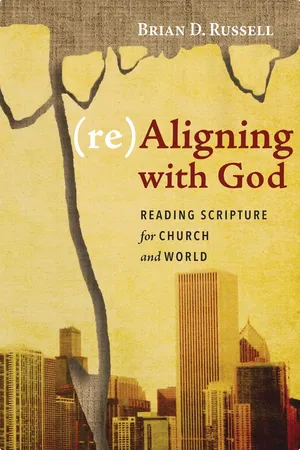
How do we communicate the message of the Scriptures in our twenty-first-century, post-Christian context? (re)Aligning with God: Reading Scripture for Church and World answers this question by presenting the Scriptures through the lens of mission and by teaching a method for reading Scripture with a missional hermeneutic. The biblical story seeks to convert us to its perspective and to transform its readers and hearers into God's missional community that exists to reflect and embody God's character to/for/in the world. Ready to revolutionize your reading of the Bible and expand your ability to unleash the Scriptures in your context? (re)Aligning with God will give you rich content and practical tools to become a profound, inspiring, and confident reader of the Bible for all who are seeking to hear its good news.
Information
1
Scripture and Conversion
The goal of biblical interpretation is conversion. We must not forget this. The Bible may be read as a gateway to understanding the ancient world, or to encounter stories about God, Jesus, and an assortment of interesting characters. It can be read for spiritual formation. It can even be used as the basis for understanding the literature and culture of the Western world. But without a conversion to the Scriptural story, the reading and study of the Bible is incomplete.
Scripture must become our story. Most of us in the Church will eagerly cry out, “The Bible already is our story,” and confess our belief in the authority and efficacy of the Scriptures. But how many of us really grasp the implications of it for living?
In John Steinbeck’s classic, East of Eden, Liza Hamilton serves as the pillar of faith for her family. She is a staunch advocate of biblical morality and ostensibly reads the Scripture as the guide for her earthly existence. Yet, there are cracks in her pious veneer. Steinbeck describes her use of the Bible sublimely:
Her total intellectual association was the Bible. . . . In that one book she had her history and her poetry, her knowledge of peoples and things, her ethics, her morals, and her salvation. She never studied the Bible or inspected it; she just read it. The many places where it seems to refute itself did not confuse her in the least. And finally she came to a point where she knew it so well that she went right on reading it without listening.1
To this day, the final line of this quotation haunts me. As I reflect and dream about advancing the Gospel in our day, I am convinced that, like Hamilton, we are missing out on the true riches and power of the Scripture not only to transform our lives but also our world. Even much of our biblical preaching and teaching misses the central theme of the Scriptures.
The goal of (re)Aligning with God is the unleashing of the Scriptures in all of their richness and complexity. This book is not merely a call to return to the Scriptures. It is an invitation to experience a conversion to Scripture. It is a summons to a rehearing of the core message of the Bible. It is a bold and daring reentry into the world of the text for there we find God’s visions and dreams for humanity. In the Old and New Testaments we discover the true story of our lives as individuals and as part of the fabric of creation.
The Scriptures are the narrative about God’s mission from Creation to a New Creation. They focus primarily on God’s relationship with humanity and serve to call women and men to live as the people whom God created them to be. The goal of the Scriptures is our conversion to its viewpoint and way of thinking. Such a reading of Scripture seeks to shape us into the sort of people whom God desires for the purpose of the advance of God’s mission in Creation.
In the following three chapters we will take a big-picture look at the narrative found in the Scriptures. The storyline may be summarized succinctly: Creation—Fall of Humanity—Israel—Jesus the Messiah—Church—New Creation.
In this chapter, we will start our journey through the Bible with the beginning of Jesus’ ministry. Jesus Christ is the central figure of the Scriptural story so the life, death, and resurrection of Jesus is the foundation of the Christ following movement. Jesus launched his ministry with a provocative message: “Repent for the Kingdom of Heaven is at hand” (Matt 4:17).2 In Jesus’ opening proclamation, he announced the long awaited age of salvation. The Gospels use the synonymous phrases “Kingdom of God” and “Kingdom of Heaven” to express this reality. This language answered the longings of Israel who were hoping for the renewal of God’s activity in their day. Jesus’ words signify the inauguration of God’s reign on earth. God’s kingdom is the sphere in which God manifests his reign.
Jesus’ words need unpacking for our twenty-first-century world. Why does Jesus begin his ministry with a call to repentance? What does repentance mean in this context? Who is Jesus’ primary audience? Why all this talk about the Kingdom of heaven? Why do Jesus’ words mirror those of John Baptist (Matt 3:2) from earlier in the Gospel as well as the message with which he entrusts his disciples later in his ministry (Matt 10:7)?
When we carefully observe Jesus’ words, we notice that it consists of an exhortation “Repent,” followed by the rationale for this call to action “for the Kingdom of Heaven is at hand.” But let’s first look at the context of Jesus’ initial proclamation.
Who was Listening?
The question of audience is critical for understanding the missional force and model of Jesus’ message. Jesus begins his public ministry on the margins. This is significant. Matthew (4:12–16) understands Jesus’ move to the margins as a fulfillment of Isaiah’s words about a coming Messiah who would pierce the darkness with light (Isa 9:1–2). Galilee was the region linked to the eschatological expectation of the renewal of God’s kingdom. The reference to “Galilee of the Gentiles” is important. In Galilee, Jesus is nowhere near the religious epicenter of Jerusalem and the Second Temple. Instead, he is far to the north. This was Gentile country. Jesus proclaimed the message of the Kingdom to people who lived around the Sea of Galilee. This region was a mixture of Jews and Gentiles with Jews perhaps in the minority.3 It was under the authority of Herod Antipas. This context is significant for understanding all of Scripture. If we are not careful we can easily misread the Bible as a story of God’s preferential dealings with God’s people. Rather, the Bible is the story of God’s calling of a people for the sake of God’s mission to the nations. It is fitting then for Jesus to locate his own ministry on the margins of Israel in the Galilee. Moreover, it is significant for understanding the movement of God to recognize the importance of the margins.
In the biblical narrative the Gospel moves repeatedly from the margins to the center. The first responders to Jesus’ message were fishermen (Matt 4:18–22). The first recipients of Jesus’ miracles were lepers, gentiles, and women (Matt 8:1–17). John the Baptist preached his fiery call for repentance in the wilderness (Matt 3). If we go to the Old Testament, Abram was a wanderer in the world (Gen 11:27ff.; Deut 26:5) before God called him to be the eponymous ancestor of God’s people. Israel’s home in the hill country of Canaan was not the epicenter of the ancient world, but rather a “backwoods” region wedged between the dominant power centers of Egypt and Mesopotamia. Moreover, the history of God’s people is rooted in servitude and slavery out of which God redeemed them (Exod 20:2).
The Gospel is not about power but about people—all people. Thus, the beginning of Jesus’ ministry adumbrates the post-resurrection mission—the proclamation of the Gospel to all people everywhere. Moreover, Jesus’ initial message is inclusive of both insiders and outsiders. He has come to save his people from their sins (Matt 1:21). It is easy to assume this meant Israel, but Jesus’ actions in the Gospel of Matthew suggest a broader understanding. Jesus’ people certainly include “the lost sheep of Israel” (Matt 10:6), but we must not miss the dynamic expansion of mission embodied in Jesus’ ministry. Matthew reminds us in the initial verse of the Gospel that Jesus is the “son of Abraham.” Abraham stands in the biblical story as the one through whose seed all peoples of the earth will be blessed (Gen 12:3). Jesus embodies this calling. This theme reaches its climax in the story of Jesus when in Matt 28:16–20 Jesus sends out his disciples to make disciples of all nations. Significantly, this sending out occurs when the disciples meet the resurrected Jesus in Galilee.
Rationale for (Re)alignment
Jesus’ opening words are audacious and demand an immediate shift in the orientation of his audience. Jesus is declaring that the new age of God’s salvation has arrived. It is a declaration that a new page in history is now being written. This new age is God’s long awaited era of salvation. It had been originally envisioned in Israel’s Scriptures. The Old Testament rings with anticipation. As we will see, Israel’s prophets foresaw a future renewal and redemption for the nation on the other side of its experience of judgment and exile. Israel’s prayers and songs celebrated the rule of God and hoped for a renewal of the Davidic monarchy. Those living in Palestine at the time of Jesus were languishing under the thumb of the Roman Empire. They were longing for a renewal of God’s saving power. They hungered for a Messiah who would bring liberation from oppression and usher in God’s new age of peace, wholeness, hope, and restoration.
In short, the people of God in Jesus’ day were expecting a decisive climax to occur in history. This would be marked by the arrival of God’s kingdom. The present evil age would pass away and a new age of justice, righteousness, peace, and salvation would replace it. What does the kingdom look like? In the LORD’s Prayer Jesus helps us to unpack its core reality with the phrases, “May your Kingdom come. May your will be done, on earth as it is in heaven” (Matt 6:10). In other words, the Kingdom of God is dynamically present whenever and wherever God’s will is being embodied and accomplished. In the Gospels, Jesus is the announcer of the Kingdom’s arrival and its personal embodiment. Jesus models the ethos and values of the Kingdom in his earthly ministry. He demonstrates the reality of the Kingdom through his acts of power and miraculous works (Matt 11:4–6). In his life, death, and resurrection Jesus embodies God’s Kingdom.
In his first-century context, Jesus’ words are bold and daring. For he declares that God’s long anticipated end-time rule is now present in his person. The announcement of the Kingdom is the core message of Jesus. Jesus’ coming is not the start of a new religion; it is more radical. It is a full-blown declaration of the saving power and presence of God’s Kingdom.
This puts Jesus’ message in continuity with the prophets of old and with the future proclamation of the Church. In Matthew’s Gospel, John the Baptist functions as the last of the prophets. Matthew records his message in 3:2 in identical fashion with Jesus’ in 4:17, “Repent for the kingdom of heaven has come near.” Likewise, when Jesus sends out his disciples for ministry, they are to proclaim the gospel of the Kingdom: “The kingdom of heaven has come near.” In Jesus, God has arrived to usher in his end-time rule. This i...
Table of contents
- Title Page
- Acknowledgments
- Introduction
- Chapter 1: Scripture and Conversion
- Part One: (re)Engaging God’s Story
- Chapter 2: The Old Testament Story:Creation, Fall, and Israel
- Chapter 3: The Old Testament Story: Israel’s Life in the Land, Prophets, and Writings
- Chapter 4: The New Testament Story: Jesus the Messiah, the Mission of the Church, New Creation
- Part Two: Learning to Speak Human: Reading the Bible for All People
- Chapter 5: Learning to Speak Human: Methodology and Missional Hermeneutics
- Chapter 6: Reading the Old and New Testament Missionally:Jonah and Philippians
- Part Three: Aligning Our Communities
- Chapter 7: Unleashing the Biblical Narrative: Implementing a Missional Hermeneutic in Our Communities of Faith
- Bibliography
Trusted by 375,005 students
Access to over 1.5 million titles for a fair monthly price.
Study more efficiently using our study tools.
Frequently asked questions
Yes, you can cancel anytime from the Subscription tab in your account settings on the Perlego website. Your subscription will stay active until the end of your current billing period. Learn how to cancel your subscription
No, books cannot be downloaded as external files, such as PDFs, for use outside of Perlego. However, you can download books within the Perlego app for offline reading on mobile or tablet. Learn how to download books offline
Perlego offers two plans: Essential and Complete
- Essential is ideal for learners and professionals who enjoy exploring a wide range of subjects. Access the Essential Library with 800,000+ trusted titles and best-sellers across business, personal growth, and the humanities. Includes unlimited reading time and Standard Read Aloud voice.
- Complete: Perfect for advanced learners and researchers needing full, unrestricted access. Unlock 1.5M+ books across hundreds of subjects, including academic and specialized titles. The Complete Plan also includes advanced features like Premium Read Aloud and Research Assistant.
We are an online textbook subscription service, where you can get access to an entire online library for less than the price of a single book per month. With over 1.5 million books across 990+ topics, we’ve got you covered! Learn about our mission
Look out for the read-aloud symbol on your next book to see if you can listen to it. The read-aloud tool reads text aloud for you, highlighting the text as it is being read. You can pause it, speed it up and slow it down. Learn more about Read Aloud
Yes! You can use the Perlego app on both iOS and Android devices to read anytime, anywhere — even offline. Perfect for commutes or when you’re on the go.
Please note we cannot support devices running on iOS 13 and Android 7 or earlier. Learn more about using the app
Please note we cannot support devices running on iOS 13 and Android 7 or earlier. Learn more about using the app
Yes, you can access (re)Aligning with God by Brian D. Russell in PDF and/or ePUB format, as well as other popular books in Theology & Religion & Biblical Criticism & Interpretation. We have over 1.5 million books available in our catalogue for you to explore.