eBook - ePub
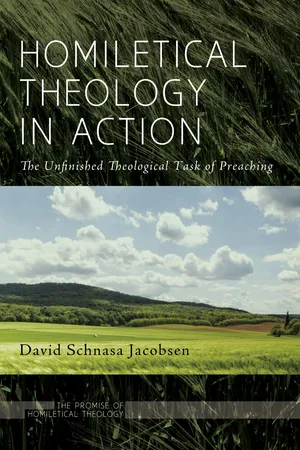
Homiletical Theology in Action
The Unfinished Theological Task of Preaching
- 202 pages
- English
- ePUB (mobile friendly)
- Available on iOS & Android
eBook - ePub
Homiletical Theology in Action
The Unfinished Theological Task of Preaching
About this book
Homiletics is taking a theological turn. But what does the preaching task look like if we think of it not so much as a mastery of technique, but an exercise in theological method? Homiletical Theology in Action: The Unfinished Theological Task of Preaching tries to envision the work of homiletics as theological in root and branch. By placing theological questions at the center of the process, the authors, some of the leading lights of the field of homiletics, try to show how their work as preachers and homileticians is a thoroughgoing theological activity. By beginning with troublesome texts and problematic doctrines, they seek to show how preachers and homileticians engage in theology, not as consumers, but as producers--and in the thick of the kinds of questions that preachers have to ask. Practitioners and theological educators alike will catch a glimpse of how they too are residential theologians in their own preaching praxis.
Information
Subtopic
Ministère chrétienSection I:
Homiletical Theology in the Descriptive Mode
1
Theological Attentiveness on the Path from Text to Sermon
A Descriptive Approach
Introduction: Homiletical Theology in a Descriptive Mode
Contributors to the Homiletical Theology Project have related questions of theology to homiletical theory and practice in remarkably diverse ways. Contributions to the project have been shaped not only by our diverse interests, but also by different underlying assumptions about what “homiletical theology” is or does. Complicating any discussion of “homiletical theology,” of course, is the range of meanings that the word “theology” itself has had, and continues to have, in contemporary academic discourse.
Theology can refer, for example, to a set of theological discourses that cohere in some particular way. Defined this way, theology includes sub-genres such as systematic, confessional, dogmatic, historical, philosophical, and constructive theology. From this perspective, “homiletical” theology could be thought of either as another sub-genre or as the homiletical appropriation or expression of any of these. On the other hand, theology can be thought of as an activity or mode of reasoning in response to a question or in response to the demands of a situation. In these cases, theology refers to something being done, rather than to a tradition (or several traditions) upon which one draws.
In this chapter, I want to consider homiletical theology as something a working preacher does on a weekly basis. My exploration of this “doing” of homiletical theology on the part of one preacher, in and for her particular preaching context, will take the form of specifically descriptive practical theology.
The Descriptive Task within Practical Theology
Practical theologians describe the distinctiveness of practical theology among the disciplines in various ways. In my view, what distinguishes practical theology from other modes of theological reasoning is its sustained attentiveness to lived religious practices. In other words, our first concern is with religious practices—and in their concreteness, not simply considered abstractly. Before beginning to talk about how any religious practice could or should be done, a practical theologian seeks to observe and describe it in specific settings.15
The specifically descriptive mode of practical theological inquiry is described by Richard R. Osmer as one of the four basic “tasks” of the practical theologian.16 These four interrelated tasks are:
1. The descriptive/empirical task (describing what we see happening as a practice unfolds).
2. The interpretive task (using both theological categories and social-scientific constructs to express our understanding of why a practice is unfolding as it does).
3. The norm-generative task (proposing appropriate theological and social-scientific norms to test the fittingness, both theological and sociocultural, of the context-specific practice at hand).
4. The strategic/pragmatic task (providing guidance to practitioners to improve ongoing practice in light of the norms we have developed).17
The descriptive mode of inquiry has often been suppressed in contemporary homiletics. It is tempting to assume we already know what is going on and how to fix it; the temptation is to rush straight to theory building. I have done it time and again myself (and may be caught doing it again). There is value in this kind of creative and constructive work; but ultimately, if we want to change what is actually going on in preaching practice today, there is no substitute for attending to lived practices.
This is my aim in this chapter. If we lament a lack of theological backbone in some of the preaching we are hearing today, maybe we need to look more closely at the process that produces it. In the pages to follow, I attend to dimensions of theological attentiveness in one preacher’s sermon preparation process, slowing it down to see its working parts. The point is to foreground the role that theological attentiveness may play in sermon preparation, not to propose, commend, or defend this specific instance of homiletical practice in every detail. Inevitably, the descriptive mode of practical theology generates interpretive, criteriological, and strategic questions, but I leave systematic pursuit of those questions to others.
Theological Attentiveness in a Preaching Context: Five Horizons of Theological Understanding
That said, every effort at description needs a vocabulary suited to the task at hand. My sense is that all working preachers find themselves brokering a kind of buzzing conversation among multiple “horizons” of theological understanding as they interpret a biblical text and work toward the core theological affirmations of a sermon. By “horizon of theological understanding” I mean some set of convictions or claims about the nature of God and God’s action, past and present, in and toward the world. Such horizons are social constructions and thus have a range of flexibility.18 Thus, I offer here a heuristic schema for identifying the five distinct “horizons” of theological understanding that appear to be in play in this preacher’s process.
Briefly, the five horizons that I propose play into the sermon preparation process are:
1. The “working theology” of the preacher, both in terms of his or her overarching theological sense of what is “gospel,” as well as more specific theological understandings pertinent to the text under study.
2. The “working theologies” of the congregation—a plurality of horizons, since no congregation represents a single, univocal horizon of theological understanding.
3. The overt theological language in a text, and the theological claims made there.
4. Deeper theological semantic possibilities that emerge as the text is read in relation to broader canonical and theo-cultural contexts, including both the historical past and the congregation’s present experience.
5. The theological horizon of understanding that the preacher ultimately decides to articulate in the sermon itself.
None of these five horizons are original to me. All five are indicated, at least implicitly, in the theologically focused homiletics of Ronald Allen, as well as Burton Z. Cooper and John S. McClure.19 The relationship between TH #1, the “working theology” of the preacher, and TH #2, the “working theology” of the congregation, receives detailed attention in the work of both John McClure and Leonora Tubbs Tisdale.20 Tisdale and McClure both attend to TH #5, the theological claims of the sermon as it interacts with the congregation’s theological imagination; so do James Nieman and Thomas Rogers.21 Since grasping the distinctions among these five horizons of theological understanding is important to the rest of this chapter, they require elaboration.
Theological Horizon #1: the “working theology” of the preacher—that is, the theological convictions and assumptions, conscious and unconscious, about God’s nature and activity that frame the preacher’s interpretation of congregational context, biblical text, and the wider world, and which shape the preacher’s sermon crafting. Today it is widely understood that any preacher brings to the preaching task a set of theological convictions as well as unconscious theological assumptions. I call this a preacher’s “working theology.” Some obvious sources for such “working theology” include a preacher’s theological education, the impact of ongoing denominational debates and discussions (particularly as one takes an active role in these debates), reading both theological and non-theological material, online sources and conversations, interaction with other ministry practitioners, and everyday ministry experience. In other words, one’s “working theology” is not fixed, but evolving. Being present to the suffering or dying, for example, surely shapes one’s working theology, either subtly or dramatically.22
We can detect alertness to this horizon of theological understanding on the part of a preacher when he or she asks, for example, “What am I inclined to assume theologically about this particular biblical book before me, or specific texts within it?” or when he or she begins to compare a text’s apparent theological claims with his or her working assumptions.
Theological Horizon #2: the “working theologies” of the congregation. A congregation’s working theologies are inevitably multiple; thus we need to think of this horizon as pluriform and complex, not univocal. It includes all those theological convictions and assumptions, conscious and unconscious, that shape church members’ practice of faith, including the varied theological assumptions they bring to reading the Bible, listening to sermons, or debating issues. Some of the working theologies present in a congregation may be similar to the preacher’s in some respect; others will not. Naturally, these multiple theological understandings will vary in comprehensiveness and coherence. If asked, church members might sum up their theological perspective in phrases from a creed, hymn, or praise song. If pressed, they may cite sermons that impressed them, fragments gathered in Sunday school or camp settings, favorite religious pundits encountered in print or electronic media, or ideas picked up in a Bible study or fellowship group. Taken together, these sources may produce something considerably less than a comprehensive theological world view.
What makes such a horizon of theological understanding a “working” theology is that it has so far proven sufficient to the demands, great or minimal, that the believer places upon it. One’s working theology only gets revised as it is tested by contrary views or the demands of experience, and its limitations come to light.
As will become clear in the congregational setting we are about to observe, tension or conflict in a congregation can bring into sharper relief the pluriform nature of congregational culture(s) and theological understanding(s). Mostly, these realities do not emerge because a preacher sets out deliberately to interrogate...
Table of contents
- Title Page
- Contributors
- Acknowledgments
- Introduction
- Section I: Homiletical Theology in the Descriptive Mode
- Section II: Homiletical Theology in the Confessional Mode
- Section III: Homiletical Theology in the Analytical Mode
- Afterword
- Appendix A: Contextual Analysis
- Appendix B: Exegetical Questions for Preaching
- Bibliography
Trusted by 375,005 students
Access to over 1.5 million titles for a fair monthly price.
Study more efficiently using our study tools.
Frequently asked questions
Yes, you can cancel anytime from the Subscription tab in your account settings on the Perlego website. Your subscription will stay active until the end of your current billing period. Learn how to cancel your subscription
No, books cannot be downloaded as external files, such as PDFs, for use outside of Perlego. However, you can download books within the Perlego app for offline reading on mobile or tablet. Learn how to download books offline
Perlego offers two plans: Essential and Complete
- Essential is ideal for learners and professionals who enjoy exploring a wide range of subjects. Access the Essential Library with 800,000+ trusted titles and best-sellers across business, personal growth, and the humanities. Includes unlimited reading time and Standard Read Aloud voice.
- Complete: Perfect for advanced learners and researchers needing full, unrestricted access. Unlock 1.5M+ books across hundreds of subjects, including academic and specialized titles. The Complete Plan also includes advanced features like Premium Read Aloud and Research Assistant.
We are an online textbook subscription service, where you can get access to an entire online library for less than the price of a single book per month. With over 1.5 million books across 990+ topics, we’ve got you covered! Learn about our mission
Look out for the read-aloud symbol on your next book to see if you can listen to it. The read-aloud tool reads text aloud for you, highlighting the text as it is being read. You can pause it, speed it up and slow it down. Learn more about Read Aloud
Yes! You can use the Perlego app on both iOS and Android devices to read anytime, anywhere — even offline. Perfect for commutes or when you’re on the go.
Please note we cannot support devices running on iOS 13 and Android 7 or earlier. Learn more about using the app
Please note we cannot support devices running on iOS 13 and Android 7 or earlier. Learn more about using the app
Yes, you can access Homiletical Theology in Action by David Schnasa Jacobsen, Jacobsen in PDF and/or ePUB format, as well as other popular books in Théologie et religion & Ministère chrétien. We have over 1.5 million books available in our catalogue for you to explore.