- 130 pages
- English
- ePUB (mobile friendly)
- Available on iOS & Android
eBook - ePub
About this book
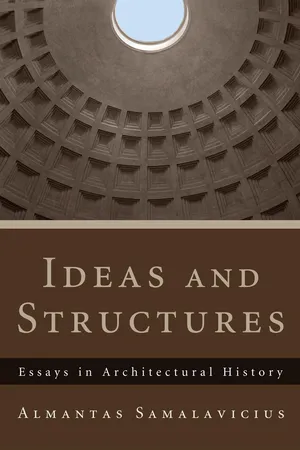
This book is a scholarly inquiry into several dimensions of culture, exploring the close relationship between architecture and metaphysical ideas as well as religious and philosophical concepts in each period of human history, a relationship which has, however, been largely forgotten or neglected by modernity. Rather than being a specialized account of any particular epoch, it is an intellectual attempt to map out a general picture of how certain ideas have made their way into architectural structures or shaped them in one or another way, from classical Antiquity through the Middle Ages and the Renaissance to the present. The four essays it contains, focusing on light, water, color, and sound in architecture, are written by an author who is a historian and critic of architecture as well as literary scholar, who firmly believes in the value of discussing these issues from the perspective of the history of ideas. The author is conscious about the limits of any generalizations, but he believes that architecture should be studied not only as an art in its own right, but as something larger, enveloping many layers of culture and reflecting the bonds between human thinking and the practice of the art of building.
Information
Topic
Scienze socialiSubtopic
Storia mondiale1
Architecture and Light
In the penetrating short story “Alef,” Jorge Louis Borges describes a mystical source of light that opens under a staircase in a cellar somewhere on the outskirts of Buenos Aires. A tiny globe that can be taken into the cup of one’s hand shines in the colors of a sunflower, and the protagonist of this striking story is deprived of speech by the transparency and brightness of the globe’s rays. It is a point where all the points of the universe meet, and while focusing one’s eyes on Alef one can see all the possible angles of this world, which miraculously open themselves to visual perception. By exposing the metaphysical aspects of being, Borges brings his readers to a dimension that is not so much associated with the power of human sight as it is with the powers of the soul to comprehend the incomprehensible, to perceive what is imperceptible to the naked eye. In describing this mystical vision, Borges approaches a tradition of metaphysical thinking that is thousands of years old, when the inner sight, inspired by illuminating light, was treated as a manifestation of divine will and grace. In old metaphysical doctrines, light was interpreted as a symbol of morality, reason, and the seven virtues: to be illuminated meant gaining an understanding about the existence of the source of light, and this provided spiritual power to a human being.1
The Divinity of Light in Ancient Civilizations
It is obvious that light is an essential condition of human and planetary existence: as it is directly related to warmth, it predetermines the survival of human beings in the world. No wonder then, that man’s attempts to comprehend and explain the origin of this mysterious phenomenon date to ancient times. In the mythic consciousness, light was related to divinity. Evidence of this primeval concept is found in the vocabularies of many ancient cultures: the word stem div- or dyu-, found in the Aryan language, meant “to shine”; the notion deva (god) originated from the former, while Dyaus and his brothers Zeus and Jupiter from the latter. In Sanskrit—the parent language of Indo-European—the noun dyu means two things: the sky and the day. Furthermore, the Greek prayer “Rain, rain, dear Zeus, on Athenian lands and fields,” mentioned by Marcus Aurelius, Homer, and Petronius, sheds light on the origin of Zeus’ name: from the very beginning the bright sky was called by this name; gradually the Greeks and later the Romans forgot the earlier meaning of the word.2 Macrobius, whose authority on spiritual matters was greatly valued and considered indisputable during the Middle Ages, claimed that these lines of Orpheus are direct reflections on the light-providing omnipotence of the sun: “Hear, o Thou who dost, wheeling afar, ever make the turning circle of rays to revolve in its heavenly orbits, bright Zeus Dionysus, Father of Sea, Father of Land, source of all Life, all-gleaming with thy golden light.”3
Archaic myths, although the meaning of their content changed as time went by, are full of stories relating how light defeats the darkness and makes its appearance in the world. In the well-known myth of the ancient world about Oedipus, the Theban hero is a personification of sunrise and sunset. After the Delphic Oracle predicts that when the boy grows up he will kill his father and marry his mother, the new-born baby is left in the forest at the order of his father; however, while left alone in the heart of dark woods, the child is saved by passers-by. When the boy grows up, he returns to his birth-place, and quarrels and then kills an old man he meets on the road; eventually he rescues the town from the Sphinx and gets the whole kingdom and a bride as a reward. His bride, however, perishes as soon as she discovers the truth, while Oedipus pokes out his eyes and dies. The anthropomorphic and moral meaning of incest was extracted from the myth by the Greeks somewhat later; in the very beginning this was a story relating how the sun rises, defeating the Vedic demon of darkness, and is united in the evening with the dawn that gave birth to him. It is suggested that the etymology of the names of the heroes implies the original meaning of the myth.4 Such myths about solar heroes were common, not only in ancient Greece but in other antique cultures as well: the cult of the sun god Ra was widespread in Egypt in 2400 B.C., during the Fifth Dynasty. The opposition between life and death and the powers of light and darkness was particularly emphatic in the cosmological conceptions of ancient Egypt. Egyptians believed that when the night comes, the powerful Sun sets out to fight his brother, the incarnation of evil, who turns into a gigantic snake of dusk and darkness during the night. When the morning arrives, the world receives a message proclaiming the victory of goodness over evil.5 Persian mythology contains the same irreconcilable oppositions: Ahriman, the power of darkness, and Ahura Mazda, the god of light. It is known that in Egypt Horus (as Osiris was initially called) is referred to as the “light of the world,” “the Lord of life and light”; strikingly, almost identical descriptions were later used in references to the Christian God.6 The sun was worshiped in many other Eastern civilizations: Babylonia, Asir, Persia, Phoenicia, and Asia Minor. In most ancient religions the East was associated with ideas of life and renewal, with light and warmth, while the West was associated with cold, decay and death. Graves and sanctuaries were erected taking these two poles into consideration. The great temple of Amon-Ra and the temple of Ra-Hor-Akhty at Karnak were both pointing to the mid-winter solstice sunrise.7 Christianity probably adopted this tradition from Eastern cultures; even later Christian churches were built so that the main altar of the church was directed eastwards.8 This was especially noted by Honorius of Autun, the author of the twelfth century’s Christian Guide to Symbols, who wrote in his treatise: “Churches are directed to the East, where the sun rises, because in them the sun of justice is worshiped and it is foretold that it is in the east that Paradise our home is set.”9
Pre-Socratic Greek philosophers contemplated the nature of things and attempted to single out the primary elements of the world’s constitution. They classified these elements according to the degree of hardness or mobility. The bodiless nature of light was opposed to the tangibility of earth. The Pythagoreans, an esoteric sect that followed the vows of secrecy, were strongly influenced by the dualistic concept of morality that originated in the Orphic religion; they viewed the world as a mixture of controversial principles of good and evil, form and chaos, boundary and vagueness, and light and darkness, and believed an understanding of cosmic harmony finally leads to inner harmony, i.e., the harmony of the soul. On the other hand, Heraclitus, who objected to the Pythagorean understanding of the Cosmos, claimed that fire is the origin of all things: it destroys and provides life as if it were an eternal go-between, establishing a unity among disappearing and reappearing forms.10
In Egyptian hieroglyphics, fire was associated with the solar symbolism of flame, and especially with ideas of life and health. In primitive cultures fire was treated as a creative power that is radiated by the sun and is expressed by sun rays and lightning. Persian mythology contains a prophecy claiming that the world will be destroyed by either fire or water. The writings of the philosophers known as the Stoics, as well as the predictions of the Sibyls, are full of references to fire’s power of purification and renewal. Plato in Timaeus speaks of fire, and associates it with light and the power of vision; he also insightfully notes that light is closely related to the human mind: reasoning needs light, and the light becomes visible only because it is comprehended by reason. Plotinus, the father of Neoplatonic thought, emphasized the transcendental character of light. In his philosophy, light and radiance were attributed to the one and the same source—an immaterial substance that has the power to radiate beauty, goodness, and wisdom to the material world.
The Medieval Metaphysics of Light
Somewhat later, these ideas were echoed in Christian sources, especially in the writings of St. Augustine, who set out to adjust the legacy of pre-Christian thinking to the comparatively young tradition of Christian religious philosophy: his interpretation of light was based on the assumption that it is a heavenly gift to a human being, whose intelligent soul rejoices as soon as it is touched by the bodiless light.11 Augustine’s doctrine based on the divinity of light had a strong response in the imagination of the Middle Ages, which was deeply rooted in the height of religious feeling. The celebration of the life of the senses was strongly pierced with a religious sensibility; the whole epoch was marked with the strife of searching for the invisible hand of Almighty Creator, not only in abstract values but in all things of material world. Inspired by Biblical texts, Christian philosophers and theologians stressed the duality of the phenomenon of light. In the Book of Genesis it is said that when God created the world, on the first day he separated light from darkness, and called light day and the darkness night, but it was only on the fourth day of creation that he lit the lights in the emptiness of the sky. This approach implied that light and its source were something different. The divinity of light’s substance became of utmost importance in the dogmas of early Christianity; this explains why the Roman Christian Church condemned the Manichean heresy. The Manicheans, following the teaching of the Zoroastrian and Babylonian sages, preached that there was an ongoing fight between the two incompatible essences: Darkness, reigning in the material world (Angra Mainyu according to Zoroaster) and Light (Spenta Mainyu), ruling in the spiritual world. It is also important to note that in the interpretations of Holy Scripture during the early Christian ...
Table of contents
- Title Page
- Preface
- Acknowledgments
- Chapter 1: Architecture and Light
- Chapter 2: Architecture and Color
- Chapter 3: Architecture and Sound
- Chapter 4: Architecture and Water
- Bibliography
Trusted by 375,005 students
Access to over 1.5 million titles for a fair monthly price.
Study more efficiently using our study tools.
Frequently asked questions
Yes, you can cancel anytime from the Subscription tab in your account settings on the Perlego website. Your subscription will stay active until the end of your current billing period. Learn how to cancel your subscription
No, books cannot be downloaded as external files, such as PDFs, for use outside of Perlego. However, you can download books within the Perlego app for offline reading on mobile or tablet. Learn how to download books offline
Perlego offers two plans: Essential and Complete
- Essential is ideal for learners and professionals who enjoy exploring a wide range of subjects. Access the Essential Library with 800,000+ trusted titles and best-sellers across business, personal growth, and the humanities. Includes unlimited reading time and Standard Read Aloud voice.
- Complete: Perfect for advanced learners and researchers needing full, unrestricted access. Unlock 1.5M+ books across hundreds of subjects, including academic and specialized titles. The Complete Plan also includes advanced features like Premium Read Aloud and Research Assistant.
We are an online textbook subscription service, where you can get access to an entire online library for less than the price of a single book per month. With over 1.5 million books across 990+ topics, we’ve got you covered! Learn about our mission
Look out for the read-aloud symbol on your next book to see if you can listen to it. The read-aloud tool reads text aloud for you, highlighting the text as it is being read. You can pause it, speed it up and slow it down. Learn more about Read Aloud
Yes! You can use the Perlego app on both iOS and Android devices to read anytime, anywhere — even offline. Perfect for commutes or when you’re on the go.
Please note we cannot support devices running on iOS 13 and Android 7 or earlier. Learn more about using the app
Please note we cannot support devices running on iOS 13 and Android 7 or earlier. Learn more about using the app
Yes, you can access Ideas and Structures by Almantas Samalavicius in PDF and/or ePUB format, as well as other popular books in Scienze sociali & Storia mondiale. We have over 1.5 million books available in our catalogue for you to explore.