eBook - ePub
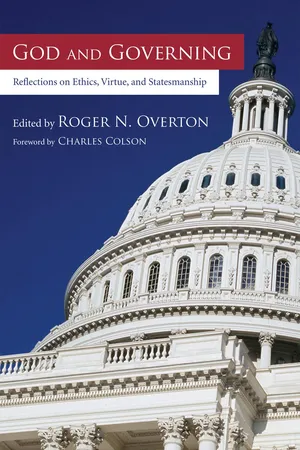
God and Governing
Reflections on Ethics, Virtue, and Statesmanship
- 144 pages
- English
- ePUB (mobile friendly)
- Available on iOS & Android
eBook - ePub
About this book
Abortion. Poverty. Pornography. More than thirty years ago evangelical conservatives, moderates, and liberals alike began tackling these and other major social problems head on through concerted political effort. The intervening decades witnessed the rise of groups such as the Moral Majority and the Christian Coalition, which supported numerous politicians and religiously driven policies. Why is it, then, that despite the seemingly great potential of these and other similar groups, the same pervading social problems still persist? How is it that evangelicals have been so ineffective at changing the political and social landscape of the United States in a positive way?
Based on a conference organized by Trinity Law School, God and Governing brings together theologians, politicians, law professors, and cultural critics in order to examine the root causes of evangelical political failure over the past thirty years. With a foreword by Charles Colson, contributors include David Wells, Paul Marshall, Os Guinness, Patrick Nolan, Vishal Mangalwadi, Dallas Willard, Donald McConnell, and Stephen Kennedy.
Information
Topic
Theology & ReligionSubtopic
Christian Theology1
Why Being Good Is So Political
Introduction
That evangelicals voted on opposite sides in the 2008 presidential election which brought Obama to the White House, and that they evaluated the issues at stake differently, is rather clear. While it is inevitable that some differences will always be evident in the way that Christians think, how we think should never be narrowly partisan. There are, so to speak, much larger fish that need to be fried. That is what I want to consider in this essay.
In fact, the argument I want to advance is that evangelicals have not distinguished themselves in recent engagements with political issues. It is not because they thought thoughts that were too bold about the ordering of America’s political and social life, thoughts that were too adventurous, or too big, and then failed. Rather, they have often failed because they have thought thoughts that were too small, too partisan, too fragmented, and too muddled, and they are therefore in danger of losing their way.
There is a difference between politics and culture, but today this difference is often obscured and this works itself out in the assumption that the right political program will also right our social life, as well as many of our social wrongs. Some of the more politically vocal evangelicals, therefore, have pursued political issues with a new intensity in recent decades in step with their perception that America is sliding into moral decay. Their hope seems to have been that by this political involvement, America will be transformed.
The problem, of course, is that exposed to the vagaries of competing political agendas, they find themselves, as sociologist David Martin says, “with little more than native good sense and the limited inferences they can draw from the Bible.”1 But they also find themselves, despite the biblical truth they hold, with a diminished understanding of corrupted human nature, exaggerated expectations about what the political process can accomplish, and confusion about how best to address issues that are more cultural than political, more about human nature than about government policy. So, let us begin by thinking about the place of morality in our public life.
Moral Framing
American democracy, like other modern democracies, is liberal in the sense that it is, on principle, both inclusive and impartial. It is inclusive in that all its people are citizens rather than subjects. It is impartial in that all its citizens have equal standing before the law, equal weight within the electoral processes, and an equal right to believe whatever they want to believe.2 It is, of course, this last point that makes democracies vulnerable because all democracies are as strong or as frail as the people who exercise their right to believe whatever it is that they want to believe. Government may be representative but, as Alexis de Tocqueville observed long ago, it is also “clear that the opinions, prejudices, interests, and even passions of the people can find no lasting obstacles preventing them from being manifest in the daily conduct of society.”3 It is true, as James Madison observed, that government would not be necessary if all people were angelic. But it is just as true, as Madison also recognized, that government has only a limited capacity to restrain fallen passions. The founders of the American democracy never imagined that the government had the power to restrain many of the human passions. These passions would have to be restrained by religion and morality if the Constitution was to work.4
This, then, was the basis on which Tocqueville went on to contrast political parties that are “great” from those that are not. In the former category are those parties that are fundamentally about principles rather than consequences, about ideas rather than personalities. They seek to articulate national priorities in terms of a Good that trumps all individual passions and prejudices. They are great because they are able to harness the opinions and interests of a majority in realizing ends that are greater then mere private interest. This means that all are asked, in some measure, to subjugate some aspect of self-interest, but it is important to remember that this kind of self-subjugation produces no enduring long-term national redemption. It remains a condition of national flourishing that must be constantly renewed.
Unless demands are made on all, and made out of moral considerations and not just political calculation, we are left to live in the solitude of our own internal worlds amidst the clashing interests of private, unregulated passions. Lofty convictions stir people beyond their private worlds and private interests whereas the base agendas of the “small parties,” are only about petty self-interest. They corrupt society. As the great ideas about society disintegrate, ironic as it is, people are left happier, but the nation is left less moral, Tocqueville asserted.5
So what is it, we should be asking ourselves, that makes for a healthy democracy, one that is about great ideas? It is, at the very least, that kind of democracy which is seeking the common Good—which, if it is truly good, is necessarily moral in its nature. Democracy, as Aristotle observed a long time ago, is about people freely deliberating together on how they ought to order their common life. If we are serious about this language of ought then we are saying that public life is to be framed and directed by moral considerations. These considerations should trump private interest, which is often carried out in all the new forms of tribalism that are coalescing. Western forms of tribalism are not simply ethnic. Rather, what has emerged are coalitions centered on an interest the coalition has in common. It is a self-interest that is being realized in the group’s interest. Its service feeds those whose interest it is, usually at the expense of others. Among these new tribes are the generational clusters—the Builders, Boomers, Gen-Xers, and Millennials; gender preoccupations, which seek to draw those of the same gender into coalition; and, of course, the old racial interests, which divide the political landscape along racial lines. Religious tribes also mark our national discussion. Political life, cultural critic Craig Gay writes, is “a kind of window into the soul of a people, revealing their most basic assumptions about the nature of the world and their most cherished aspirations for life within it.”6 And some of those most basic assumptions have to do with this tribal consciousness in our postmodern forms.
The question that has to be answered, then, concerns how those most basic and cherished aspirations about life are going to be realized and how they are going to be disciplined. And here we have a clear fork in the road. We have to distinguish between habits of the heart that, through the political process, can be given public shape, and those habits of the heart that need to be disciplined by means other than the political process. Habits of the heart may be for good or ill, and this raises the most basic of questions in the life of a democracy. We have to decide how what is good will be played out publicly, and how what is bad will be restrained.
Obedience to the Unenforceable
A pluralistic society such as ours balks at the idea that any one system of ethics should be given a formal, preferential role in ordering the nation’s life, but at the same time, it is worth remembering that both civil and criminal law have already ensconced some moral norms in our national life. Our society is already agreed that it is wrong to murder, rob, rape, slander, and defraud. These actions have been criminalized and they are penalized. Yet the range of moral issues that can be handled through the courts in this way is really quite small and, in any case, the penal code is quite inadequate to provide the moral guidance for much of what happens in our society each day.
The Three Domains
In an illuminating observation, the English jurist John Fletcher Moulton noted that in a democracy such as ours, three domains have to be preserved. On the one side, we have to preserve the domain of law, both criminal and civil, because every society needs this system of restraints against dangerous and harmful human behavior. On the other side, lies the domain of freedom which sustains life in other but equally important ways. It is in this soil that artistic life flourishes, as does capitalism itself, as well as all forms of religious believing including Christian faith.
However, this view of freedom needs to be qualified in important ways. It is quite true that if America is to be true to itself, this freedom needs to be protected. At the same time, it is a freedom that often needs to be restrained for moral reasons. It is a freedom that is not absolute and unqualified. Hence the importance of the third domain.
Lying between law and freedom, then, is this other domain. It is what is characterized, John Fletcher Moulton said, by “obedience to the unenforceable.”7 It is this domain that, in fact, is rooted in the moral fabric of reality. Here restraint comes from within, not from without through the law, be it civil or criminal. It comes from self-discipline, from commitment to a Good that trumps mere self-interest, from the willingness to sacrifice self-interest and self-desire in order to do what is right. And here this decision to act upon what is good, and to avoid what is unethical, is likewise not commanded from without but compelled from within. In the context of Christian faith, of course, this Good is personal and is none other than the triune God of Scripture. Yet even outside of a redemptive context such as this, there is a Good written into the fabric of human nature, which reflects who we are in the image of a moral God (Rom 1:18–20; 2:14–16).
This third domain is quite as important as the other two. After all, most lying is not illegal, but it is always unethical. Selfishness is wrong, from an ethical point of view, but it is not illegal unless it crosses legal lines. Racist attitudes are ethically wrong, but not illegal until they are acted upon. And, on the other side of the coin, while the law can forbid many things that are wrong, it cannot command many things that are right (except by implication). It can forbid assault, but it cannot command kindness and compassion. It can forbid theft, but it cannot command generosity, philanthropy, or care for the abandoned and dispossessed. These are the fruit of ethical and religious commitment. They are born of a sense of moral obligation. They arise from the middle territory, the land of “obedience to the unenforceable,” and without this land, a nation is dangerously impoverished. More than that, without this domain, the domains freedom on the one side and law on the other are likely to run amok.
The Lost Domain
So, what happens when, as Barna reported in 2005, only 16 percent of Americans base moral decisions on the content of the Bible? And what happens when 65 percent think that there are no moral absolutes?8 What happens is that the domain of the “obedience to the unenforceable” begins to disappear, to be held down “in unrighteousness.” As this land, as it were, shrinks, law from the one side, and freedom from the other, rush in to occupy its vacated space. The result is that we increasingly look to our nation’s laws to regulate behavior, which, in fact, is the proper function of morality. And because America has 70 percent of the world’s lawyers, the consequence is that the fear of litigation is often far more p...
Table of contents
- Title Page
- Foreword
- Introduction
- Chapter 1: Why Being Good Is So Political
- Chapter 2: The Travails of Evangelical Politics
- Chapter 3: The Golden Triangle of Freedom
- Chapter 4: Lessons on Fleeing Temptation
- Chapter 5: The Future of Virtue and Statesmanship in Pagan America
- Chapter 6: The Failure of Evangelical Political Involvement
- Chapter 7: Practical Ways Forward
- Chapter 8: Justice in Evangelical Political Theology
- Contributors
Trusted by 375,005 students
Access to over 1.5 million titles for a fair monthly price.
Study more efficiently using our study tools.
Frequently asked questions
Yes, you can cancel anytime from the Subscription tab in your account settings on the Perlego website. Your subscription will stay active until the end of your current billing period. Learn how to cancel your subscription
No, books cannot be downloaded as external files, such as PDFs, for use outside of Perlego. However, you can download books within the Perlego app for offline reading on mobile or tablet. Learn how to download books offline
Perlego offers two plans: Essential and Complete
- Essential is ideal for learners and professionals who enjoy exploring a wide range of subjects. Access the Essential Library with 800,000+ trusted titles and best-sellers across business, personal growth, and the humanities. Includes unlimited reading time and Standard Read Aloud voice.
- Complete: Perfect for advanced learners and researchers needing full, unrestricted access. Unlock 1.5M+ books across hundreds of subjects, including academic and specialized titles. The Complete Plan also includes advanced features like Premium Read Aloud and Research Assistant.
We are an online textbook subscription service, where you can get access to an entire online library for less than the price of a single book per month. With over 1.5 million books across 990+ topics, we’ve got you covered! Learn about our mission
Look out for the read-aloud symbol on your next book to see if you can listen to it. The read-aloud tool reads text aloud for you, highlighting the text as it is being read. You can pause it, speed it up and slow it down. Learn more about Read Aloud
Yes! You can use the Perlego app on both iOS and Android devices to read anytime, anywhere — even offline. Perfect for commutes or when you’re on the go.
Please note we cannot support devices running on iOS 13 and Android 7 or earlier. Learn more about using the app
Please note we cannot support devices running on iOS 13 and Android 7 or earlier. Learn more about using the app
Yes, you can access God and Governing by Roger N. Overton, Overton in PDF and/or ePUB format, as well as other popular books in Theology & Religion & Christian Theology. We have over 1.5 million books available in our catalogue for you to explore.